You know what iPaaS is. The next question is what you’d actually use it for, and whether a business like yours has done it. Here are the most common retail use cases, each with a real brand, the systems involved and what changed.
| Use case |
Systems involved
|
What it fixes | Example brand |
|---|---|---|---|
| Order management |
Storefront and ERP
|
Re-keying orders by hand
|
Jacuzzi Group
|
| Stock sync |
ERP or WMS, storefronts, marketplaces
|
Overselling
|
AYBL
|
| Fulfilment and 3PLs |
Storefront, ERP, 3PL
|
Slow dispatch and missing tracking
|
SealSkinz
|
| Marketplaces |
Storefront, ERP, marketplaces
|
Listings and orders managed by hand
|
Micro Scooters UK
|
| Product data |
PIM, storefronts, marketplaces
|
Out-of-date product content
|
Any brand with a PIM
|
| Customer data |
Storefront, CRM, email platform
|
Marketing from old data
|
Any brand using a CRM
|
| Finance |
Storefront, ERP, accounting
|
Manual invoice and refund posting
|
Any brand
|
| Peak trading |
All of the above
|
Integrations that fail under load
|
Castore
|
| B2B and EDI |
Storefront, ERP, trading partners
|
Trade and DTC orders run separately
|
Natural Instinct
|
| Replatforming |
Old and new storefront, ERP
|
Downtime and lost data during a move
|
Miniature Market
|
What is iPaaS used for?
iPaaS is used to connect business systems and automate the data that moves between them. In retail, that means orders, stock, products, fulfilment, customers and finance flowing between the storefront, ERP, warehouse and marketplaces, without anyone re-keying it.
For the full explanation, read our guide to what is iPaaS?
What are the main iPaaS use cases in retail and ecommerce?
The main retail use cases are order management, stock sync, fulfilment, marketplaces, product data, customer data, finance, peak trading, B2B and replatforming. Each one below follows the same pattern: what starts it, what moves, and what changes for the business.
Order management: storefront to ERP
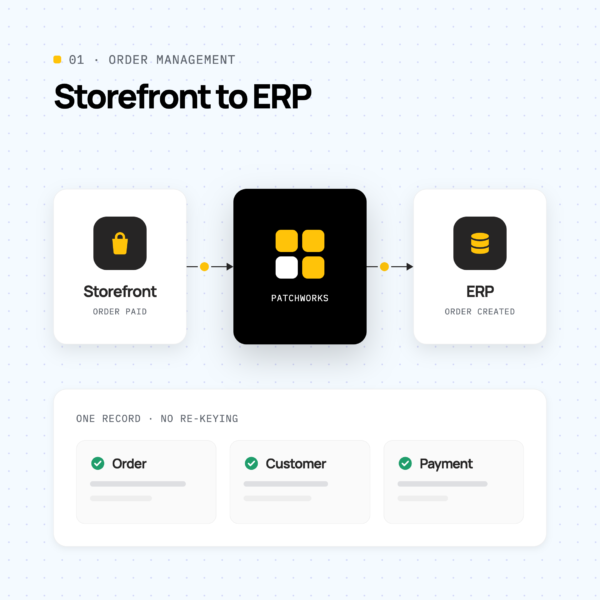
Order management uses iPaaS to send every paid order from the storefront into the ERP automatically, so nobody types it in twice.
- Trigger: a customer pays for an order on Shopify.
- What moves: the order, customer and payment details go into an ERP such as NetSuite, Sage or Business Central.
- Result: finance and fulfilment work from one record, with no re-keying.
Jacuzzi Group runs several Shopify stores alongside NetSuite. With Patchworks, its sales orders, inventory updates and fulfilments now sync in real time. The result was a significant reduction in manual order entry, and Slack alerts now tell the team if a sync fails.
Read more about ecommerce ERP integration.
Stock sync across channels
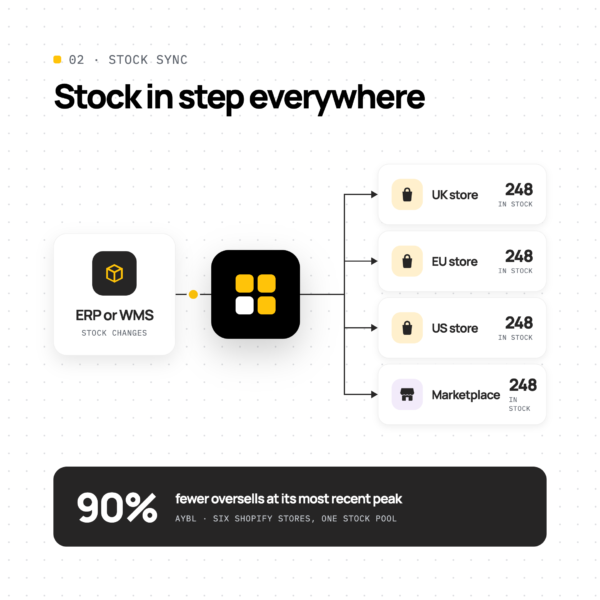
Stock sync uses iPaaS to push available stock from the ERP or warehouse to every sales channel, so retailers don’t sell what they don’t have.
- Trigger: stock changes in the ERP or WMS.
- What moves: the new available stock level goes to every storefront and marketplace.
- Result: fewer oversells, cancellations and apology emails.
AYBL runs six Shopify stores that share one stock pool. With Patchworks keeping stock in step, it cut oversells by 90% at its most recent peak.
Read more about inventory and stock synchronisation.
Fulfilment and 3PLs
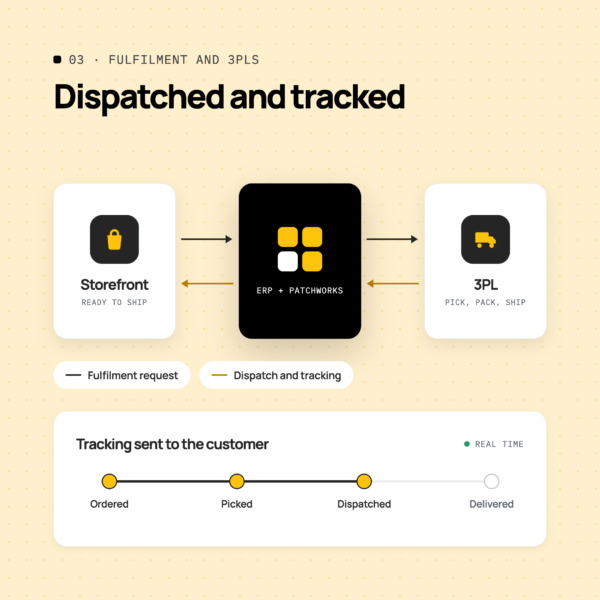
Fulfilment integration uses iPaaS to send orders to the 3PL and bring dispatch and tracking details back to the store and the customer.
- Trigger: an order is ready to ship.
- What moves: a fulfilment request goes to the 3PL, and dispatch and tracking details come back.
- Result: faster dispatch and fewer “where’s my order?” tickets.
SealSkinz connects Shopify, NetSuite and SEKO Logistics through Patchworks. It now has real-time sync across sales, operations and fulfilment, and clearer visibility from order creation to delivery.
Read more about fulfilment and 3PL orchestration.
Marketplaces and multichannel
Marketplace integration uses iPaaS to send listings, prices and stock to marketplaces, and bring their orders back into the same flow as web orders.
- Trigger: a new product, price change or stock update.
- What moves: listings go out to Amazon, eBay or Argos Virtualstock, and orders come back to the ERP.
- Result: one place to run every channel, with no copying between seller portals.
Micro Scooters UK connects Shopify, Amazon Seller Central and Virtualstock to its Khaos Control ERP through Patchworks.
Read more about marketplace and multichannel integration.
Product data: PIM to channels
Product data integration uses iPaaS to send product content from the PIM to every channel, so descriptions, images and attributes match everywhere.
- Trigger: a product is created or updated in the PIM.
- What moves: content, images and attributes go out to each storefront and marketplace.
- Result: new products go live faster, with the same details on every channel.
Patchworks connects PIMs such as Akeneo and Pimberly to storefronts and marketplaces.
Customer and CRM data
Customer data integration uses iPaaS to send orders and sign-ups into the CRM or email platform, so marketing and support work from current data.
Finance and accounting
Finance integration uses iPaaS to post invoices, payments and refunds into the accounting system automatically.
- Trigger: an order is paid, refunded or settled by a payment provider.
- What moves: invoices, payments and refunds go into Xero, QuickBooks or Sage.
- Result: the books match the store, without month-end catch-up.
Peak trading
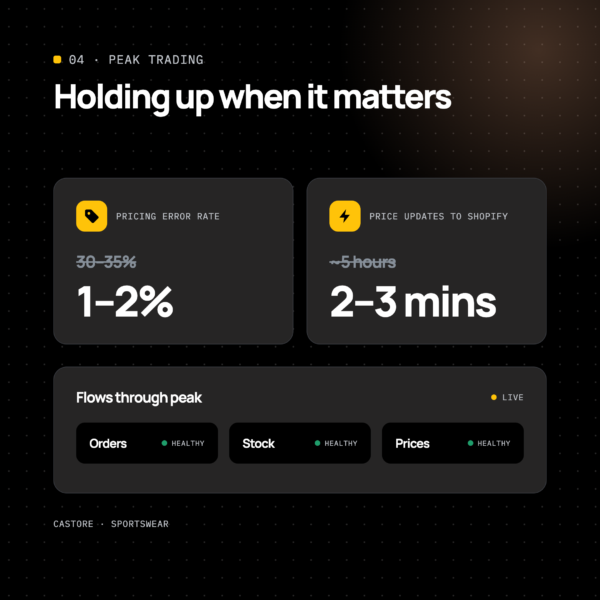
Peak trading isn’t a separate flow. It’s every flow above holding up when order volumes jump at Black Friday or a big product launch.
- Trigger: a surge in orders, price changes or stock updates.
- What moves: the same orders, stock and prices, but far more of them, far faster.
- Result: integrations that keep working when they matter most.
Castore, the sportswear brand, cut pricing error rates from 30–35% to 1–2% with Patchworks. Its pricing updates to Shopify went from around five hours to two to three minutes, and held through peak trading.
Read our guide to peak season readiness for retailers.
B2B and EDI
B2B integration uses iPaaS to run trade orders and direct-to-consumer orders on one stack. Trade orders can arrive through a B2B store or as EDI files from trading partners.
- Trigger: a trade customer orders through a B2B store, or a trading partner sends an EDI order.
- What moves: the order, pricing and payment terms go into the ERP, and stock and invoices go back.
- Result: one set of systems for wholesale and DTC, not two.
Natural Instinct, the raw pet food brand, sells to stockists, breeders and consumers. It now runs one Shopify Plus store for both B2B and DTC customers. A Patchworks connector syncs its orders, inventory and customer data with Sage, replacing a file-based workflow.
Read more about B2B integration.
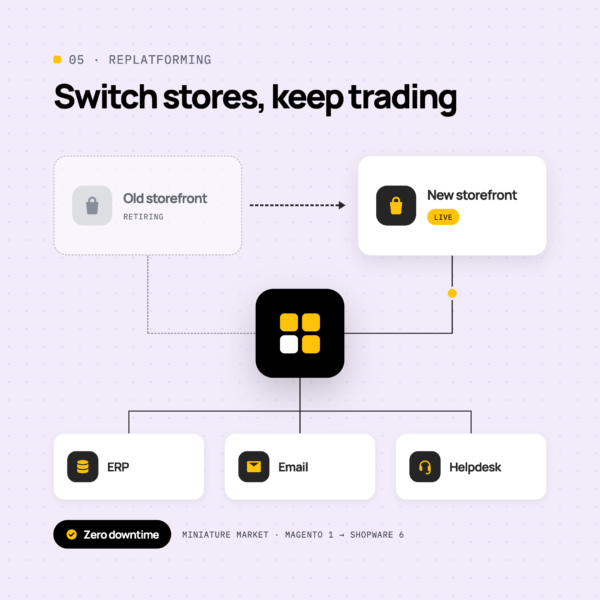
Replatforming
Replatforming uses iPaaS to keep the ERP and other systems connected while the storefront or ERP is replaced.
- Trigger: a move to a new storefront or ERP.
- What moves: products, customers and orders, plus the live flows that keep trading going during the switch.
- Result: a move without downtime or lost data.
Miniature Market, a tabletop and board game retailer, moved from Magento 1 to Shopware 6. Patchworks connected the new store to its Deposco ERP, Klaviyo and Zendesk. The move had zero downtime, and manual data entry between Shopware and Deposco was eliminated.
For the business case behind these use cases, read the benefits of iPaaS.
How do retailers use Patchworks in practice?
Retailers use Patchworks to connect their storefront, ERP, warehouse and marketplaces, then measure the result in fewer errors and faster orders. Here are three fuller examples, each taken from the brand’s own case study.
Bare Minerals: reliable stock on Shopify
- Challenge: Shopify was showing the wrong stock levels, which led to cancelled orders.
- What was built: Patchworks connected Shopify to its 3PL, GXO, so Shopify took stock levels straight from the warehouse.
- Result: a 50% reduction in order cancellations caused by incorrect inventory. Revenue rose 100% after go-live, once the brand could market the site with confidence.
SoldThrough: faster orders across US marketplaces
- Challenge: SoldThrough helps international brands sell through US marketplaces such as Macy’s, Bloomingdale’s and Nordstrom. Its orders synced only once an hour, and some low-stock orders had to be entered by hand.
- What was built: integration partner MRE Digital built five flows on Patchworks, including inventory updates sent as EDI files.
- Result: order sync went from hourly to every 15 minutes, and the manual low-stock order work was eliminated.
Bollin Group: one set of flows for 20 brands
- Challenge: Bollin Group runs more than 20 brands across ecommerce, retail and wholesale. Its sales channels weren’t properly connected to the ERP.
- What was built: Patchworks blueprints let the team copy the same process flows for each brand, managed from one dashboard.
- Result: when a change was needed to warehouse pick instructions, the team deployed it in minutes. Bollin’s ecommerce manager said it would have been a two-week build and release cycle before.
What types of iPaaS platform are there?
iPaaS platforms fall into a few broad types, and the right one depends on how many systems you run and how specific your industry is.
- Industry-focused iPaaS: built around one sector’s systems and data. Patchworks is the retail-first, AI-native orchestration layer for retail tech stacks.
- General enterprise iPaaS: a toolkit for any industry, usually run by a large IT team.
- Lightweight automation tools: good for simple tasks between a few apps, but not built for high order volumes or complex logic.
- Embedded iPaaS: built into a software company’s own product. Read embedded iPaaS explained.
To compare providers side by side, see how Patchworks compares with other iPaaS providers.
How long does an iPaaS use case take to implement?
It depends on the systems involved and how much custom logic you need. A common pairing with a prebuilt flow can go live much faster than a custom build.
- Prebuilt integration pairs: Patchworks has ready-made flows for pairings such as Shopify and NetSuite and Shopify and Sage. You start from a working integration.
- AI-assisted building: AI Studio agents help draft flows and mappings from plain-English prompts. AI Studio is available on all plans.
- Real timelines: Blinc moved all four of its system integrations onto Patchworks from its previous iPaaS in under two weeks. Mint Velvet went from discovery to go-live in three months, and now runs 91 managed flows.
For how use cases fit into a retail stack, read iPaaS for ecommerce.