If you build software for retailers, this will sound familiar. A prospect asks whether your product connects to Shopify, NetSuite, Sage or their 3PL. Your team builds the connector, then builds it again for the next customer, and then maintains both every time an API changes.
Embedded iPaaS is how software companies stop rebuilding the same integrations. It puts a ready-made integration layer inside your product, so your customers connect their own systems without a ticket in your engineering backlog.
This article is for software companies and platforms. If you’re a retailer looking to connect your own systems, start with our guide to what is iPaaS?
What is embedded iPaaS?
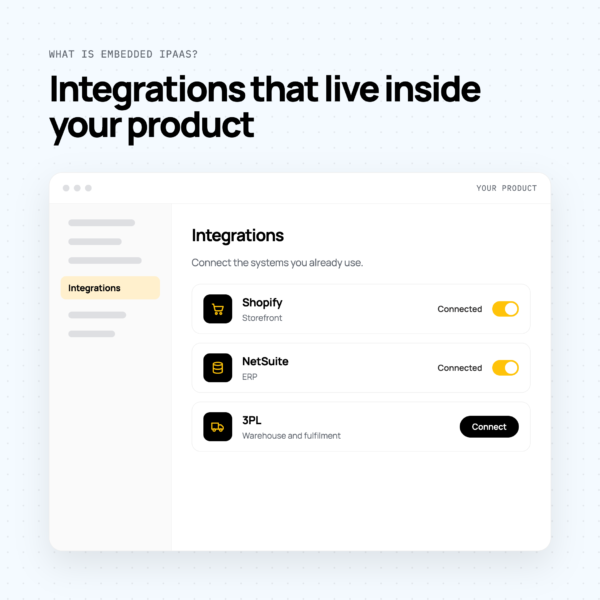
Embedded iPaaS (embedded integration platform as a service) is an integration platform that a software company builds into its own product. It lets the company’s customers connect that product to their other systems, such as Shopify, NetSuite or a 3PL, from inside the app. The integrations appear as part of the software company’s product, not as a separate tool.
Embedded iPaaS is used by SaaS companies, commerce platforms and technology partners whose customers need integrations to get value from the product.
What’s the difference between embedded iPaaS and iPaaS?
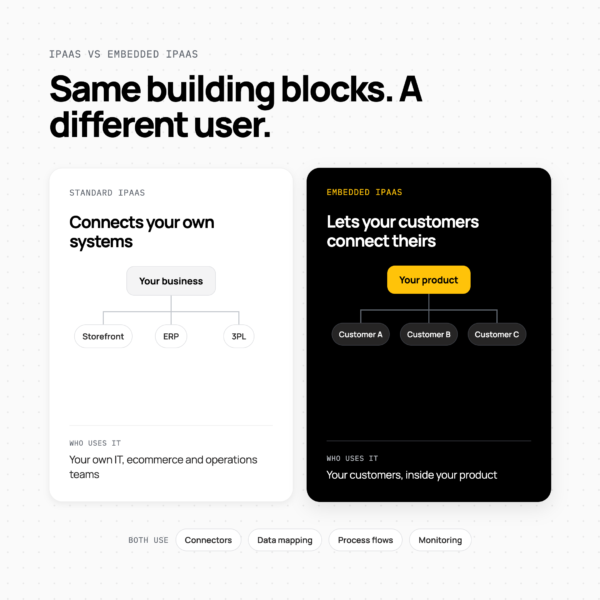
The difference is who uses it. A standard iPaaS connects a company’s own systems for its internal teams. An embedded iPaaS sits inside a software product, so that product’s customers can connect their systems themselves.
| Standard iPaaS | Embedded iPaaS | |
| Who buys it | A retailer or brand, usually the IT or operations team | A software company or platform |
| Who uses it | The buyer’s own IT, ecommerce or operations team | The software company’s customers, inside its product |
| Who sees it | Internal teams only | The software company’s customers, as part of the product |
| What it connects | The buyer’s own storefront, ERP, 3PL and other systems | The software product to each customer’s systems |
| How it’s usually priced | A subscription for the company’s own integrations | A platform fee paid by the software company, often passed on in its own plans |
Both use the same building blocks: connectors, data mapping, process flows and monitoring. What changes is the person on the other end. With embedded iPaaS, your customer sets up the connection, and your team runs it at scale.
Patchworks offers both. Retailers use the Patchworks platform to connect their own systems, and software companies use Patchworks Embedded iPaaS to offer integrations inside their products.
How does embedded iPaaS compare with the alternatives?
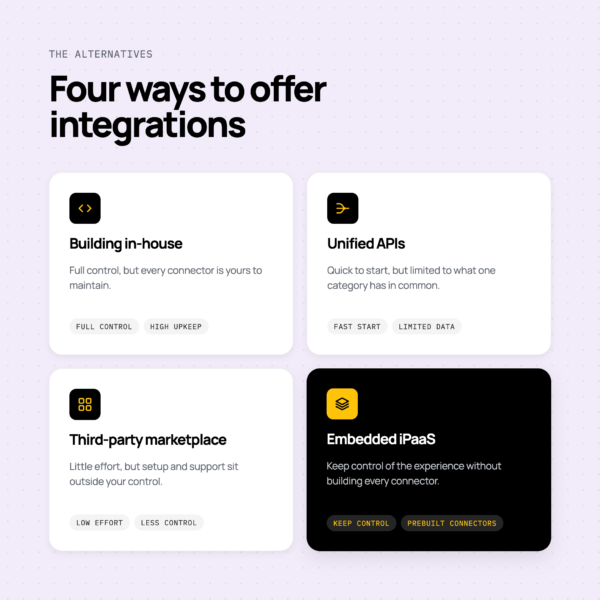
Software companies have four main ways to offer integrations. Each one trades control against the effort of building and maintaining connectors.
Building integrations in-house
Your engineers build and own every connector. You get full control over how each integration behaves, but every connector is yours to maintain for as long as customers use it.
Unified APIs
A unified API gives you one API for a whole category of systems, such as “all ecommerce platforms”. It’s quick to start with, but you’re limited to the data and actions the provider has standardised across that category.
An integration marketplace of third-party apps
You list apps built by other companies and let customers choose one. It takes little effort from your team, but the setup, reliability and support sit outside your control.
Embedded iPaaS
You use prebuilt connectors and tooling from an integration platform, and the integrations run inside your product. You keep control of the customer experience without building every connector from scratch.
Who uses embedded iPaaS?
Embedded iPaaS is used by software companies and platforms whose customers expect the product to connect to the rest of their stack. That’s common in commerce software, where every customer runs a different storefront, ERP and warehouse:
- Order management systems (OMS) that read orders from Shopify and write them back to an ERP such as NetSuite or Business Central.
- Returns platforms that need to update the 3PL, the ERP and the finance system for every return.
- Product information management (PIM) systems that push product data to every storefront and marketplace.
It isn’t limited to commerce. Any SaaS product with an integration backlog can use embedded iPaaS.
Company stage changes the reason. Early-stage software companies use it to win deals that depend on a specific integration. Scale-ups use it to clear the backlog and spend less engineering time on maintenance.
How does embedded iPaaS work?
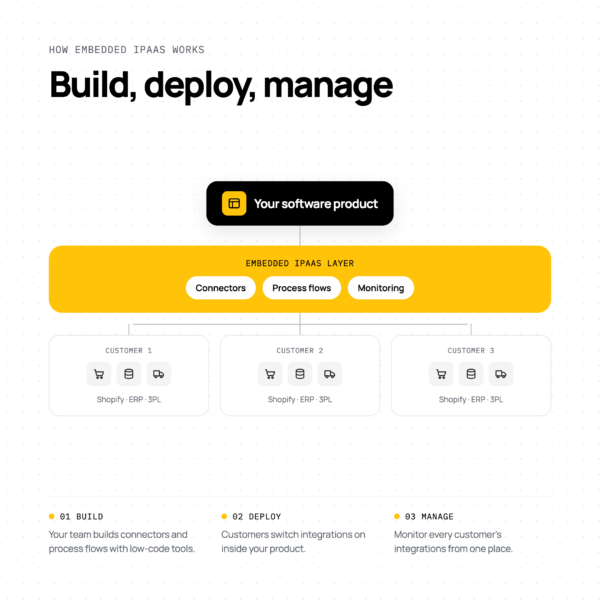
Embedded iPaaS works in three stages. Your team builds the integrations, your customers switch them on inside your product, and your team manages them.
- Build: your team, or the iPaaS provider, builds connectors and process flows using low-code tools, and adds custom logic where your product needs it.
- Deploy: your customers see an integrations page inside your product. They choose a system, sign in, set a few options and switch it on.
- Manage: your team monitors every customer’s integrations from one place, handles new versions and API changes, and keeps flows stable as volumes grow.
For more on the parts underneath, read how iPaaS works.
Should you build integrations in-house or buy an embedded iPaaS?
Build in-house when you need one or two integrations that are central to your product. Buy an embedded iPaaS when customers keep asking for more, because the real cost of each connector is in maintaining it, not building it.
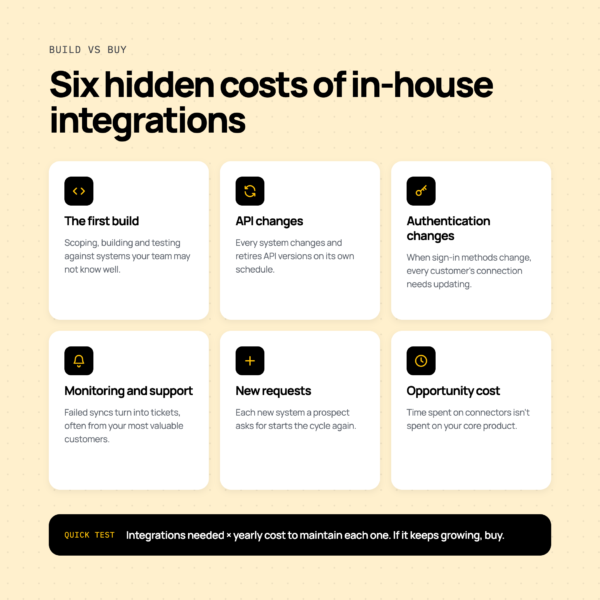
In-house integrations tend to hide six costs:
- The first build: scoping, building and testing each connector against a system your team may not know well.
- API changes: every connected system changes and retires API versions on its own schedule.
- Authentication changes: when a system changes how apps sign in, every customer’s connection needs updating.
- Monitoring and support: failed syncs turn into support tickets, often from your most valuable customers.
- New requests: each new system a prospect asks for starts the cycle again.
- Opportunity cost: engineering time spent on connectors isn’t spent on your core product.
A simple way to decide is to multiply the number of integrations your customers need by the yearly cost of maintaining each one. If that number keeps growing, an embedded iPaaS is usually cheaper over time.
What are the benefits and drawbacks of embedded iPaaS?
The main benefit is that integrations stop competing with your product roadmap for engineering time. The main drawback is that you depend on another vendor for part of your product.
Benefits:
- Integrations ship sooner, because connectors and tooling already exist.
- Less engineering time goes on building and maintaining connectors.
- Customers get set up faster, because they connect their own systems inside your product.
- Customers who connect your product to the rest of their stack have more reasons to stay.
- Integrations can become a paid tier or add-on, if that suits your pricing.
Drawbacks:
- Platform cost: you pay a fee to the iPaaS provider, which needs to make sense against the cost of building.
- Vendor dependence: part of your product relies on the provider’s uptime, roadmap and support.
- Less control at the edges: very specific behaviour may need custom code or workarounds.
- A learning curve: your team needs time to learn the platform before it pays back.
How do you choose an embedded iPaaS?
Choose an embedded iPaaS on whether it already connects the systems your customers run, and whether your team can run it across every customer. Check each provider against seven criteria.
- Connector coverage: prebuilt connectors for the systems your customers use most, such as their storefront, ERP and 3PL.
- Experience inside your product: how far the integrations page can match your product’s design and branding.
- Developer experience: room for custom code, scripting and APIs and webhooks when the standard flow doesn’t fit.
- Monitoring across customers: one view of every customer’s integrations, with alerts when something fails.
- Scale and performance: proof that it handles high volumes, such as peak trading for commerce customers.
- Pricing model: how the cost changes as you add customers, integrations and volume.
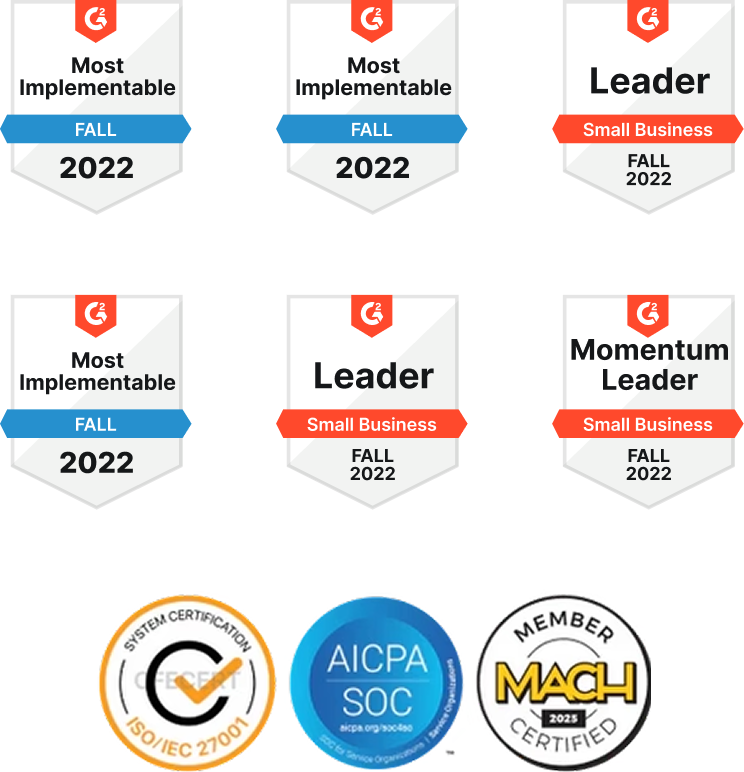
- Security and compliance: which certifications the provider holds, and the evidence behind them.
How does Patchworks Embedded iPaaS work?
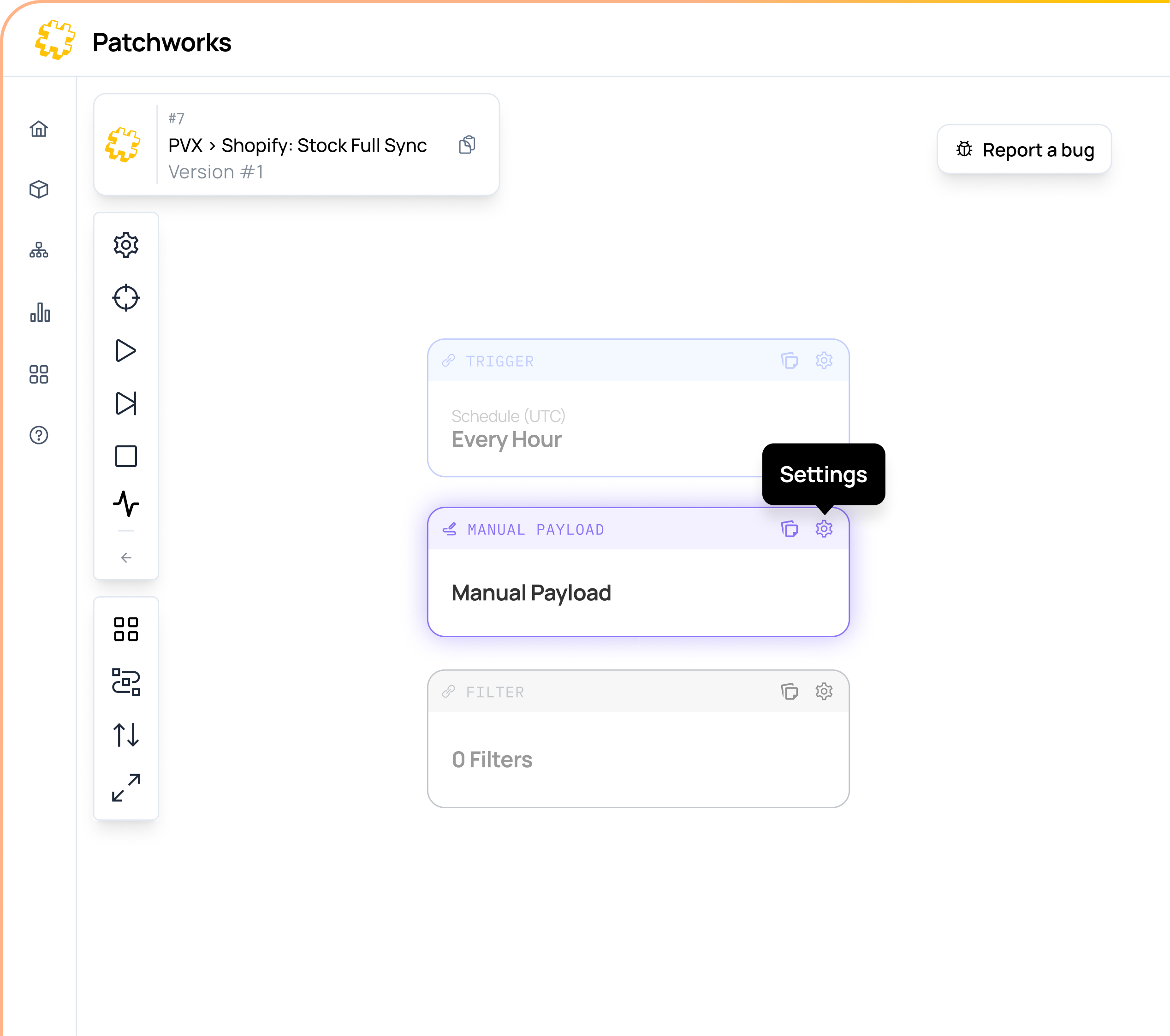
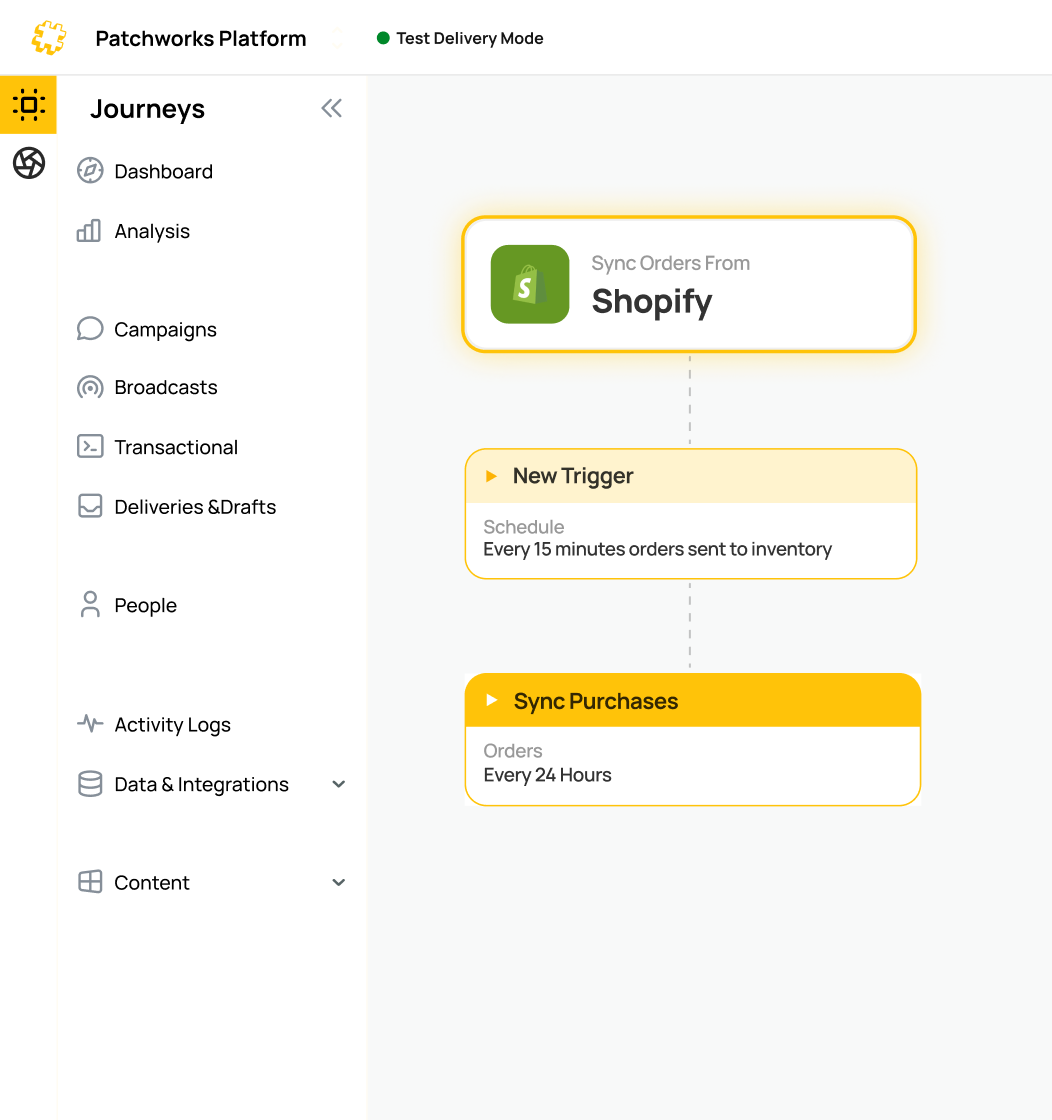
Patchworks Embedded iPaaS lets software companies and platforms offer integrations inside their own products. It runs on Patchworks, the retail-first, AI-native orchestration layer for retail tech stacks, and follows the same build, manage and deploy model.
- Build: create integrations with low-code process flows or custom logic, using the Connector Builder for systems that aren’t in the marketplace yet.
- Manage: monitor, update and scale integrations, including high-volume data flows and new versions.
- Deploy: give customers an interface inside your product where they connect their own systems.
Patchworks’ connector library is built around commerce systems: storefronts, ERPs, WMS and 3PLs, PIMs and marketplaces. AI Studio agents help your team build flows and mappings from plain-English prompts. Patchworks is used by 2,000+ brands and is Shopify’s only Certified Technology Partner for integrations.
Developers can find documentation and scripting options on the developers page. If you’d rather partner with Patchworks than embed it, see the partners overview.