iPaaS (integration platform as a service) isn’t free, and it isn’t right for every retailer. For most multi-channel retailers, the benefits are fewer order errors, integrations that hold up at peak and new channels live sooner.
This article covers what changes day to day, what the drawbacks are, and how to tell whether your business is ready. It’s written for ecommerce, operations and finance leads building the case for investment.
If you’re new to the term, start with our guide to what is iPaaS?
What are the benefits of iPaaS?
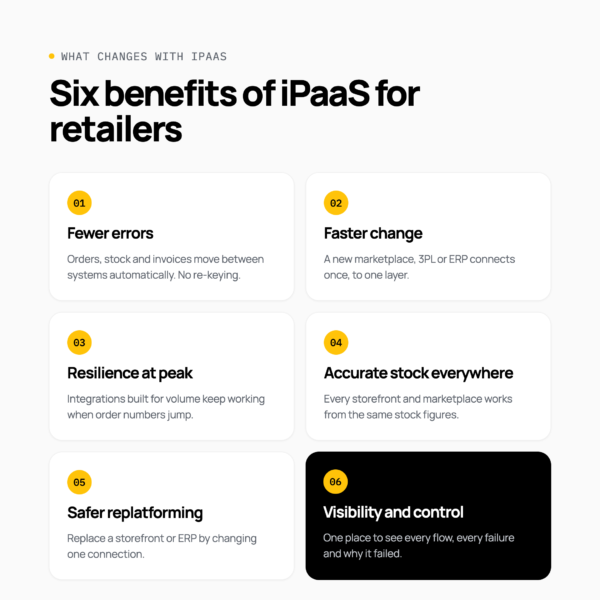
The main benefits of iPaaS for a retailer are fewer errors, faster change and integrations that keep working at peak. In short, an iPaaS gives you:
- Fewer errors: orders, stock and invoices move between systems automatically, so nobody re-keys them.
- Faster change: a new marketplace, 3PL or ERP connects once, to one layer, instead of to every system.
- Resilience at peak: integrations built for volume keep working when order numbers jump.
- Accurate stock everywhere: every storefront and marketplace works from the same stock figures.
- Safer replatforming: replacing a storefront or ERP means changing one connection while the rest stay as they are.
- Visibility and control: one place to see every flow, every failure and why it failed.
How does iPaaS help retail and ecommerce teams day to day?
iPaaS helps retail teams by taking the manual work and the risk out of moving orders, stock and customer data between systems. Here’s what each benefit looks like in practice, with a retailer’s result where one is published.
Fewer manual errors and less re-keying
An iPaaS cuts errors because data moves between systems automatically instead of being typed in twice. Orders reach the ERP, stock updates reach every channel, and invoices reach finance without anyone copying them across.
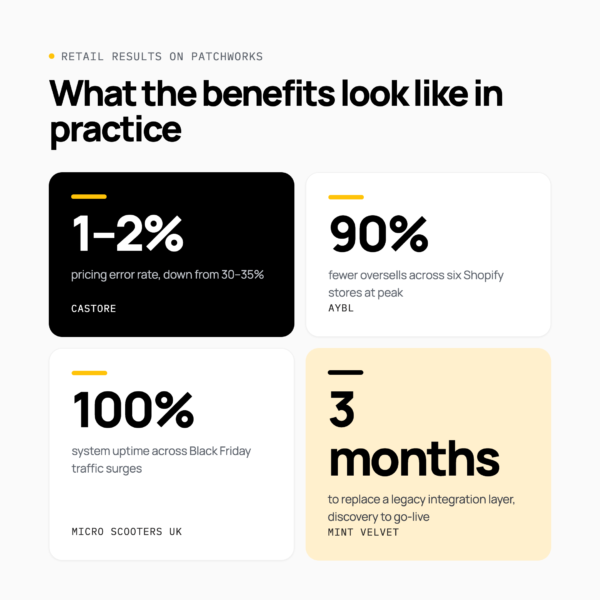
Castore, the sportswear brand, cut pricing error rates from 30–35% to 1–2% after moving its pricing updates onto Patchworks.
New channels and systems live sooner
With an iPaaS, adding a marketplace or swapping a 3PL means one new connection to a layer you already run. Every other system stays as it is.
Prebuilt connectors and popular integration pairs, such as Shopify and Sage Accounting, mean many flows start from a working blueprint. Blinc, the cosmetics brand, moved all four of its system integrations onto Patchworks from its previous iPaaS in under two weeks.
Integrations that hold up at peak
An iPaaS built for volume queues and retries work, so a surge in orders doesn’t knock a connection over. That matters most at peak, when a failed sync costs the most.
In Patchworks’ Retail Integration Report 2025/26, 42% of retail tech leaders said peak trading causes sleepless nights. Almost half (48%) rely on manual fixes to get through it.
Micro Scooters UK maintained 100% system uptime across its Black Friday traffic surges on Patchworks. Castore’s pricing updates to Shopify went from around five hours to two to three minutes, and held through peak trading.
To prepare for your next peak, read our guide to peak season readiness for retailers.
One accurate view of stock and orders
An iPaaS keeps stock and order data the same in every system, so you stop selling what you don’t have. When stock changes in the ERP or warehouse, the new level goes to every storefront and marketplace.
AYBL runs six Shopify stores from one pool of stock. During its most recent peak, it cut oversells by 90% across all six. Fewer oversells also mean fewer cancellations and fewer “where’s my order?” emails.
Changing systems without rebuilding everything
With an iPaaS in the middle, replacing your ERP or storefront means changing one connection, while the others stay as they are. Without one, every system that touched the old platform needs rework.
That makes a replatform or an ERP change easier to plan, such as a move from Sage to Microsoft Dynamics 365 Business Central. Mint Velvet replaced its legacy integration layer in three months, from discovery to go-live. It now runs 91 managed flows in Patchworks.
Visibility, security and control in one place
An iPaaS gives you one place to see every flow, every failure and the reason it failed. Alerts reach the right person before a customer notices a missing order.
Access, logging and audit trails sit in the same place too, instead of being spread across dozens of apps and scripts. Your developers spend less time firefighting integrations and more on the work customers see. In the same report, 39% of retail tech leaders said developers spend more time firefighting than optimising.
What are the drawbacks of iPaaS, and how can you reduce them?
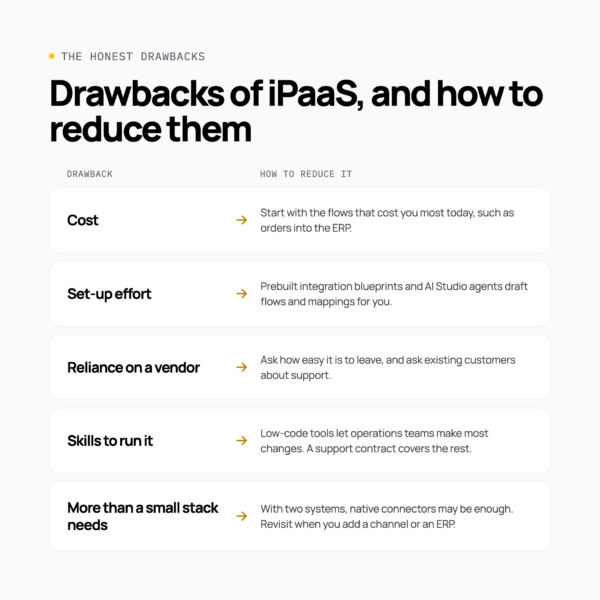
The main drawbacks of iPaaS are cost, set-up effort, reliance on a vendor and the skills to run it. Each one can be reduced, and for a very small stack an iPaaS may be more than you need.
- Cost: an iPaaS is a subscription, plus the work to implement it. Reduce it by starting with the flows that cost you most today, such as orders into the ERP.
- Set-up effort: mapping data and testing flows takes time. Prebuilt integration blueprints, and AI Studio agents that draft flows and mappings, shorten it.
- Reliance on a vendor: part of your operation depends on the provider’s uptime and support. Ask how easy it is to leave, and ask existing customers about support.
- Skills: someone has to own the platform. Low-code tools let operations teams make most changes, and a support contract can cover the rest.
- More than a small stack needs: with two systems and a few hundred orders a month, apps and native connectors may be enough. Revisit the decision when you add a channel or an ERP.
Micro Scooters UK uses a Patchworks support contract for the skills gap. Patchworks acts as an extended technical team, handling infrastructure maintenance, health monitoring and new change requests.
When is iPaaS worth it for a retailer?
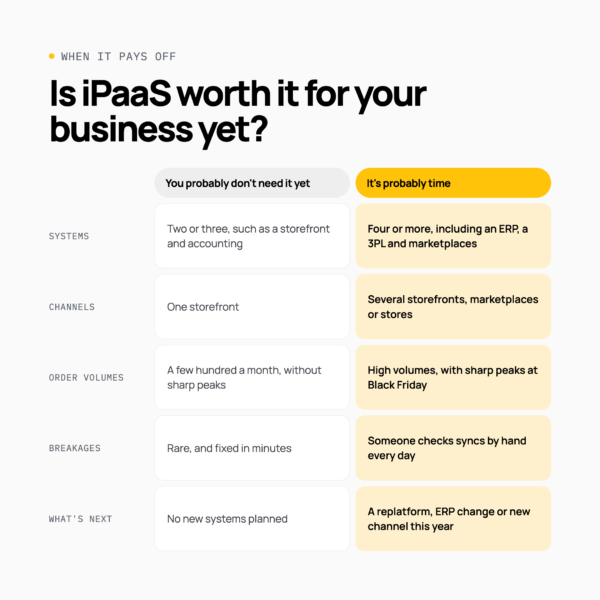
iPaaS is usually worth it once several systems and channels need the same orders and stock, and a failed sync starts to cost sales. Use this table as a rough guide.
| Sign |
You probably don't need it yet
|
It's probably time |
|---|---|---|
| Systems |
Two or three, such as a storefront and an accounting package
|
Four or more, including an ERP, a 3PL and marketplaces
|
| Channels |
One storefront
|
Several storefronts, marketplaces or physical stores
|
| Order volumes |
A few hundred orders a month, without sharp peaks
|
High volumes, with sharp peaks around Black Friday and launches
|
| How often things break |
Rarely, and a manual fix takes minutes
|
Often enough that someone checks syncs by hand every day
|
| What changes next |
No new systems planned
|
A replatform, an ERP change or a new channel in the next year
|
| Who fixes problems |
The app's support team
|
Your own developers, instead of building what customers see
|
If several signs on the right sound familiar, read why fast-growing D2C brands outgrow their ecommerce integrations.
How do you make the business case for iPaaS?
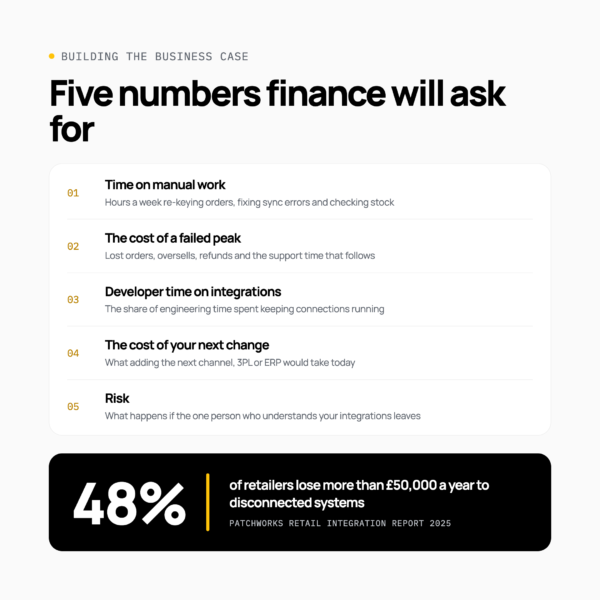
Make the business case by comparing what disconnected systems cost you today with the total cost of ownership of an iPaaS. These five numbers are the ones finance will ask for:
- Time on manual work: hours each week spent re-keying orders, fixing sync errors and checking stock by hand.
- The cost of a failed peak: lost orders, oversells, refunds and the support time that follows.
- Developer time on integrations: the share of engineering time spent keeping connections running.
- The cost of your next change: what it would take to add the next channel, 3PL or ERP with your current setup.
- Risk: what happens if the one person who understands your integrations leaves.
The costs add up. Patchworks’ Retail Integration Report 2025 found that 48% of retailers lose more than £50,000 a year to disconnected systems. Read more in the hidden cost of poor integration.
On the other side of the case, G2 reviewers report an average time to ROI of 4 months for Patchworks. That’s based on mid-market reviews collected in Summer 2026, shown on the iPaaS comparison page.
Patchworks pricing is based on how many systems you connect and how much data you move. For how Patchworks keeps costs predictable over three years, see finance and leadership.
Where does Patchworks fit?
Patchworks is the retail-first, AI-native orchestration layer for retail tech stacks. It’s an iPaaS built around the data retailers run on: orders, stock, products, customers and fulfilment.
Patchworks is used by 2,000+ brands and is Shopify’s only Certified Technology Partner for integrations. Prebuilt connectors, integration pairs and AI Studio agents help integrations go live sooner, and monitoring catches problems before customers notice. For real examples, read iPaaS use cases and examples or iPaaS for ecommerce.