Most retail tech stacks grow one system at a time. A Shopify store, then Amazon and eBay, then an ERP such as NetSuite or Sage, a 3PL and a dozen apps. Each one gets connected to the others in whatever way was quickest at the time.
That works until peak trading. Order volumes jump, apps hit their limits, stock stops matching across channels, and someone ends up fixing orders by hand late at night.
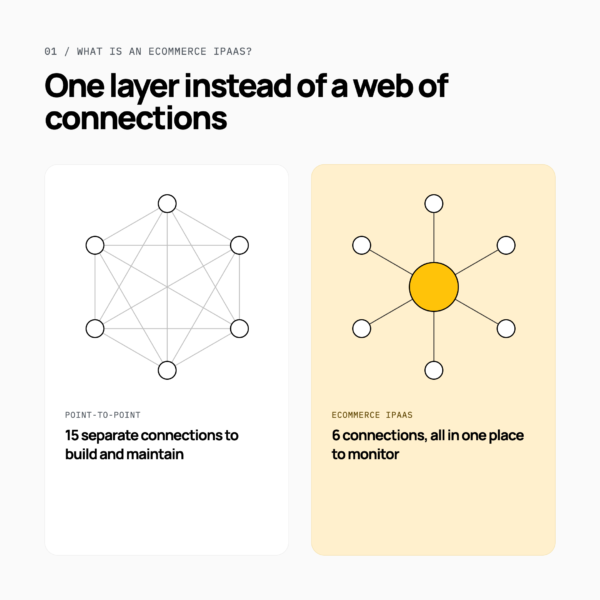
An ecommerce integration platform replaces those separate connections with one layer that keeps every system in step. Below, we cover how it works, where retail integration tends to break, and how to choose a platform.
What is an ecommerce integration platform?
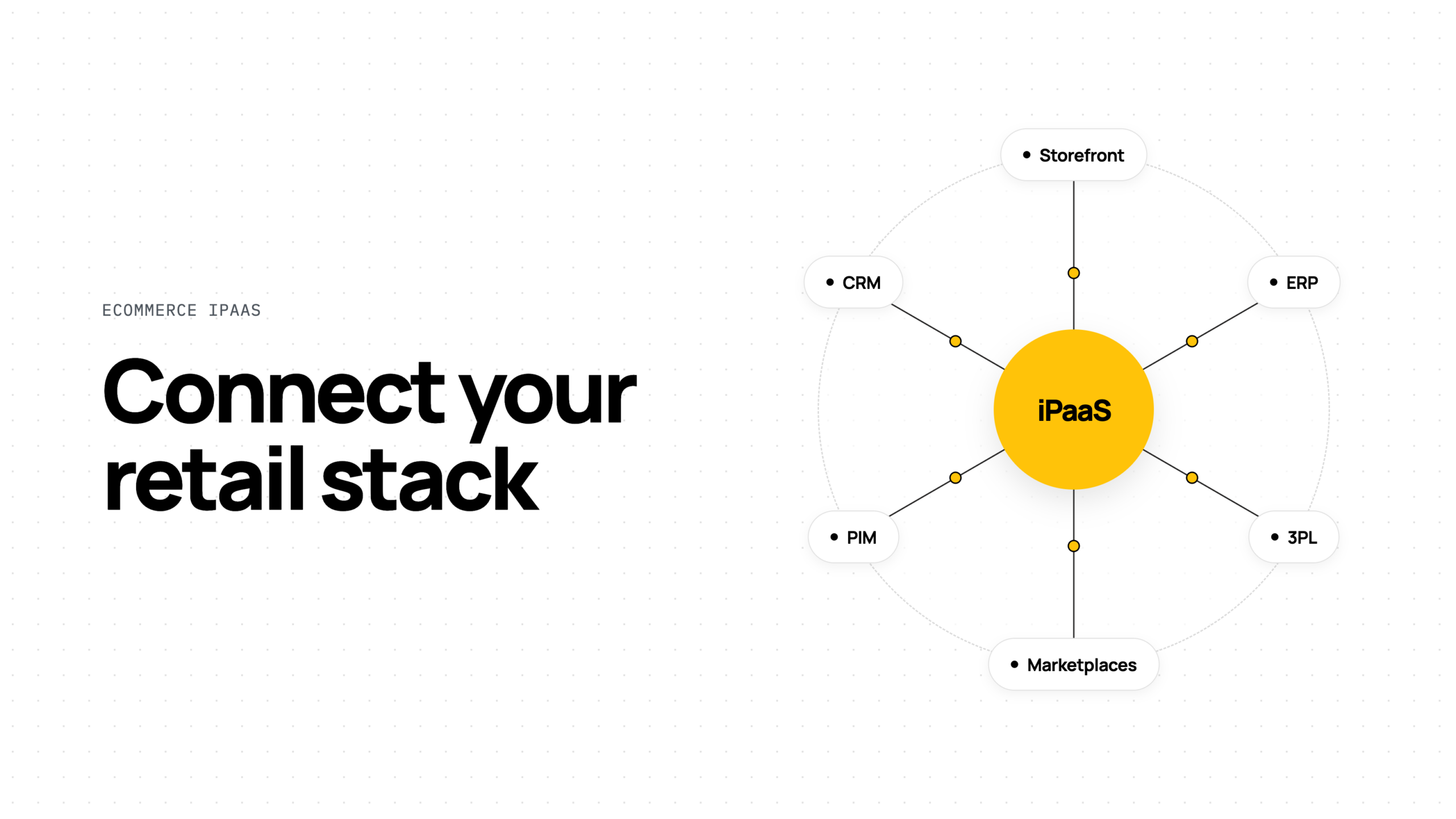
An ecommerce integration platform, or ecommerce iPaaS (integration platform as a service), is a cloud platform built to connect the systems a retailer runs on. Those are usually the storefront, ERP, warehouse or 3PL, marketplaces and finance tools. It moves orders, stock, products and customer data between them automatically, so nobody has to re-key anything.
The difference from a general-purpose iPaaS is the starting point. A general iPaaS gives you a blank canvas for any industry. An ecommerce iPaaS starts with connectors and prebuilt flows for retail systems and retail data, such as orders, stock, returns and fulfilment.
For a fuller introduction to the category, read what is iPaaS?
Why is ecommerce integration harder than other integration?
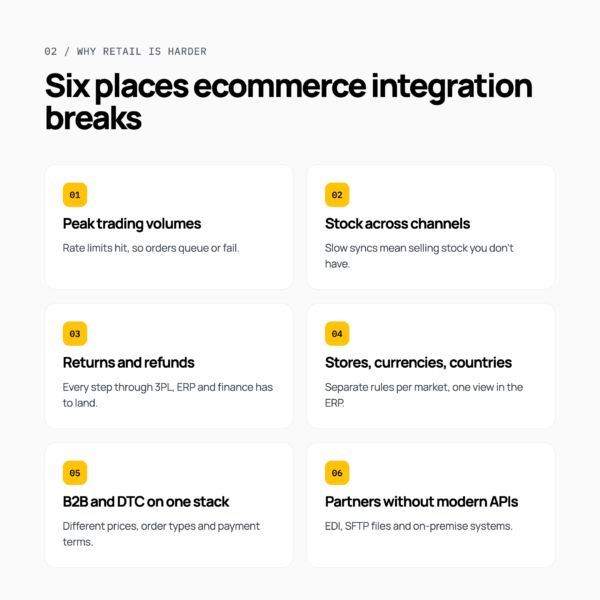
Ecommerce integration is harder because retail data changes fast, in high volumes, across many channels at once. A connection that’s fine on a quiet Tuesday can fail on Black Friday. Six areas cause most of the trouble.
Peak trading volumes
Order volumes rise sharply during peak trading. Point-to-point connections and apps that call each system’s API directly can hit rate limits and fall behind. Orders then queue up or fail, and stock levels go out of date. Read why ecommerce systems fail during Black Friday.
Stock across several channels
The same unit is often for sale on your website, on Amazon and in store at the same time. If stock levels sync slowly, you sell items you no longer have. AYBL runs six Shopify stores from one pool of stock. During its most recent peak, it cut oversells by 90% across all six.
Returns and refunds
A return has to travel back through the 3PL, the ERP and the finance system, often in a different order from the original sale. If one step is missed, stock is wrong, or a customer waits for a refund that never arrives.
Several stores, currencies and countries
International storefronts often feed a single ERP, each with its own currency, tax rules and fulfilment options. The integration layer has to keep those rules apart while the ERP sees one business.
B2B and direct-to-consumer on one stack
Trade customers and consumers usually need different prices, order types and payment terms. Running both through the same systems means the integration has to route each order correctly.
Partners without modern APIs
Not every trading partner has a modern API. Many still send EDI (electronic data interchange) messages or flat files over SFTP, and some core systems sit on-premise. An ecommerce integration platform needs routes for all of these, not just APIs.
Which systems does an ecommerce iPaaS connect?
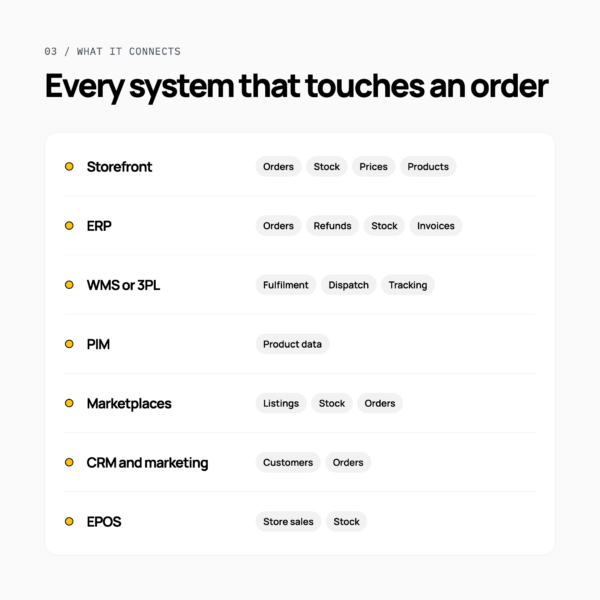
An ecommerce iPaaS connects every system that handles an order, a stock level, a product or a customer. The usual set looks like this.
An ecommerce iPaaS connects every system that handles an order, a stock level, a product or a customer. The usual set looks like this.
| System | Examples | What moves in and out |
| Storefront | Shopify, BigCommerce, Adobe Commerce | Orders out; stock, prices and products in |
| ERP (enterprise resource planning) | NetSuite, Sage, Microsoft Dynamics 365 Business Central | Orders and refunds in; stock, prices and invoices out |
| WMS or 3PL | GXO, Descartes Peoplevox, Huboo | Fulfilment requests in; dispatch, tracking and stock out |
| PIM (product information management) | Akeneo, Salsify, Pimberly | Product data out to every channel |
| Marketplaces | Amazon, eBay, TikTok Shop, OnBuy | Listings and stock in; orders out |
| CRM and marketing | HubSpot, Klaviyo | Customer and order data in |
| EPOS (electronic point of sale) | Lightspeed Retail, Sitoo | Store sales out; stock in |
For the full list of systems Patchworks connects, see ecommerce integrations.
Should you use native connectors, Shopify apps or an iPaaS?
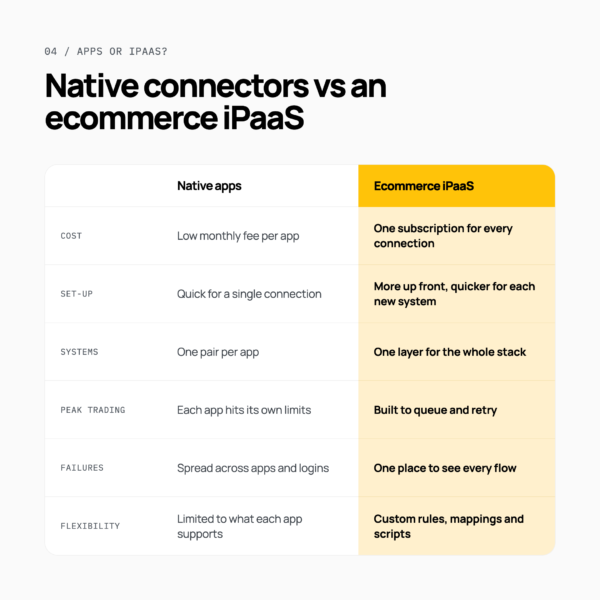
Native connectors and Shopify apps are the right choice for a small, simple stack. An iPaaS starts to make sense once several systems need the same data, or when a failed sync at peak costs real money. Here’s how they compare for a retailer.
| Native connectors and Shopify apps | Ecommerce iPaaS | |
| Cost | A low monthly fee for each app | One platform subscription covering every connection |
| Set-up time | Quick for a single connection | More work at the start; each new system is quicker after that |
| Number of systems | Each app links one pair of systems | One layer links every system in the stack |
| Peak trading | Each app has its own limits, which peak volumes often reach | Built to queue and retry work across every connection |
| Seeing what broke | Spread across separate apps and logins | One place to see every flow and every failure |
| Flexibility | Limited to what each app supports | Custom rules, mappings and scripts where you need them |
If you’re seeing the warning signs, read why fast-growing D2C brands outgrow their ecommerce integrations.
What are the most common ecommerce integration use cases?
The most common ecommerce integration use cases move orders, stock and fulfilment data between the storefront, the ERP and the warehouse.
- Orders into the ERP: a customer pays on the storefront, the order is created in the ERP, and finance and fulfilment work from one record. Read what is ecommerce ERP integration?
- Stock across channels: when stock changes in the ERP or warehouse, the new level goes to every storefront and marketplace. You stop selling what you don’t have.
- 3PL fulfilment: orders go to the 3PL, and dispatch and tracking details come back to the store and the customer.
- Marketplace orders: listings, prices and stock go out to marketplaces, and their orders come back into the same flow as web orders.
- Returns: a return is booked, the 3PL confirms receipt, and the ERP, stock and refund all update.
- Customer data: orders and sign-ups flow into the CRM or email platform, so marketing works from current data.
For worked examples, read iPaaS use cases and examples.
What should you look for in an ecommerce integration platform?
Look for a platform that already connects the systems you run and has been proven at retail peak. Ask every provider on your shortlist these questions.
- Connectors for your systems: are there prebuilt connectors for the storefront, ERP, 3PL and marketplaces you run, and the ones you plan to add?
- Proven at peak: can it show retailers who traded through Black Friday on it, with results you can check?
- Prebuilt integration pairs: are there prebuilt flows for common pairings such as Shopify and NetSuite or Shopify and Sage Accounting, or does every flow start from scratch?
- Room for custom logic: can your team add rules, mappings or scripts when your process doesn’t fit the standard flow?
- Routes beyond APIs: can it handle EDI, SFTP files and on-premise systems as well as modern APIs?
- Monitoring and alerts: will you see a failed order or stock sync before a customer does?
- Pricing as you grow: how does the cost change as order volumes, systems and channels increase?
- Security: which certifications does the provider hold, and can you see the evidence?
- Support that knows retail: who helps when something breaks during peak, and do they understand your systems?
To compare providers side by side, see how Patchworks compares with other iPaaS providers.
What do real ecommerce integrations look like?
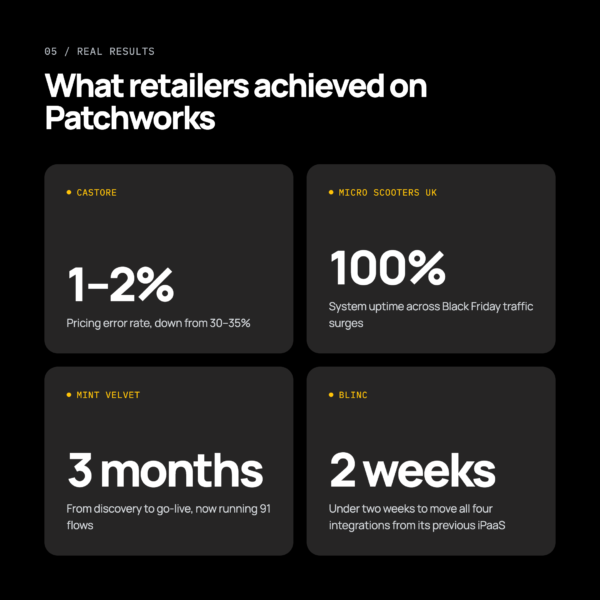
A real ecommerce integration connects named systems and is judged on results: error rates, uptime at peak and time to go live. Each example below links to the full case study.
- Castore, the sportswear brand, cut pricing error rates from 30–35% to 1–2%. Its pricing updates to Shopify went from around five hours to two to three minutes, and held through peak trading.
- Micro Scooters UK connects Shopify, Amazon and Argos Virtualstock to its Khaos Control ERP. It maintained 100% system uptime across its Black Friday traffic surges.
- Mint Velvet replaced its legacy integration layer in three months, from discovery to go-live. It now runs 91 managed flows in Patchworks, connecting Shopify with its ERP.
- Blinc, the cosmetics brand, moved all four of its system integrations onto Patchworks from its previous iPaaS in under two weeks.
How does Patchworks approach ecommerce integration?
Patchworks is the retail-first, AI-native orchestration layer for retail tech stacks. It’s an iPaaS built around the data retailers run on: orders, stock, products, customers, fulfilment and returns.
- Prebuilt connectors and integration pairs: connectors for the storefronts, ERPs, 3PLs and marketplaces retailers use, plus prebuilt flows for common pairings.
- More than APIs: EDI with trading partners, SFTP files for 3PLs and suppliers, and a VPN connection for on-premise systems.
- Low-code, with room to script: teams build flows in a drag-and-drop builder, and developers can add scripts where they need to.
- AI Studio: agents that help build, run and troubleshoot integrations from plain-English prompts. AI Studio is available on all plans.
- Proven in retail: Patchworks is used by 2,000+ brands and is Shopify’s only Certified Technology Partner for integrations.