TL;DR: Ecommerce ERP integration connects your online store to your ERP system so orders, inventory, pricing and financial data move automatically between them — no manual re-entry, no mismatched stock counts, no end-of-month scramble to reconcile numbers.
Ecommerce ERP integration links your ecommerce platform (Shopify, BigCommerce, Magento, or similar) directly to your ERP system, so operational data moves between the two without anyone touching a spreadsheet. Orders, inventory levels, product and pricing data, customer records and fulfilment status all sync automatically in both directions. No more manual exports, imports and copy-pasting — the stuff most growing retailers start out doing by hand, and eventually can’t keep up with.
If you’re scaling, this isn’t a nice-to-have. It’s what stops your ops team re-keying every order into the ERP by hand, and what stops finance finding out about a stock discrepancy three weeks after it happened. Done well, it removes that friction entirely: a customer places an order, and your ERP already knows about it, has adjusted inventory, and has started the fulfilment process, before anyone on your team has opened either system.
As your order volume grows, ERP and ecommerce integration stops being a nice-to-have and starts being infrastructure. Disconnected systems that felt like a minor inconvenience at 50 orders a day turn into a genuine operational risk at 5,000: overselling, delayed fulfilment, and financial reports that don’t match what’s actually happening in your warehouse.
This guide walks through what ecommerce ERP integration actually does, how it works under the hood, what data typically moves between systems, and how to think about choosing the right approach for your business.
What Is ERP Integration in Ecommerce?
An ERP (Enterprise Resource Planning) system is the software you use to run your back office. Finance, inventory, procurement and fulfilment all typically live inside it. Platforms like NetSuite, SAP, Microsoft Dynamics and Sage exist to manage the operational side of your business: what’s in stock, what’s owed, what’s been shipped, and what the numbers look like at the end of the month.
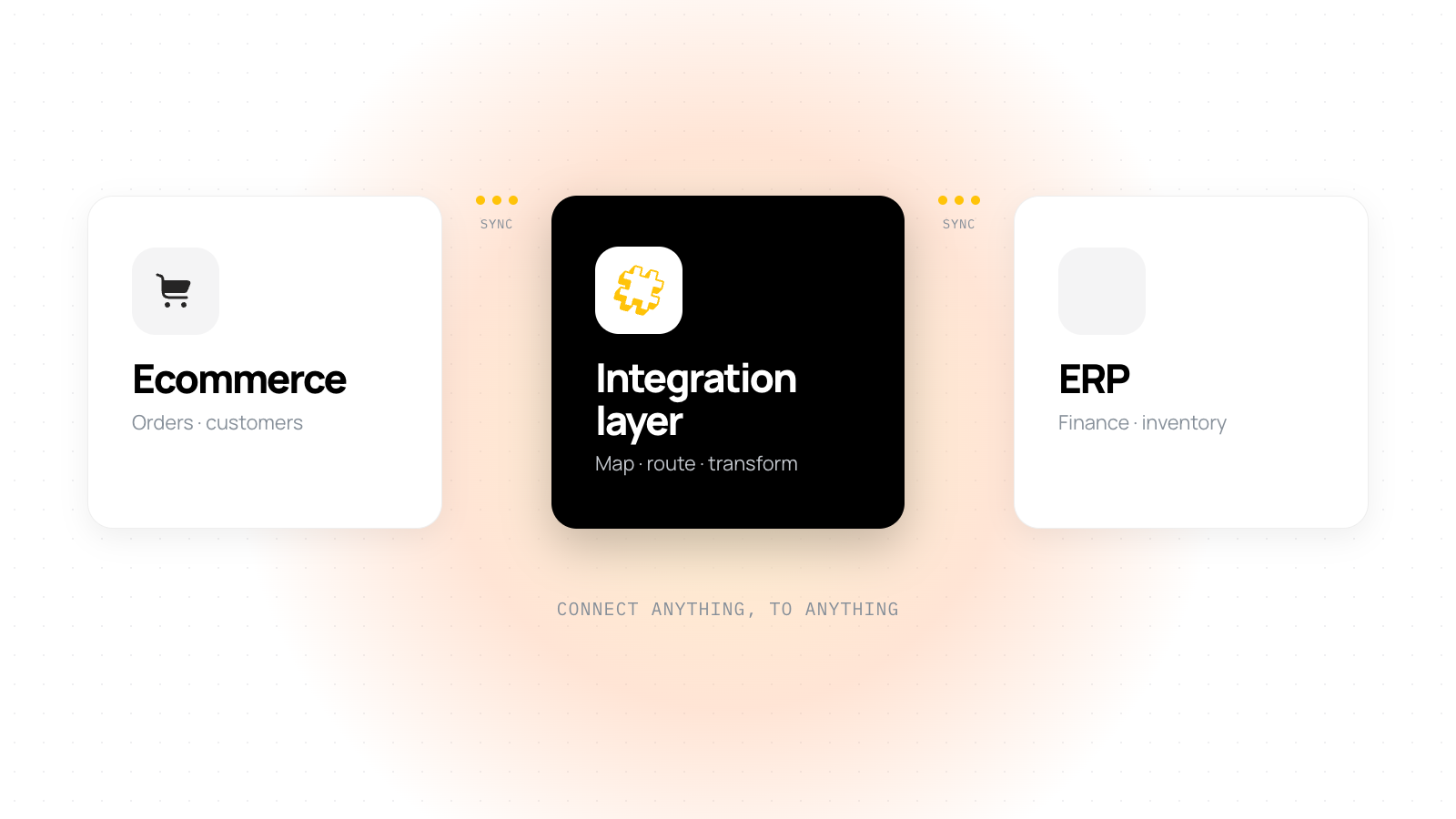
Your ecommerce platform, by contrast, is built to manage the customer-facing side: browsing, checkout, payment. ERP integration for ecommerce is simply the bridge between the two. It’s what turns “a customer bought this” (an event your storefront knows about) into “adjust stock, start fulfilment, record the sale” (a set of actions your ERP needs to take).
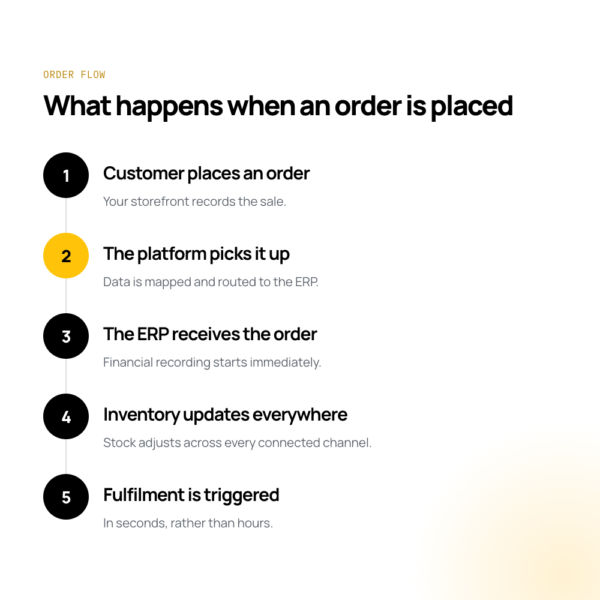
Here’s what that looks like in practice: a customer places an order online. Without integration, someone on your ops team logs into the ERP and manually enters that order, often hours later, sometimes the next morning. With ecommerce website integration with ERP in place, the order lands in your ERP within seconds, inventory adjusts automatically, and the fulfilment workflow starts without anyone touching a keyboard.
Why ERP and Ecommerce Integration Is Important
The case for integration is easiest to see in the problems it removes. Without it, you’ll likely run into some version of the same five issues as you grow:
- Manual order entry between systems, which doesn’t scale past a handful of orders a day and introduces errors as volume grows.
- Inventory mismatches that lead to overselling — a customer buys something the warehouse doesn’t actually have.
- Delayed reporting, because operational data only reaches the ERP in batches, not in real time.
- Finance teams spending hours each month reconciling numbers between two systems that don’t agree.
- Customer service issues caused by disconnected data — a support agent can’t see order or shipping status because it’s sitting in a different system.
These aren’t really efficiency problems, they’re risk problems. If you’re selling across Shopify, a marketplace and wholesale, you can lose track of stock accuracy fast without a shared source of truth. And if your finance team is reconciling two disconnected systems by hand, they’re one missed row away from a reporting error that reaches the board. The benefits of ERP ecommerce integration are best understood as removing that risk, not just saving time. Patchworks case studies report error-rate reductions of up to 97% once manual data entry between systems is replaced with automated sync.
If any of that sounds familiar, you’re not alone. It’s the single most common growing pain we hear about from ecommerce teams before they integrate.
How ERP Ecommerce Integration Works
Conceptually, this doesn’t need to be complicated. Most integrations work through either a direct API connection or, more commonly once you’re at scale, an integration platform (iPaaS) that sits between your ecommerce store and your ERP, translating and routing data between the two. APIs are simply the connectors that let systems built by different vendors talk to each other in a structured way.
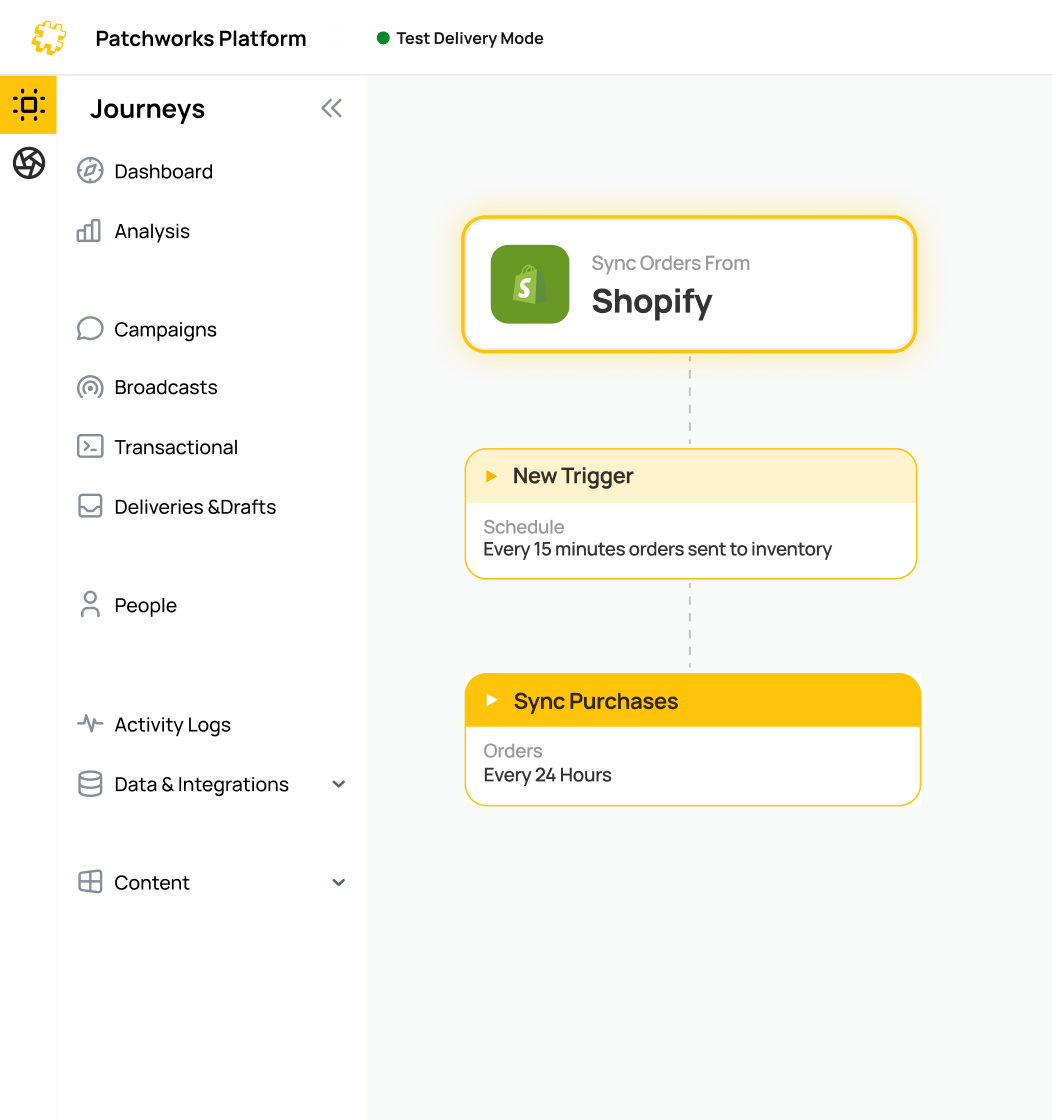
A typical order flow looks like this: a customer places an order → the integration platform picks it up and processes the data → the ERP receives the order → inventory updates across every connected channel → fulfilment is triggered. Each step happens automatically and, in a well-built integration, within seconds rather than hours.
This is where platforms like Patchworks come in: pre-built connectors and data-mapping logic mean you’re not building this from scratch for every new system you add. The result is automation that runs quietly in the background, rather than a project someone on your team has to babysit.
Key Data Synced Between ERP and Ecommerce Platforms
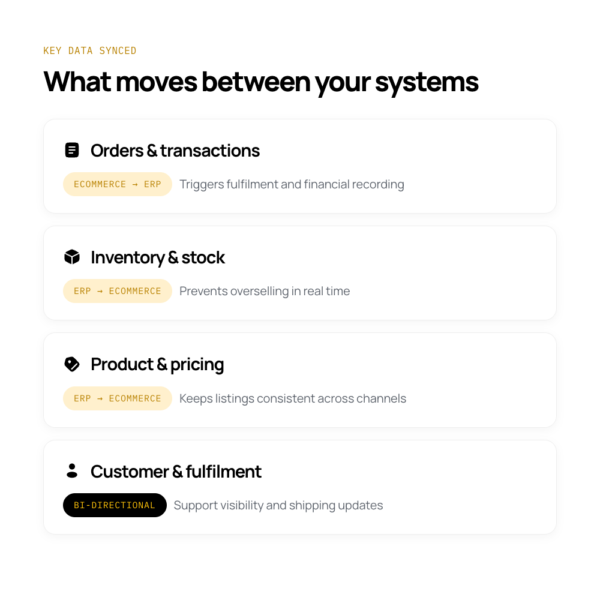
Integration success comes down to which data actually moves between systems, and in which direction. Most ecommerce ERP integrations focus on four categories:
| Data type | What typically syncs | Direction | Why it matters |
|---|---|---|---|
| Orders & transactions | Order ID, payment status, shipping method, tax data, order status | Ecommerce → ERP | Triggers fulfilment and financial recording the moment an order is placed |
| Inventory & stock | Stock levels by SKU, by warehouse or location | ERP → Ecommerce | Prevents overselling by keeping storefront stock counts accurate in real time |
| Product & pricing | SKUs, pricing rules, product attributes, catalogue changes | ERP → Ecommerce | Keeps listings consistent across every channel a product is sold on |
| Customer & fulfilment | Customer records, shipping updates, tracking numbers | Bi-directional | Improves support visibility and keeps shoppers informed automatically |
Orders and Transaction Data
Orders typically flow from your ecommerce platform into the ERP for fulfilment and financial processing: order ID, payment status, shipping details and tax data all need to arrive intact. Real-time syncing matters here specifically because delay compounds. A two-hour lag on order data is a two-hour delay on every downstream step, from picking to invoicing.
Inventory and Stock Availability
In most setups, your ERP acts as the master source of inventory truth, with stock updates flowing back out to every connected sales channel. This matters most if you’re running multiple warehouses or selling across channels, where this is what actually stops two channels selling the same last unit.
Product Information and Pricing
ERP systems often hold the master product record: SKUs, pricing rules, and attributes. Syncing this means a price change or new attribute updates consistently across every channel a product is listed on, rather than you having to enter it separately in each one.
Customer and Fulfilment Data
Customer records typically sync into the ERP or a connected CRM, while shipping updates and tracking numbers flow back out to the storefront. This is largely what powers automated shipping notifications, and gives your support team visibility into an order’s status without switching systems.
Benefits of Ecommerce Integration With ERP
The benefits are easiest to explain as outcomes rather than software features: what actually changes operationally once your systems are connected.
Improved Operational Efficiency
This removes the repetitive manual work: copying orders between systems, updating spreadsheets, manually reconciling inventory counts. Most operations teams experience this as hours reclaimed each week, rather than one dramatic before-and-after moment.
Better Data Accuracy
Automated, always-on syncing removes the human error that creeps into manual re-entry. Think of this as risk reduction more than convenience: disconnected systems drift out of agreement over time, and integration keeps them aligned continuously, rather than only when someone remembers to check.
Faster Order Processing
It means your fulfilment team can act on an order the moment it’s placed, rather than waiting for someone to transfer the data manually. That’s a meaningful difference for both operational speed and the experience your customer has.
Scalability for Growth
Manual processes that work fine at low volume become the actual blocker to growth once you start launching new regions, adding marketplaces, or expanding your product range. This is infrastructure you want in place before you hit that wall, not after.
Better Reporting and Visibility
With financial, operational and ecommerce data sitting in one connected system instead of three disconnected ones, forecasting and financial planning both get materially easier. You’re making decisions on numbers that are actually current.
B2B Ecommerce ERP Integration Considerations
If you’re running B2B ecommerce, you typically need deeper integration than B2C, because the operational complexity is higher: customer-specific pricing, contract pricing, credit accounts, bulk ordering, multi-user accounts and purchase approval workflows all need to be reflected accurately between systems. For B2B specifically, this isn’t really an enhancement. It’s close to a prerequisite for running the business at all.
B2B distributor ISG is a useful illustration of what this looks like in practice: connecting BigCommerce, NetSuite and HubSpot through Patchworks to run 22 automated workflows that processed more than three million operations in a single quarter. Order processing, product updates and financial tracking, all reflected consistently across three separate storefronts.
Common Challenges With ERP Ecommerce Integration
Worth being upfront about: integration isn’t friction-free. The realistic challenges are legacy ERP limitations, data mapping complexity, custom workflows that don’t map neatly between systems, ongoing maintenance, and the internal technical resource you’ll need to manage it all. These are planning considerations, not reasons to avoid integration, but worth knowing going in.
- Do map your data fields before you start building — most implementation delays come from mismatched assumptions about what a field like “status” means in each system, not from the integration technology itself.
- Don’t assume a legacy or heavily customised ERP rules integration out. Most integration platforms are built to handle non-standard configurations; it usually changes the mapping work required, not whether integration is possible.
How Integration Platforms Simplify ERP Ecommerce Integration
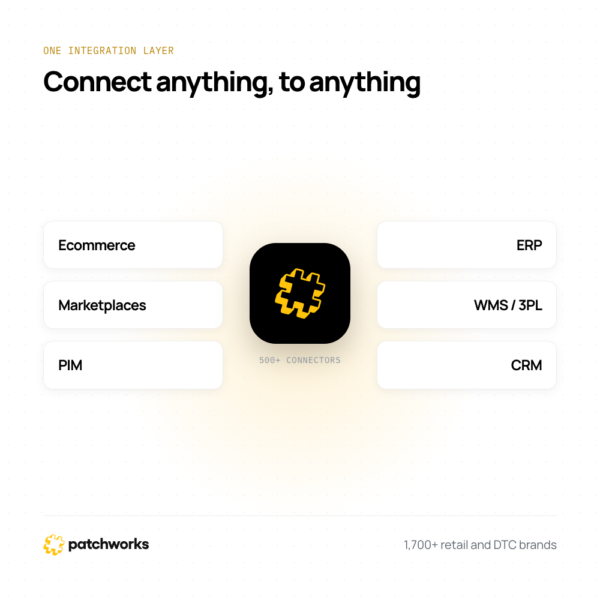
This is where an ecommerce ERP integration platform (iPaaS) earns its place. Rather than building and maintaining each connection as a bespoke development project, an integration platform acts as middleware: connecting your systems faster, cutting the development work required, standardising how integrations are built, and improving reliability through built-in monitoring and error handling.
Pre-built connectors are what actually accelerates this. Instead of starting from a blank page for every new system, you start from a connector that already understands how that ERP or ecommerce platform structures its data, and configure it to your specific setup.
Patchworks customer Castore, for example, runs a single warehouse and ERP integrated across 40+ stores through Patchworks, completed a full 3PL migration in eight weeks, and can now integrate a new brand website in around four hours. Mint Velvet processes 150,000 orders a year through its Shopify integration and 75,000 monthly sales across its combined Shopify and NetSuite setup: the kind of volume that simply isn’t viable to reconcile by hand. See how Patchworks handles this for the full picture of what this looks like in practice.
How to Choose the Right ERP Integration Approach
There’s no single correct answer here, it depends on your business. The factors worth weighing are speed of implementation, ongoing maintenance requirements, flexibility to handle non-standard workflows, scalability as your order volume grows, the internal technical resource you have available, and how the approach fits into your longer-term architecture plans rather than just solving today’s problem.
A good starting point, regardless of which ERP or ecommerce platform you’re running, is understanding what’s already available as a pre-built connector versus what would need custom development. You can browse our full library of ERP connectors to see what’s already built for the systems you’re running.
Frequently Asked Questions About ERP Integration for Ecommerce
What is ecommerce ERP integration?
Ecommerce ERP integration is the automated connection between an ecommerce platform and an ERP system, allowing orders, inventory, pricing, customer and financial data to move between them without manual data entry.
Why do ecommerce businesses need ERP integration?
Without it, businesses rely on manual data entry between systems, which doesn’t scale and introduces errors as order volume grows — leading to overselling, delayed fulfilment, and inaccurate financial reporting.
How long does ERP ecommerce integration take?
Timelines vary by complexity and the systems involved. Pre-built connectors and integration platforms typically implement in weeks; fully custom, bespoke integrations can take several months.
Can legacy ERP systems integrate with ecommerce platforms?
Yes. Most integration platforms are designed to handle legacy and heavily customised ERP systems — it typically affects the data-mapping work required rather than whether integration is possible at all.
What data should be synced between ERP and ecommerce systems?
Most integrations synchronise four categories of data: orders and transactions, inventory and stock levels, product and pricing information, and customer and fulfilment data.
Is ERP integration necessary for growing ecommerce brands?
As order volume, channels, or regions increase, manual processes that worked at small scale typically become the operational bottleneck. Integration is best treated as infrastructure to have in place before that happens, not after.
What is the difference between ERP integration and middleware?
Middleware is the underlying technology layer that moves and translates data between systems. ERP integration is the broader outcome — middleware (often via an integration platform, or iPaaS) is typically how that integration gets built.
Can small ecommerce businesses benefit from ERP integration?
Yes — the benefits (accuracy, time savings, reduced risk of overselling) apply at a smaller scale too, though the urgency tends to increase sharply once order volume or channel count grows.