TL;DR: NetSuite ecommerce integration connects your storefront to NetSuite so orders, inventory, customers and financial data move automatically between the two — infrastructure most NetSuite-run retailers need well before it starts to feel urgent.
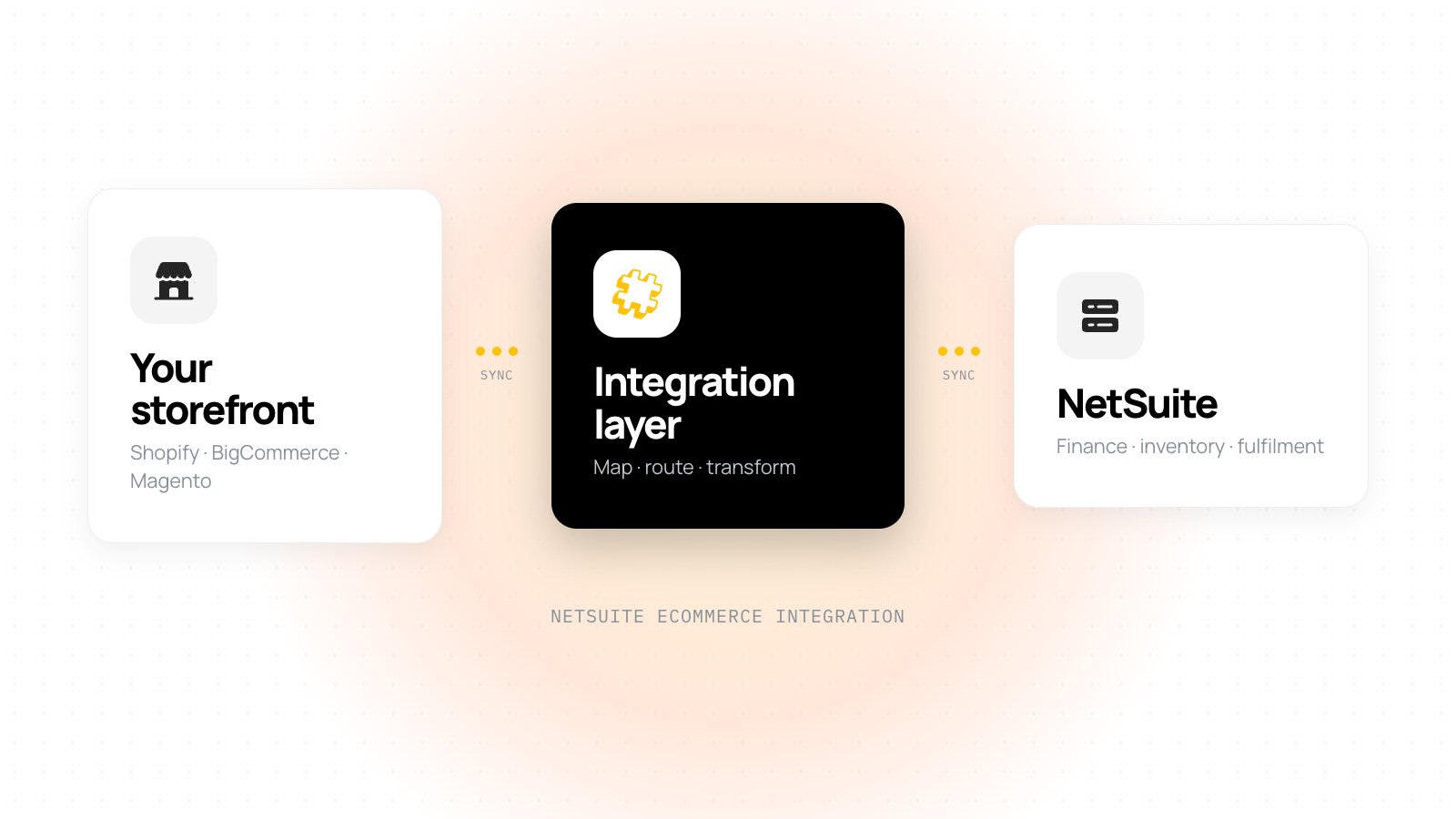
NetSuite ecommerce integration connects NetSuite with your ecommerce platform so operational data (orders, inventory, customers, financial information) moves automatically between the two, instead of someone moving it by hand. If NetSuite is your ERP, this is the connective tissue that keeps your storefront and your back office actually in sync.
The goal is straightforward: remove manual processes, improve data accuracy, and support ecommerce operations that can genuinely scale. Growing ecommerce brands, B2B businesses and companies managing multiple sales channels are usually the ones who reach for this first, typically once manual processes start visibly breaking down rather than before.
This guide covers what NetSuite ecommerce integration actually involves, how it works, what data typically moves between the two systems, and how to think about choosing the right approach.
What Is NetSuite Ecommerce Integration?
NetSuite acts as a central business management platform: finance, inventory, procurement and operational workflows typically all run through it. Your ecommerce platform manages the buying experience out front; NetSuite manages what happens once a sale is actually made.
Integration is simply the connection between the two. It’s what lets customer activity on your storefront trigger the right operational processes in NetSuite automatically, rather than someone bridging the gap by hand. NetSuite integration with Patchworks is built to do exactly this, using pre-built connectors rather than custom development for every new connection.
Why Businesses Integrate NetSuite With Ecommerce Platforms
The real drivers, more often than not: manual order processing, inventory discrepancies, disconnected reporting, delayed fulfilment, and customer service challenges caused by siloed data. None of these are dramatic on their own. They compound.
Jacuzzi Group is a good illustration of what that compounding looks like, and what fixing it involves: Jacuzzi Group connected NetSuite, Shopify and Slack through Patchworks after inventory syncing issues and slow returns had become a recurring operational headache. The result was fewer manual processes, real-time data synchronisation, and a noticeably better customer experience.
Framed as risk reduction rather than just efficiency, this is where our ecommerce and ERP integration solution is worth a look if you’re at the point of weighing this up seriously.
How NetSuite Ecommerce Integration Works
At a conceptual level, this isn’t complicated: systems communicate through APIs or through an integration platform, moving structured data rather than requiring deep custom engineering.
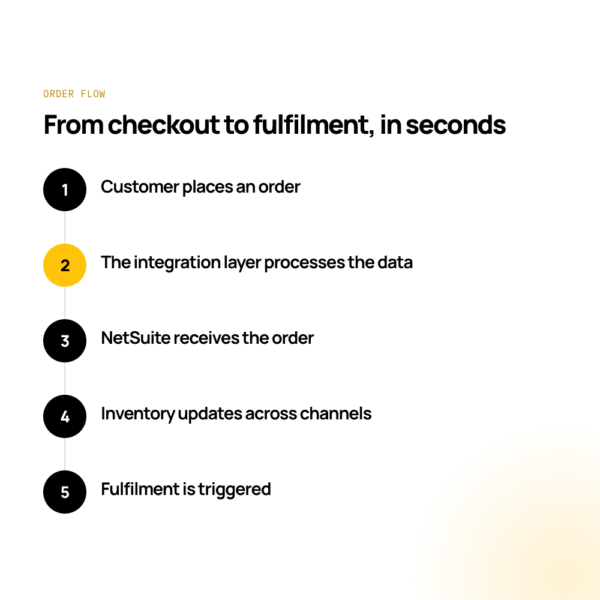
A typical flow: customer places order → your ecommerce platform sends the data → the integration layer processes it → NetSuite receives the order → inventory updates → fulfilment is triggered. Each step happens automatically, and in a well-built setup, within seconds.
How Data Flows Between NetSuite and Ecommerce Platforms
Integration typically involves bi-directional data movement: some data flows into NetSuite, some flows back out. Order data tends to move into NetSuite, while inventory and fulfilment data flows back out to your ecommerce platform, keeping both systems in agreement rather than drifting apart.
Common Integration Architectures
The main structural approaches are direct integrations, middleware, and native platforms. Understanding the landscape here is more useful than memorising the technical detail behind each one, since the right choice depends on your specific setup rather than which is theoretically superior.
Native vs Middleware vs Custom Integration Approaches
Native ecommerce platforms like SuiteCommerce, integration platforms (iPaaS), and custom API integrations each represent a different tradeoff. Our pre-built Shopify ↔ NetSuite Accelerator is a concrete example of the native/pre-built end of that spectrum, built specifically for this ERP-platform pairing rather than assembled from generic parts.
What Data Is Typically Synced Between NetSuite and Ecommerce Systems
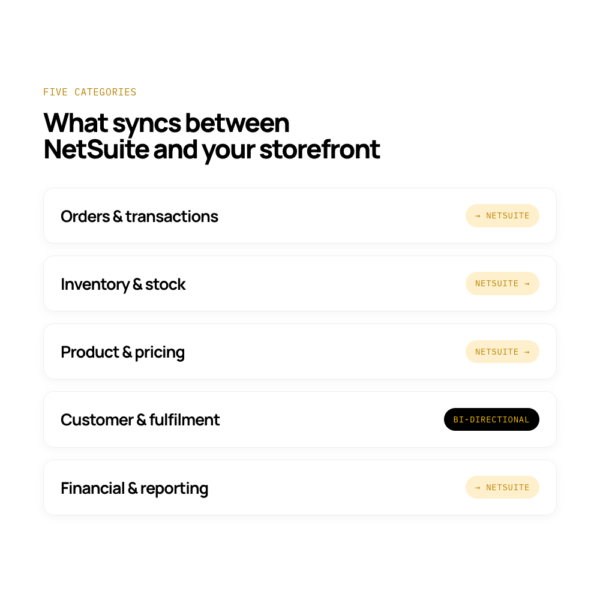
Successful integration depends on which operational data is synchronised, and in which direction. Most NetSuite ecommerce integrations focus on five categories:
| Data type | What typically syncs | Direction | Why it matters |
|---|---|---|---|
| Orders & transactions | Order ID, payment data, shipping details, tax calculations, order status | Ecommerce → NetSuite | Starts fulfilment and financial processing the moment an order is placed |
| Inventory & stock | Stock levels by SKU, by warehouse or location | NetSuite → Ecommerce | Prevents overselling by keeping storefront stock counts accurate in real time |
| Product & pricing | SKUs, pricing structures, product attributes | NetSuite → Ecommerce | Keeps listings consistent across every channel a product is sold on |
| Customer & fulfilment | Customer records, tracking numbers, shipping updates | Bi-directional | Improves support visibility and keeps shoppers informed automatically |
| Financial & reporting | Sales data, reconciliation records, accounting entries | Ecommerce → NetSuite | Keeps accounting and reporting numbers current without manual reconciliation |
Orders and Transaction Data
Orders are transferred into NetSuite for processing, fulfilment and financial recording: payment data, shipping details, tax calculations and order status all need to arrive accurately and without delay.
Inventory and Stock Availability
NetSuite often acts as the master inventory system, with updates flowing back out to your ecommerce platform. This matters most if you’re running multi-warehouse operations or selling across several channels, where it’s what actually stops you overselling.
Product Catalogue and Pricing Data
NetSuite may hold your master product records: SKUs, pricing structures, attributes. Syncing this keeps listings consistent across every channel rather than needing separate entry in each.
Customer and Fulfilment Information
Customer records and fulfilment updates move between systems to improve visibility: tracking numbers, shipping updates, and the kind of support visibility that lets an agent actually answer a status question without switching tools.
Financial and Reporting Data
Integration connects sales and accounting data, improving reconciliation and reporting accuracy. The month-end process gets noticeably less painful once this is automated rather than manual.
Key Benefits of NetSuite Ecommerce Integration
Framed around business impact rather than software features: reduced manual work, improved data accuracy, operational scalability, improved fulfilment speed, and better decision-making visibility.
Operational Efficiency Improvements
Integration reduces manual workflows and the internal process friction that comes with them, freeing up time your team would otherwise spend on data entry rather than the work that actually needs a person.
Improved Inventory Accuracy
Real-time stock updates improve reliability across every channel you sell on, removing the drift that builds up when systems aren’t actually talking to each other.
Faster Order Processing
Automation improves order-handling speed, meaning your fulfilment team can act the moment an order is placed rather than waiting for someone to transfer the data across.
Scalability for Growth
Integration supports expansion into new markets, new channels and higher order volumes. It’s infrastructure worth having in place before you need it, not scrambled together once you do.
Better Business Visibility
Unified reporting improves forecasting and planning. You’re working from numbers that reflect what’s actually happening right now, not what was true last week.
NetSuite Ecommerce Integration for B2B Businesses
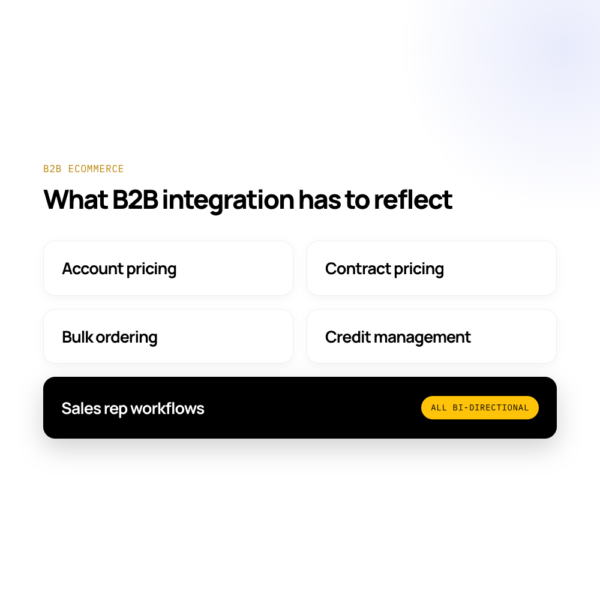
B2B ecommerce typically requires deeper ERP integration than B2C: account pricing, contract pricing, bulk ordering, credit management and sales rep workflows all need to be reflected accurately and consistently between systems.
B2B distributor ISG demonstrates this well: connecting BigCommerce, NetSuite and HubSpot through Patchworks to run 22 automated workflows processing more than three million operations in a single quarter, across three separate storefronts. That’s the kind of complexity B2B integration is actually solving for.
Common Challenges With NetSuite Ecommerce Integration
Worth acknowledging realistically: legacy NetSuite configurations, data mapping challenges, workflow customisation, and ongoing integration maintenance are all genuine planning factors, not just theoretical risks.
- Do get your data mapping right before you build. Most delays trace back to a field meaning something different in NetSuite than it does in your ecommerce platform, not to the integration technology itself.
- Don’t assume a heavily customised or older NetSuite instance rules out integration. It usually just changes how much mapping work is involved, not whether the integration is possible.
NetSuite Ecommerce Integration Solutions and Tools
The main categories are integration platforms, connector tools, integration partners, and custom development. Pre-built connectors are generally the fastest route in: our Connector Builder is a good example of the tooling that sits behind this, letting you build custom connectors without writing code from scratch.
NetSuite Ecommerce Integration Pricing Considerations
Pricing depends on complexity, which systems are involved, customisation needs and ongoing maintenance. As a general rule, pre-built connectors and accelerators cost meaningfully less than fully bespoke integrations, though the right answer depends on how standard your NetSuite configuration actually is.
How to Choose the Right NetSuite Ecommerce Integration Approach
Worth evaluating against: business size, operational complexity, future growth plans, internal technical resource, and the tradeoff between implementation speed and flexibility. See how Patchworks compares to generalist platforms like Boomi if you’re weighing platform options directly. Celigo is another platform that often comes up in the same conversation, worth including in your evaluation alongside Boomi rather than assuming there’s a single obvious choice.
When Businesses Should Consider NetSuite Ecommerce Integration
Common triggers: rapid growth, manual processes visibly breaking down, multi-channel expansion, and operational complexity that keeps increasing regardless of how many people you throw at it. None of these are subtle once they’re actually happening.
Frequently Asked Questions About NetSuite Ecommerce Integration
How long does NetSuite ecommerce integration take?
Timelines depend on complexity and the ecommerce platform involved. Pre-built connectors and accelerators typically implement in weeks; fully custom integrations can take several months.
What ecommerce platforms integrate with NetSuite?
NetSuite integrates with most major ecommerce platforms, including Shopify, BigCommerce and Magento, typically through pre-built connectors or an integration platform.
What data should be integrated with NetSuite?
Most integrations synchronise five categories of data: orders and transactions, inventory and stock, product and pricing information, customer and fulfilment information, and financial and reporting data.
Is NetSuite ecommerce integration expensive?
Cost depends on complexity, the systems involved, and customisation requirements. Pre-built connectors and accelerators are generally more cost-effective than fully bespoke development.
Do growing ecommerce businesses need NetSuite integration?
As order volume, channels or regions increase, manual processes that work at a smaller scale typically become the operational bottleneck. Integration is best treated as infrastructure to have in place before that happens, not after.