Key findings at a glance
Integration now decides how fast a retailer can launch, how well it survives peak trading, and whether it can put AI to work at all. Yet most UK retailers are still running systems that only partly talk to each other.
In August 2025, Patchworks commissioned OnePoll to survey 200 UK retail leaders who make technology decisions. The results show most retailers part-way to a fully connected stack, and paying for the gap.
- 27% of UK retailers describe their integration setup as fully connected and scalable, the third of four stages of integration maturity.
- 37% say they are mostly connected: close to scalable, but not there yet.
- Half of UK retailers lost £10,000 or more to disconnected systems in the past 12 months.
- 48% of UK retailers rely on temporary manual workarounds to get through peak trading.
- 13% of UK retailers have already moved to an integration platform as a service (iPaaS).
Connected and scalable
27% UK retailers describe their integration setup as fully connected and scalable
Mostly connected
37% of UK retailers describe their integration setup as mostly connected: close to scalable, but not there yet.
Lost £10,000 or more
Half of UK retailers lost £10,000 or more to disconnected systems in the past 12 months.
What is an integration maturity model?
An integration maturity model is a framework for measuring how well a business’s systems share data. It runs from fully siloed platforms at one end to automated, real-time operations that AI agents can safely work with at the other. For retailers, it answers three practical questions: where are we today, what is our current stage costing us, and what does the next step look like?
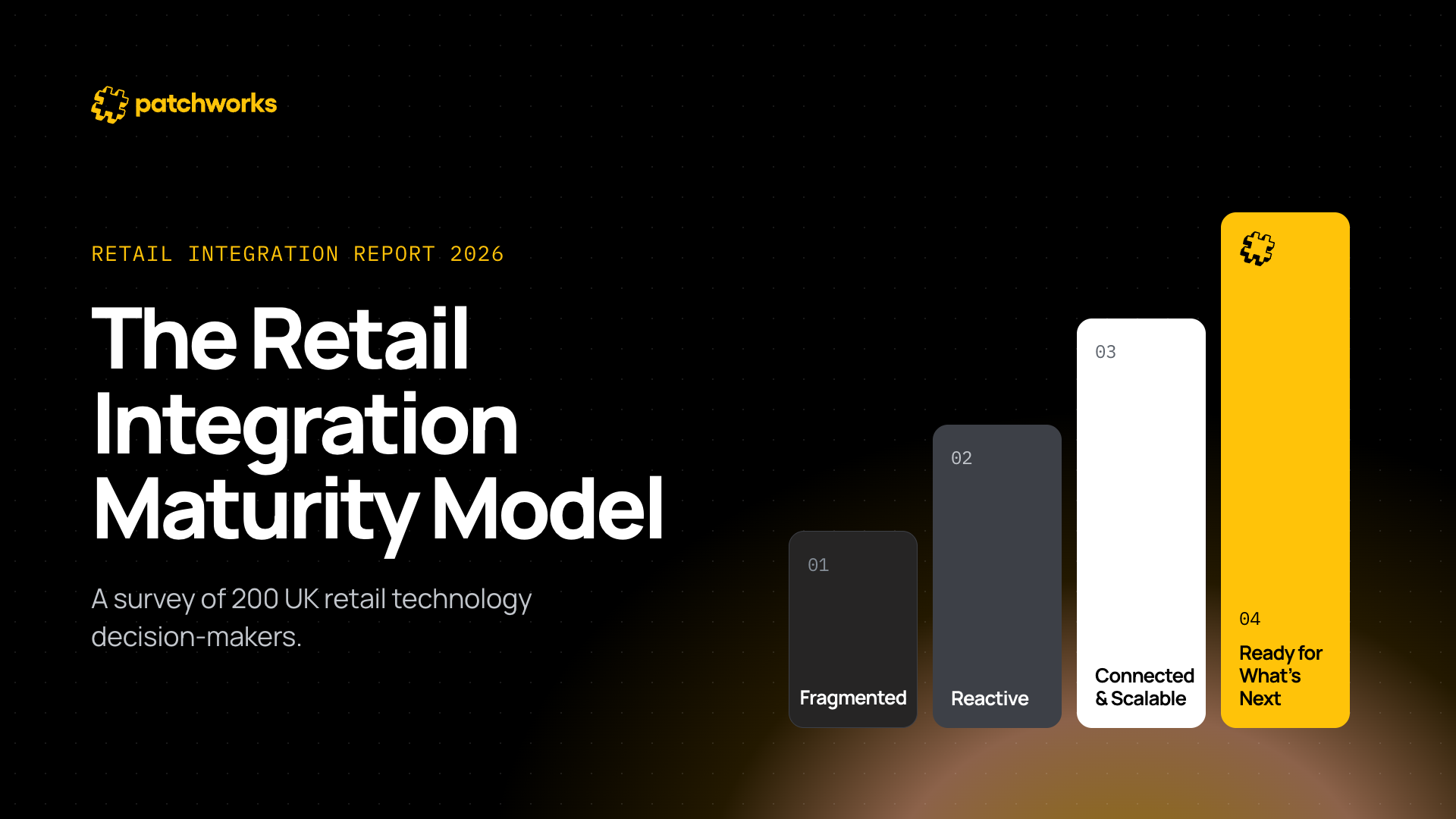
The Patchworks retail integration maturity model has four stages. Each is defined by how data moves between core retail systems (ecommerce, ERP, POS, CRM, order management and warehouse) and by how much of the team’s time goes on keeping those connections running.
| Stage |
What it looks like
|
Share of UK retailers |
|---|---|---|
| 1. Fragmented |
Siloed systems, little or no integration, data re-keyed by hand
|
10% (outdated 4%, limited 6%)
|
| 2. Reactive |
Ad-hoc point-to-point connections; IT fixes issues as they arise
|
24% (partially connected)
|
| Between 2 and 3 |
Mostly connected, with gaps that show at peak or launch
|
37% (mostly connected)
|
| 3. Connected & Scalable |
Stable integrations, streamlined processes, growth-ready operations
|
27% (fully connected and scalable)
|
| 4. Ready for What’s Next |
Automated, self-regulating stack; the threshold for agentic commerce
|
Not yet reached by any respondent.
|
Stage 1: Fragmented
At the fragmented stage, systems and data are completely siloed. The ecommerce platform, ERP, warehouse and POS each hold their own version of the truth, and moving information between them means exports, spreadsheets and re-keying. One in ten UK retailers are here, describing their integration as outdated (4%) or limited (6%).
Typical signs: stock levels that disagree between channels, orders that need checking by hand before they can be fulfilled, and month-end reconciliation that takes days.
The next step: map every place data is moved manually, then connect the highest-volume flow first. For most retailers that is orders moving from the ecommerce platform into the ERP or warehouse.
Stage 2: Reactive
Some systems are connected, but through point-to-point integrations built one at a time: a plug-in here, a custom script there. They work until something changes, such as a platform update, a new marketplace or a spike in order volume. IT teams spend their time fixing breaks as they happen rather than improving processes. 24% of UK retailers describe themselves as partially connected, and a further 37% as mostly connected: past the worst of the reactive stage, but not yet scalable.
Typical signs: a growing backlog of integration fixes, one or two people who understand how everything is wired together, and nervousness every time a vendor ships an update.
The next step: replace individual connections with a single integration layer that can be monitored, reused and changed without rebuilding.
Stage 3: Connected & Scalable
Integrations are stable, processes are streamlined, and the business can add a channel, warehouse or market without rebuilding its stack. Data moves in near real time and teams know when something fails. Only 27% of UK retailers describe their setup as fully connected and scalable.
Typical signs: new channels launched in weeks rather than months, peak trading planned rather than survived, and every team working from the same live data.
The next step: make the connected data layer available to automation and AI, with permissions, monitoring and governance in place from the start.
Stage 4: Ready for What’s Next
The fourth stage is the threshold for agentic commerce. The stack is not only connected but largely self-regulating: workflows run end to end, issues are detected and resolved with minimal human input, and AI agents can safely query and act on live operational data. No retailer in the survey described their stack this way yet; the 27% at stage three are best placed to get there first.
Typical signs: AI assistants that can check order status, retry failed syncs or flag stock risks across systems; new integrations built from plain-English instructions; and clear controls over exactly what automated systems are allowed to do.
The next step: see the agentic commerce chapter below.
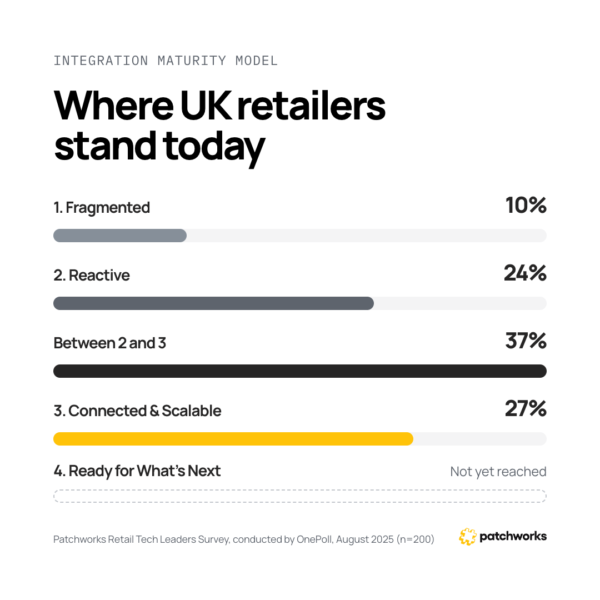
Where UK retailers stand today
Integration maturity is not an abstract score. In the survey, the stage a retailer has reached maps directly to money lost, time spent firefighting and the experience customers receive.
The cost of poor integration
Asked how much revenue disconnected or poorly integrated systems had cost them in the past 12 months:
- 60% of UK retailers report losses caused by integration issues.
- 50% lost £10,000 or more.
- 33% lost more than £50,000.
- 14% lost more than £500,000.
- 8% lost more than £1 million.
These losses come from slow launches, inflated operating costs and the inability to respond when the market shifts. Fixes tend to be temporary, which creates a cycle of manual survival that erodes margin year after year. We break down where the money goes in the hidden cost of poor integration.
Three roadblocks holding retailers back
#1: The time and resource trap. Small teams usually know what they want integration to achieve, but it is the first thing deprioritised when an urgent problem lands. As David Webster of Bollin Group put it: “We are a small team and though we know what we want to achieve, we have to keep putting integrations down when something more urgent comes along.”
#2: The third-party tug-of-war. Effective integration is rarely just about connecting APIs. Technology leaders have to juggle change requests, deployment schedules, updates and the competing roadmaps of several software vendors at once.
#3: System multiplicity. Fragmentation leads to tech bloat. Mark Lee of Bentley Gift described running three systems to support four ecommerce platforms for listings, inventory control and shipping, because no single system ties them together.

A wider pattern: beyond the UK
The figures in this section come from third-party research, not the Patchworks survey. We include them because they show the same pattern in larger markets.
KPMG research found that only 28% of retailers have achieved system-level data integration. That is almost identical to the 27% of UK retailers in our survey who describe their setup as fully connected and scalable.
Meanwhile, the volume of trade flowing through those systems keeps climbing. US ecommerce sales passed $340 billion in the second quarter of 2026, more than 17% of all US retail sales, and Shopify processed around $378 billion in gross merchandise volume across 2025.
Two independent studies in two markets reach the same conclusion: roughly three in four retailers are not yet running fully connected systems, even as the amount of commerce depending on those systems grows.
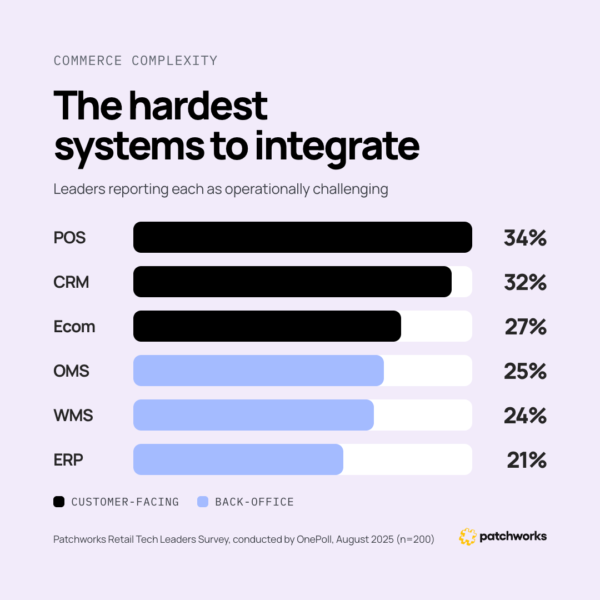
Commerce complexity and the red flags of poor integration
Front-end and customer-facing systems are proving harder to integrate than back-office functions. They change more often, come from a wider range of vendors and sit closest to the customer when something goes wrong.
| System |
Leaders reporting it as operationally challenging to integrate
|
|---|---|
| Point of sale (POS) |
34%
|
| Customer relationship management (CRM) |
32%
|
| Ecommerce platforms |
27%
|
| Order management systems (OMS) |
25%
|
| Warehouse management systems (WMS) |
24%
|
| Enterprise resource planning (ERP) |
21%
|
The red flags retail leaders spot first
What starts as a minor sync issue can quickly become a business-wide problem. Retail leaders named three signals that their systems are not connecting as they should:
- Frequent order errors, flagged by 23% as a top signal of poor integration.
- Poor customer experience, flagged by 20%. Shoppers notice when orders and transactions lack visibility.
- Lack of visibility across systems, flagged by 18%, leading to slow fulfilment and inaccurate inventory.
Peak trading: the ultimate stress test
Black Friday and Cyber Monday should be the biggest revenue opportunity of the year. For 42% of UK retail technology leaders, the risk of downtime keeps them awake during peak instead. Peak is when integration weaknesses become impossible to hide.
- 58% fear poor system performance at peak will damage their reputation with customers.
- 48% rely on manual fixes and workarounds to survive busy periods.
- 40% say peak trading pushes their systems to breaking point.
- 43% believe a single surge could halt their business altogether.
- 39% say development resource goes on manual integration work rather than maximising peak.
- 31% already lose measurable revenue during peak periods.
The stakes keep rising. In the US, shoppers spent $11.8 billion online on Black Friday 2025 and Cyber Monday 2025 generated $14.25 billion, the biggest online shopping day of the year. Across retailers more broadly, 73% generate at least 20% of their annual revenue during the holiday period.
For a practical, system-by-system preparation plan, see the ecommerce peak resilience checklist.
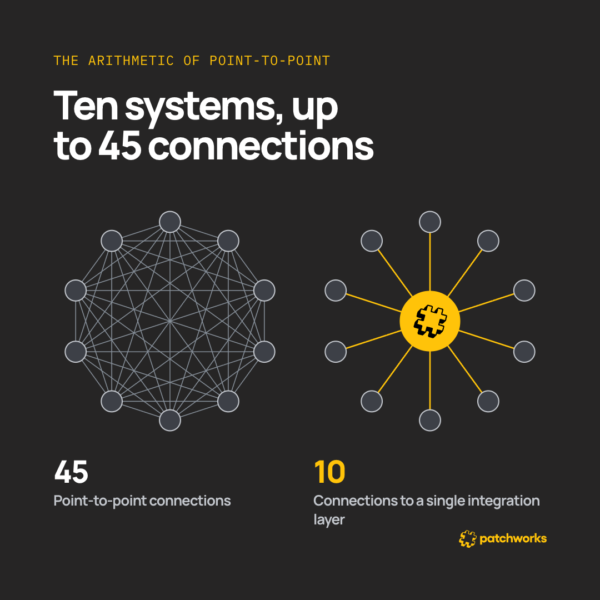
Why legacy integration approaches are hitting a ceiling
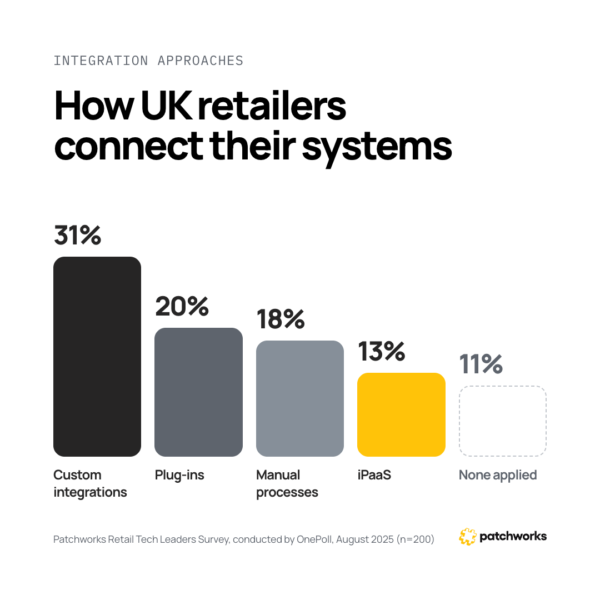
As retailers add channels, markets and systems, the integration methods that got them started begin to hold them back. The survey shows how UK retailers connect their systems today:
- 31% use custom integrations, which consume significant in-house or third-party developer time to build and maintain.
- 20% use plug-ins, which rarely work cleanly across more than one system.
- 18% rely on manual processes and hand-coded workarounds.
- 11% said no integration approach applied to their business at all.
The underlying problem is arithmetic. With point-to-point integration, every new system needs its own connection to every system it shares data with. Ten systems can mean up to 45 separate connections, each with its own failure points, update cycle and maintenance cost. That is why the second stage of the maturity model is so hard to leave: every fix adds to the web that needs fixing next time.
The pressure shows up most in the flows that carry the most volume: connecting ecommerce and ERP for orders, stock and finance, and orchestrating fulfilment across warehouses and 3PLs.
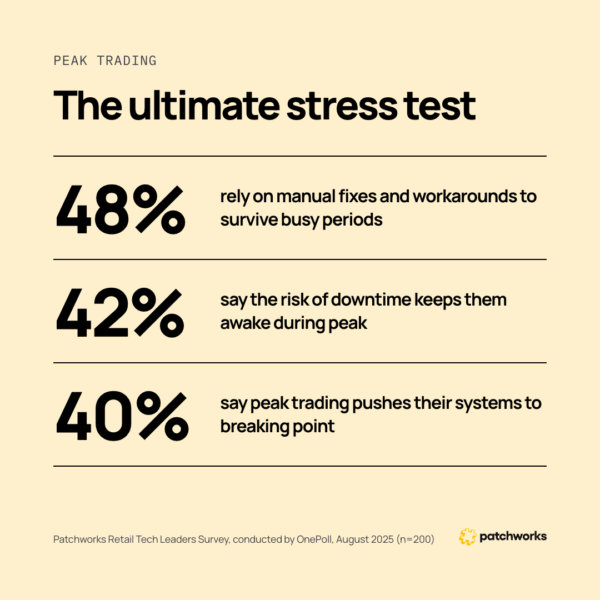
Peak Trading: The Ultimate Stress Test
Periods like Black Friday/Cyber Monday (BFCM) should be a golden opportunity, but for 42% of retail tech leaders, they are a source of “sleepless nights”. Peak trading is when integration weaknesses are most obvious.
- Reputational Risk: 58% fear poor system performance during peaks will damage their reputation with customers.
- System Failure: 43% believe a single surge could halt business altogether.
- The Firefighting Cycle: 39% of teams spend more time firefighting integrations than optimising seasonal highs.
- Survival Workarounds: 48% rely on temporary manual workarounds just to survive sales spikes.
The iPaaS shift
An integration platform as a service (iPaaS) replaces individual point-to-point connections with a single, cloud-hosted layer. It connects every system, handles data mapping and transformation, and monitors every flow in one place. 13% of UK retailers have already made the switch.
Why flexibility outweighs cost
When choosing an integration approach, UK retailers ranked their priorities clearly:
- 48% prioritise flexibility across platforms.
- 38% prioritise long-term cost reduction.
- 35% prioritise real-time visibility.
That order matters. Retailers are not primarily looking to spend less on integration; they want to stop integration from limiting what they can do next.
What changes when retailers move to iPaaS
- Faster deployment. Pre-built, reusable connectors replace one-off builds, so adding a system becomes configuration rather than a project.
- An end to the black box. Dashboards give teams direct visibility and control, instead of relying on opaque vendor-managed connections.
- More reliable operations. Operations and customer service teams work from complete, real-time information, so they can respond to customers faster.
- Room to scale. Retries, error handling and monitoring are built in, which is what keeps flows running when order volumes spike.
If you are weighing up options, our overview of how iPaaS platforms compare.
What’s next: agentic commerce
Integration and automation are converging into what the industry now calls agentic commerce. It is the clearest example of why the fourth stage of the maturity model matters.
What is agentic commerce?
Agentic commerce is retail in which AI agents, rather than people, carry out tasks: discovering, comparing and buying products on a shopper’s behalf, or running operational workflows on a retailer’s behalf. Unlike chatbots, which answer questions, agents make decisions and take actions across systems.
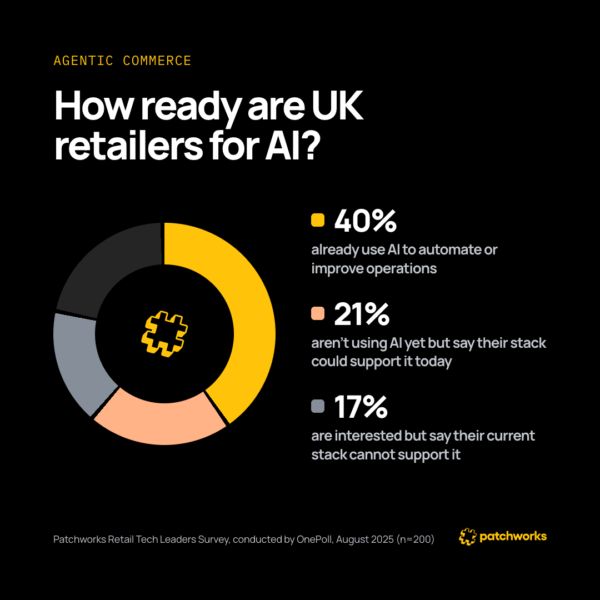
How ready are UK retailers?
- 40% of UK retailers already use AI to automate or improve operations.
- 21% aren’t using AI yet but say their tech stack could support it today.
- 17% are interested in AI but say their current stack cannot support it.
Outside the UK, the readiness gap looks similar. Amperity research found that only 11% of retailers believe they are fully prepared to scale AI across the business.
Why integration comes first
An AI agent can only act on the data it can reach. If order, stock and customer data sit in disconnected systems, an agent will either fail or act on an incomplete picture, and it will do so at machine speed. That is why the infrastructure gap matters more than the AI itself. For the 17% who want AI but say their stack can’t support it, and for many of those already experimenting in pockets, the blocker is integration rather than AI.
What the forecasts say
- Deloitte projects that 25% of enterprises using generative AI will deploy autonomous agents in 2025, rising to 50% by 2027.
- Gartner predicts that by 2029, agentic AI will autonomously resolve 80% of common customer service issues, cutting operational costs by 30%.
- Morgan Stanley estimates that AI shopping agents could add more than $100 billion in incremental US ecommerce value.
Agentic commerce readiness checklist
- Do connect core systems through a single integration layer before piloting agents. Don’t give agents direct access to each system one by one.
- Do define exactly which actions an agent is allowed to take. Don’t grant broad write access and hope for the best.
- Do log and monitor every automated action. Don’t deploy agents you can’t audit after the fact.
- Do start with operational use cases such as order triage and stock alerts. Don’t start with fully autonomous customer-facing purchasing.
From the Patchworks team: what stage four looks like in practice
in 2026, Patchworks launched AI Studio, starting with an Implementation Agent that builds process flows, maps data and creates connectors from plain-English prompts. It has since expanded into AI Agents that automate integration workflows, Custom Agents with user-defined guardrails, and an MCP Server that lets AI assistants such as ChatGPT, Claude and Gemini query and act on live integration data under defined permissions.
Hosiery brand Snag shows what that means in practice. Using the Patchworks MCP Server, Snag ran an AI agent that integrated six Shopify stores with ten systems, including Sage 200, Linnworks and ShipBob, in eight days.
Conclusion: integration as a strategic catalyst
The survey makes one thing clear. Integration is no longer a back-office IT project; it decides how fast a retailer can launch, how well it handles peak, and whether it can put AI to work at all.
Most UK retailers are still in the first two stages of the maturity model, and they are paying for it in lost revenue, manual workarounds and teams stuck firefighting. The choice every retail technology leader faces is the same: keep working around the stack, replace parts of it, or modernise the layer that connects it. The brands at stages three and four chose to modernise, and they are the ones ready for whatever comes next.
Survey methodology
The findings in this report are based on an independent online survey conducted by OnePoll on behalf of Patchworks in August 2025. It captured responses from 200 UK retail managers and leaders who make technology decisions, across a mix of business sizes and sectors including grocery and food, fashion, beauty, home, consumer electronics and multi-category retail. Figures attributed to other organisations come from their own published research and are not part of the Patchworks survey.
About Patchworks
Patchworks is a retail-focused integration platform (iPaaS) trusted by more than 2,000 brands. It connects ecommerce, ERP, WMS, 3PL, marketplace, PIM and CRM systems through a single platform, and is Shopify’s only Certified Technology Partner for integrations. Its AI Studio lets teams build and manage integrations with AI agents and connect AI assistants to live commerce data via MCP.
Which stage of integration maturity are you at?
Answer 14 questions to place your business on the four-stage retail integration maturity model, see how you compare with 200 UK retail technology leaders, and get your top three priorities. Takes about five minutes.
Loading questions. If they don’t appear, scripts are being blocked or delayed on this page.