Summary
At Gartner IT Symposium/Xpo in Barcelona (9–12 November 2026), I expected to hear a lot about AI. I did. What I didn’t expect was how often the conversation came back to integration: the unglamorous plumbing that decides whether any of that AI ambition actually works.
The short version is this. AI is only as good as the data it can reach, and getting AI-ready data to your agents is an integration problem. Between the sessions and conversations at the event, four themes kept coming up. Some confirmed what we’ve been building at Patchworks. Others were a useful challenge.
Key takeaways
- AI is only as good as the data it can reach. AI agents need live, accurate access to orders, inventory and customer data, and in retail much of that still sits in systems with no API or MCP server.
- Go-live is the start, not the finish. Integrations spend far longer running than being built, so observability, control and maintenance now matter more than build speed.
- Where your data runs is a buying decision. Enterprises, especially in Europe, want control over where integration runtimes, data and AI models run.
- Buyers choose vendors, not platforms. With iPaaS features converging, buyers decide on proof: references, support performance and customer satisfaction.
What is AI-ready data, and why does it depend on integration?
AI-ready data is data an AI system can trust and reach at the moment it needs it. Most definitions focus on quality and governance, and those matter. But for AI agents that take action in retail, readiness also means the data is live, connected across systems and accessible through governed interfaces such as APIs and the Model Context Protocol (MCP).
Every conversation I had about agents ended up in the same place: the data. An agent that can’t see accurate orders, inventory and customer records in real time isn’t much use, however capable the model behind it. Gartner made a similar point in a February 2025 prediction: through 2026, organisations will abandon 60% of AI projects that aren’t supported by AI-ready data.
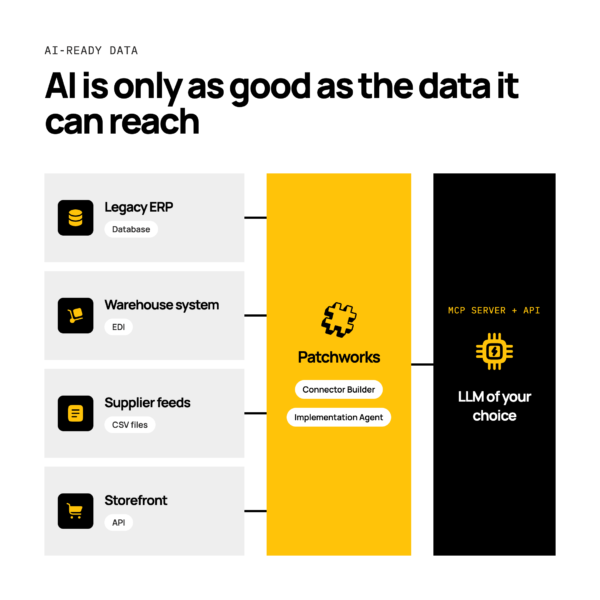
There’s a retail-specific wrinkle too. The data behind critical business decisions often lives in legacy systems: an ERP that’s been in place for 15 years, a warehouse system that talks EDI, a supplier that still sends CSV files. These systems rarely have MCP servers, and many don’t have modern APIs either. If your agents can only see the systems that come with AI integrations built in, they’re working from part of the picture.
How do AI agents connect to retail systems?
This is why we’ve put connector creation and flow creation in the hands of the user. With Connector Builder, you can connect to anything with an API, a database or a file system, including EDI and CSV. The Implementation Agent then builds the flows, and the Patchworks MCP server exposes them to the large language model (LLM) of your choice, whether that’s ChatGPT, Claude or Gemini.
As a MACH Alliance certified platform, Patchworks also makes all of this available via API. You can work from your own tools, and even extend the MCP server with the tools needed to reach systems that have no AI integration of their own.
It’s an approach that’s already working in retail. Patchworks connects Snag’s commerce and operational systems, giving its team a practical foundation for AI. You can see more in the Snag story and our AI in Retail guide.
Why deterministic integration keeps AI costs down
I believe 2027 will be the year iPaaS answers the integration part of AI orchestration. Moving and transforming data is a deterministic job: the same input should produce the same output, every time. Asking an LLM to poll systems, map fields or reconcile records burns tokens and adds risk. Let integration handle the data movement, and save agents for the decisions that need judgement.
AI cost came up again and again in Barcelona. Among the predictions Gartner published from the event: by 2029, 60% of organisations deploying AI will set up a dedicated function to map AI’s total cost to value. Deterministic integration that uses minimal tokens is one of the simplest ways to keep that equation healthy.
DO / DON’T
- Do give AI agents governed, real-time access to retail data through your integration layer.
- Do connect legacy systems through their database or file exchange when there’s no API.
- Don’t ask an LLM to fetch or reconcile data it could receive deterministically.
- Don’t build agent workflows that can only see systems with native AI integrations.
For a practical starting point, our guide ‘Is your retail stack agent-ready?’ walks through the checks.
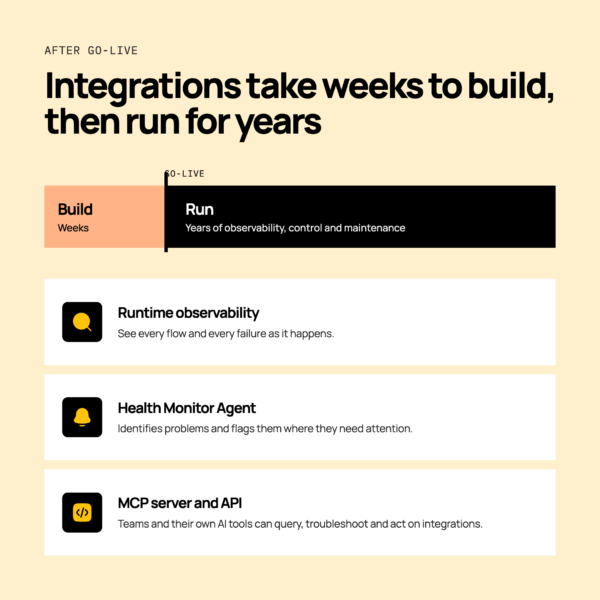
Why does what happens after go-live matter more than build speed?
Integrations take weeks to build and then run for years. What retailers live with is everything after launch: whether they can see what’s happening, spot a problem before their customers do, fix it quickly and change things without calling in a developer.
This was the point that challenged me most. iPaaS has always been sold on speed: how quickly can you connect your storefront to your ERP and go live? We’ve made that case ourselves many times. Blinc, for example, migrated to Patchworks in under two weeks.
But a view I heard repeatedly at the event was that the run side of the job (observability, control and maintenance) now matters more than build speed. I think that’s right, and it gets more urgent as AI agents start acting on integrated data. Gartner predicts that over 40% of agentic AI projects will be cancelled by the end of 2027 because of escalating costs, unclear business value or inadequate risk controls. Agents acting on data nobody is watching is exactly the kind of risk that sinks projects.
At Patchworks, we answer this with:
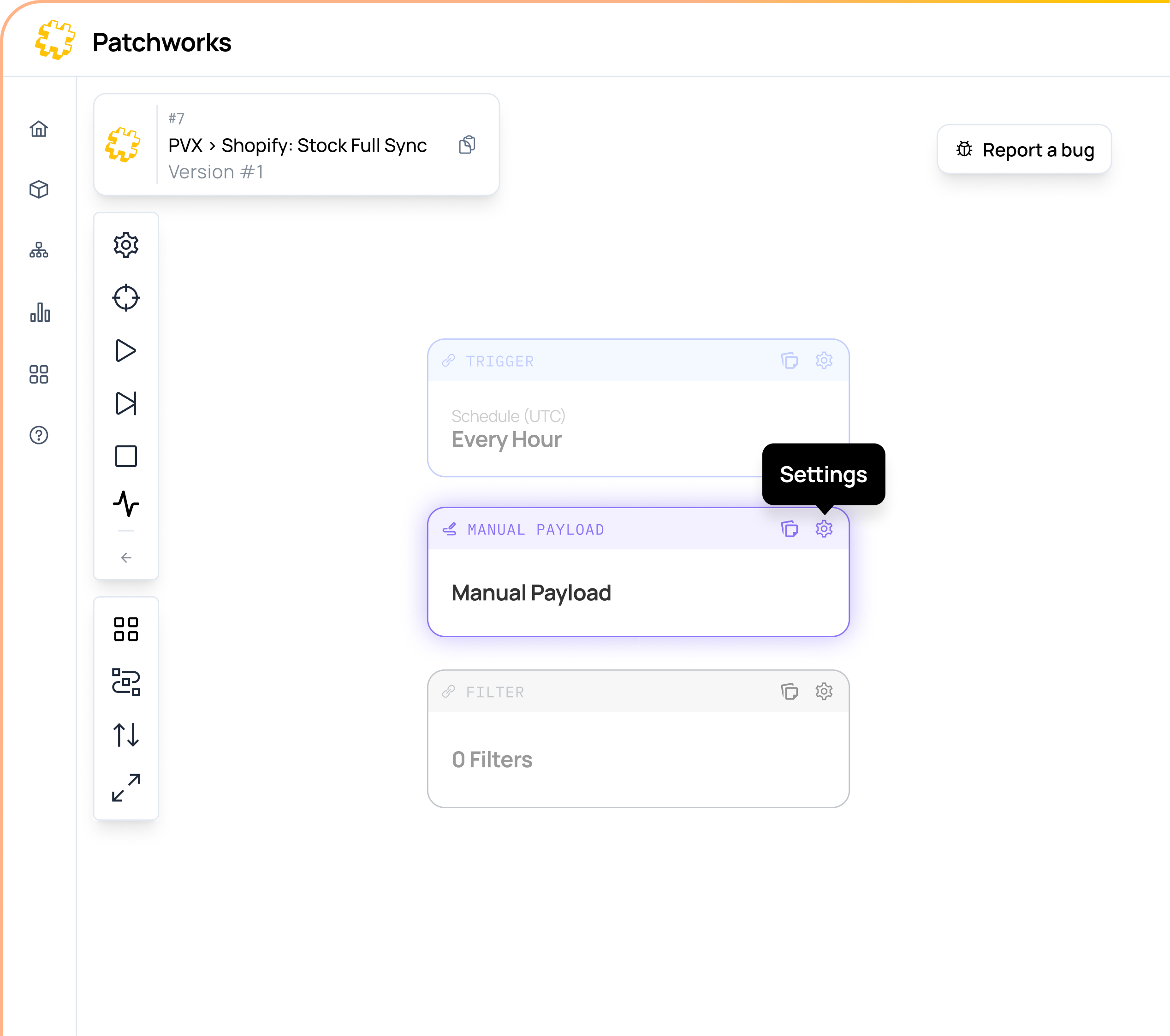
- Runtime observability, so teams can see every flow and every failure as it happens.
- The Health Monitor Agent, which identifies problems and flags them where they need attention.
- The Patchworks MCP server and API, so teams and their own AI tools can query, troubleshoot and act on integrations.
Some customers have gone further, embedding failed flows into Slack or Microsoft Teams so their teams can fix the data there and restart the flow without leaving the conversation.
From tools people operate to integration that runs itself
The longer-term view goes further. Today’s integration stack is a set of tools that people operate. Over the rest of the decade, it becomes something that largely runs itself, within rules people set. That’s where AI really earns its place in integration: not only building flows faster, but keeping them healthy. Strong integration monitoring and AI agent observability are what make that autonomy safe to hand over.
Why is data sovereignty becoming a buying decision?
Large enterprises, especially in Europe, increasingly want control over where their integration runtime and data sit: in their own data centres, or at least their own region. They’re asking the same of AI. Which models touch our data, and where do they run?
I heard this most strongly in European conversations, retailers included. Data sovereignty used to be a procurement checkbox. It’s becoming a deciding factor. Gartner’s top strategic technology trends for 2026 point the same way: by 2030, it predicts more than 75% of European and Middle Eastern enterprises will geopatriate their virtual workloads into solutions designed to reduce geopolitical risk, up from less than 5% in 2025.
For integration, data residency has to cover the whole chain: the integration runtime, the data passing through it and the AI agents acting on it. That’s why we host our AI agents in the same datacentre as our core platform, and why we offer self-hosting to enterprises that need Patchworks capabilities inside their own environment.
Why do buyers choose vendors, not platforms?
Most iPaaS platforms now offer broadly similar features, and buyers know it. What separates vendors is the experience of working with them: how the sales process feels, how good the support is and what existing customers say.
This was one of the bluntest observations of the week, and it’s a challenge for every vendor, us included. Buyers want proof. Another feature list won’t do it. So rather than tell you our platform is the best, here’s the evidence we’ll be talking about more:
- An NPS of 70 from our latest customer campaign
- 100% CSAT scores
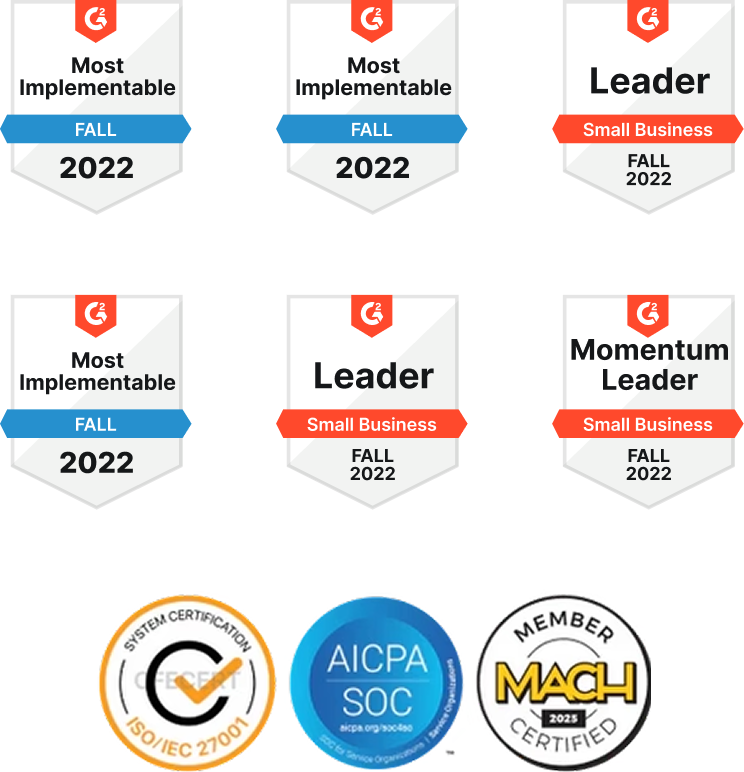
- Independent reviews on G2
- Customer case studies from retailers and brands
Patchworks is engineered to deliver an excellent experience, and that’s not just the software.
What this means for retailers heading into 2027
The common thread is that AI raises the stakes for integration. The businesses that get the most from agents will be the ones whose systems already talk to each other reliably, keep doing so without constant attention, and can make that data available to LLMs.
New capabilities such as custom agents in AI Studio will also help our customers with the data operations side of the business: automating more and giving their teams a better experience.
Five questions to ask of your integration layer
- Can your AI agents reach live order, inventory and customer data?
- Can you connect systems that have no API or MCP server?
- Can you see and fix integration failures before customers notice?
- Do you control where your data, integration runtime and AI models run?
- Can your integration vendor prove its service with customer evidence?
If you were in Barcelona too, or you run integration for your business, I’d like to hear what you’re seeing. Is the conversation shifting from how fast you can build to how well things run?