Executive Summary
- Client: Snag (Snag Tights) — a size-inclusive, direct-to-consumer hosiery and apparel brand.
- Sector: DTC Fashion & Apparel.
- The Challenge: A sprawling, multi-region tech stack — six live Shopify stores, five warehouse management systems (WMS), a product lifecycle/information management platform with no AI connector on its roadmap, and a dozen-plus advertising catalogues — that Claude’s native MCP connectors could only partially control before hitting vendor-imposed API limits, multi-account re-authentication overhead, and LLM context-window bottlenecks.
- The Solution: Deploying Patchworks as the orchestration layer between Claude and Snag’s core systems — exposing platforms with no native MCP support, and offloading heavy data operations out of the LLM’s context window while keeping Claude in full conversational control.
- Implementation: Built and self-managed by Snag’s own technology team, using Patchworks’ platform and AI agent to stand up new connectors and flows.
- Systems: Airtable, Amazon S3, AWS Translator, Carbone, Centric, Evri WMS, Inventory Planner, Linnworks Plytix, Purple Dot, Shipbob, Shopify (21 x instances), Claude
Key Results:
- 10–12 self-built connectors linking Shopify, a PIM/PLM platform, a WMS, and finance systems into Claude’s reach — most live within hours, the most complex in two days.
- 14,000+ products updated in a single operation after unlocking Shopify’s Bulk Operations API through a Patchworks-orchestrated flow — cutting jobs that took hours down to minutes.
- One of the fastest product launches to date — from concept to live in around two weeks — using Claude and Patchworks together.
- A single, natural-language-triggered flow now syncs products across all six Shopify storefronts, applying transformations and market-specific changes on demand.
- Zero traditional consultancy or front-end development spend to stand up new automated business processes.
Introduction: Scaling a Size-Inclusive Fashion Brand Across 100+ Countries
Snag was founded in 2018 on a simple premise: tights that actually fit the person wearing them, in every size. That premise has since grown into a global, size-inclusive fashion brand shipping tights, leggings, underwear, and clothing to customers in more than 100 countries, with the UK, Germany, the US, Canada, Australia, and New Zealand among its largest markets.
Running that business means running product data through a genuinely complex web of systems. Snag manages more than 12,000 active SKUs and launches new products every week, with each one needing to flow — correctly, and in local language, currency, and pricing — through six live Shopify storefronts, five separate warehouse management systems (several operated by third-party logistics partners), a dedicated product lifecycle management (PLM) platform that holds the master product record, Sage 200 for finance, and more than a dozen advertising catalogues across Meta, Google, and TikTok.
By Snag’s own estimate, moving product and order information between these systems accounted for around 70% of its technical team’s time — the highest-leverage problem in the business, and the one most resistant to a quick fix.
The Challenge: Hitting the Limits of Native AI Connectors
Earlier this year (2026), Snag adopted Claude as an operational tool, connecting it directly to systems such as Shopify and its internal data warehouse through native MCP (Model Context Protocol) connectors. The impact was immediate: tasks that once required logging into multiple admin panels could now be handled by describing the desired outcome in plain language. But as Snag scaled its use of AI across the business, three structural limitations emerged:
- Vendor-imposed limits on native MCP access: many platforms — Shopify included — restrict what an AI agent can do through their MCP server compared with what’s available through the underlying API, blocking bulk operations and other high-value actions outright.
- Reauthentication overhead across multiple accounts: with six Shopify stores and multiple systems each requiring their own authenticated session, switching context meant manually reauthenticating rather than simply issuing the next instruction.
- Context-window bottlenecks: moving significant data volumes between systems by routing it through the LLM’s own context caused performance to degrade and made large-scale synchronisation impractical.
On top of this, Snag’s PLM platform — the system of record for product data — had no MCP server on its roadmap, leaving one of the business’s most important systems entirely out of reach for its AI tools.
Snag needed two things an off-the-shelf MCP connector couldn’t provide: a way to expose systems with a standard API but no native AI connector, and a way to offload large, heavy data operations so Claude could trigger them without having to process the data itself.
“Every so often Claude would go, ‘I can’t do that, it’s not available.’ Then you’re back to logging in and doing it manually.”
Tom Martin
Co-Founder, Snag
The Solution: Patchworks as the Orchestration Layer Between Claude and Every System
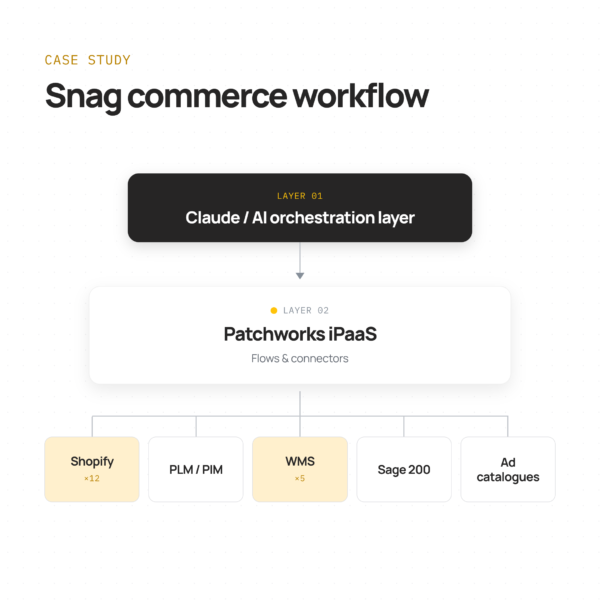
Snag’s technology team asked Claude itself to identify the right category of tool for the job. Claude’s answer: an integration platform as a service (iPaaS). Presented with a shortlist of options, Snag chose Patchworks for one specific reason — it was the only candidate with a genuinely functional MCP integration, meaning it could be operated conversationally through Claude rather than through a separate interface. Commercial terms were agreed within days, a test account was live within days of that, and the platform moved into production almost immediately.
1. AI-Orchestrated, Pass-Through Flows
Rather than building deeply mapped, heavily configured integrations, Snag’s team builds deliberately simple flows in Patchworks — typically just three steps: receive a call, execute it against the target system, and return a response. Claude handles the business logic and any data transformation in natural language; Patchworks handles execution against each system’s API. Because the payload passes straight through, most flows require no variable mapping at all.
2. Connecting the Previously Unreachable
Snag’s team has self-built 10–12 connectors — including for systems with no existing MCP support at all, such as its PLM platform and one of its warehouse management systems. Any system with a standard API and standard authentication has taken a few hours to connect and bring into Claude’s reach. The most complex build — a WMS with a non-standard authentication flow — took two days, the longest of any connector to date.
3. On-Demand, Multi-Store Product Synchronisation
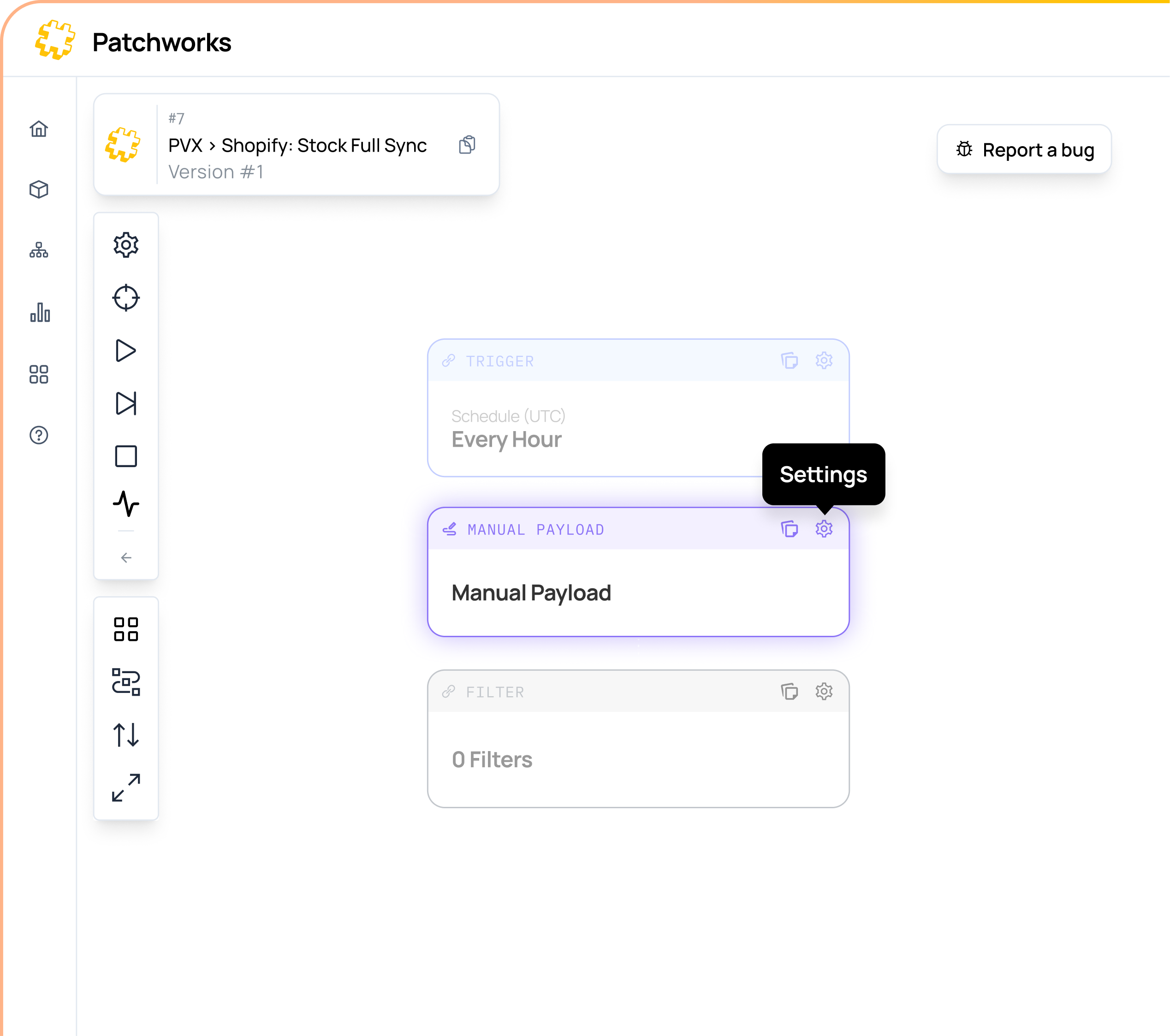
One of the flows now in production lets Snag’s team pass a product ID and a set of target store IDs into Patchworks, which fetches the product from its source Shopify store, applies any requested transformations — such as setting a new listing to draft status or preparing it for translation — and pushes it out to the chosen storefronts. Crucially, this sync runs only when instructed, to only the stores specified, rather than as a blanket, always-on synchronisation across the whole catalogue.
4. Unlocking Native Platform Capabilities at Scale
Working through Patchworks, Snag’s team discovered that Shopify exposes a Bulk Operations API that is not available through Shopify’s native MCP server. By routing GraphQL calls through a Patchworks flow, jobs that previously took hours to complete now run in minutes — including a single operation that updated tags across more than 14,000 products at once.
We didn’t want to sync everything constantly to everywhere. We wanted the ability to sync what we choose, to the places we choose, at the time we choose.
Tom Martin
Co-Founder, Snag
The Results: From Manual Plumbing to Conversational Operations
| Performance Metric | Before Patchworks | After Patchworks |
| Bulk product operations | Manual updates through the Shopify admin UI; large jobs took hours. | Bulk operations triggered by Claude and executed via Patchworks in minutes — 14,000+ products updated in one run. |
| System connectivity | Core systems like the PLM platform had no path to AI tools at all. | 10–12 self-built connectors bring Shopify, the PLM platform, WMS, Sage 200 and more into Claude’s reach. |
| New product launch speed | Manual, repetitive data entry across stores, catalogues and markets. | One of Snag’s fastest launches to date — live in around two weeks. |
| Engineering overhead | Custom point-to-point integration code requiring ongoing developer maintenance. | Lightweight, pass-through flows built and maintained by Snag’s own team, most live within hours. |
It’s revolutionary. I cannot overstate this. It is genuinely revolutionary, the things you can do.
Tom Martin
Co-founder, Snag
Frequently Asked Questions
What is an AI orchestration layer?
An AI orchestration layer is the software — in this case Claude — that interprets a person’s natural-language instructions and translates them into the specific API calls needed to carry them out. It decides what needs to happen; an iPaaS like Patchworks is what actually executes it against each target system.
Why couldn’t Snag just connect Claude directly to every system?
Some of Snag’s systems, such as its PLM platform, had no MCP server available at all. Others, like Shopify, exposed an MCP server but restricted which actions — including bulk operations — an AI agent could perform through it, even though those same actions were available through the underlying API.
What is MCP (Model Context Protocol)?
MCP is a standard that lets AI models like Claude connect to and call external tools and systems directly. It works well for individual actions, but vendors often limit what’s exposed through it, and routing large volumes of data through an MCP connection can overload the AI model’s context window.
Why does an iPaaS matter if a business is already using AI agents?
An iPaaS gives an AI agent a stable, high-throughput execution layer. It lets the agent trigger complex or high-volume operations — like a multi-store product sync or a 14,000-product bulk update — without needing to process that data itself, and it can expose systems that have no native AI connector at all.
Strategic Takeaways for Enterprise Leaders
- Let AI orchestrate, let iPaaS execute: keep large data volumes out of the LLM’s context window by having it trigger operations rather than process the data directly.
- Expose the systems your AI agent can’t reach natively: an iPaaS can bridge platforms with no MCP support, or with an MCP server that limits high-value actions.
- Favour simple, pass-through flows over deep mapping: letting the AI handle data transformation in natural language lets integration teams move faster than building heavily configured, hand-mapped flows.
- Control the blast radius of automation: on-demand, instruction-triggered synchronisation gives teams precise control that blanket, always-on syncing cannot.
You cannot do this at scale without something that takes the heavy load off. Without that, none of this works.
Tom Martin
Co-founder, Snag
Ready to Connect Your AI Agents to Every System You Run?
Whether you need to bring a system with no native MCP support into your AI agent’s reach, offload high-volume operations out of your LLM’s context window, or simply move faster than a fully custom integration allows, Patchworks gives your AI the plumbing it needs to actually run the business.
Explore how a retail-first iPaaS can remove bottlenecks from your commerce stack.
🔎 See Patchworks in action: Watch a guided video tour
🚀 Get the conversation started: Speak to a Patchworks iPaaS expert
📚Get to know the platform: Read Patchworks’ product docs