AI in retail: An expert’s view
AI in retail delivers most value behind the scenes. In this three-part series, Snag co-founder and CTO Tom Martin and Patchworks CEO Jim Herbert explain why retailers should use large language models (LLMs) as an interface, turning what people want into instructions for systems like Shopify and the warehouse, while connected, dependable systems do the work. Snag used this approach to update 14,000+ products in a single operation and take one of its fastest product launches live in around two weeks.
Snag and Patchworks were joint winners of the 2026 MACH Impact Award for real-world agentic AI and composable deployments.
Jump to episodes
Watch ‘The hidden cost of AI agents’
Watch ‘How Snag built an AI-ready stack’
Watch ‘AI playbook for retail leaders’
What are the key lessons on AI in retail?
Six lessons from the series, from a retailer that has put AI to work across its operations and the platform that connects its systems.
- Do use AI as the interface to your systems. Don’t let it do work that a dependable system can do faster and more cheaply.
- Do use LLMs for data analysis and code: SQL, scripts and API calls. Don’t rely on them for customer-facing copy, images or service.
- Do connect your systems, and agree one system of record for orders and products, first. Don’t expect AI to paper over fragmented data.
- Do budget for tokens. Don’t expect AI to cut headcount: for Snag, it shifted cost rather than removing it.
- Do keep people making the decisions. Don’t connect anything to an LLM that you wouldn’t trust a computer program with.
- Do stay flexible on AI models. Don’t lock your whole stack into one provider’s contract.
Why does AI in retail start with integration?
An AI agent can only act on the data it can reach. If orders, stock and product data sit in systems that don’t talk to each other, AI either fails or acts on an incomplete picture, and does so at machine speed.
That is where most UK retailers are today. In August 2025, Patchworks commissioned OnePoll to survey 200 UK retail leaders who make technology decisions.
Describe their integration setup as fully connected and scalable
Said they were ready for agentic commerce
Already use AI to automate or improve operations
Want to use AI in their tech stack but can’t
Read the full The Retail Integration Maturity Model: 2026 Report and find out which stage your business is at with the report’s free self-assessment.
Episode 1: Is agentic AI ready for retail?
At the start of 2026, “agentic” was the word everyone in retail was using, but it meant different things to different people. Jim Herbert, CEO of Patchworks, points out that much of the early excitement was about shoppers using LLMs as a new kind of search engine. Useful, but not an agent at work. The bigger opportunity is behind the checkout: using AI to run retail operations more efficiently.
Tom Martin, co-founder and CTO of Snag, explains how Snag approaches it. Snag runs six Shopify storefronts and five warehouse management systems, and sells to customers in more than 100 countries. Instead of logging into 20 systems and moving spreadsheets between them, Snag’s team tells an LLM what they want to do, and it works out how to do it across the systems involved. Tom’s goal is a fully headless stack, where every system can be run through a conversational interface.
But Tom is blunt about the cost. LLMs are expensive to run at scale, and setting several of them to work on the same job multiplies that cost. His answer is to keep the LLM as the interface and hand the work itself to systems that do the same job the same way every time, at a known price. The episode closes on the practical blockers Snag hit when it connected AI to its stack, and why the hardest part is often the data rather than the AI.
What is agentic commerce?
Agentic commerce is retail in which AI agents carry out tasks: discovering, comparing and buying products for shoppers, or running operational workflows for retailers. Most of the attention so far has gone on the shopper side. For retailers, the bigger near-term opportunity is behind the checkout, in pricing, product updates, fulfilment and finance. Agents that hand work to other LLMs burn tokens; agents that trigger connected, dependable systems don’t.
For a practical readiness checklist, see the agentic commerce chapter of The Retail Integration Maturity Model: 2026 Report
Why is agentic AI so expensive to run?
LLMs process text as tokens. To produce each new token, a model runs everything so far through billions of parameters, adds the result, and runs it all again. Tom compares it to stop-motion animation: move the model a fraction, take a photo, repeat. That is why cost rises with every token of context and every second a model spends working, and why AI providers charge by the million tokens.
When one LLM hands work to another, both generate tokens, and the bill grows with every exchange. Jim has seen teams build agents in a pilot, move them into production and face a £10,000 bill within days. A cheaper pattern is to ask the LLM to write a script once, then run the script as often as you need. Repeat work then costs a little computing power, not a fresh round of tokens.
“The difference in cost between me being able to execute a job in 1,000 tokens versus 2 million tokens is huge.”
Tom Martin
CTO for Snag
Why aren’t MCP connectors enough for enterprise retail?
Model Context Protocol (MCP) connectors let an AI assistant work with systems like Shopify directly. Snag found their limits quickly. Connectors sign in as an individual user, so working across six Shopify stores meant re-authenticating every time the AI switched store. Software vendors also restrict what AI can do through MCP compared with their full API, often for sensible safety reasons.
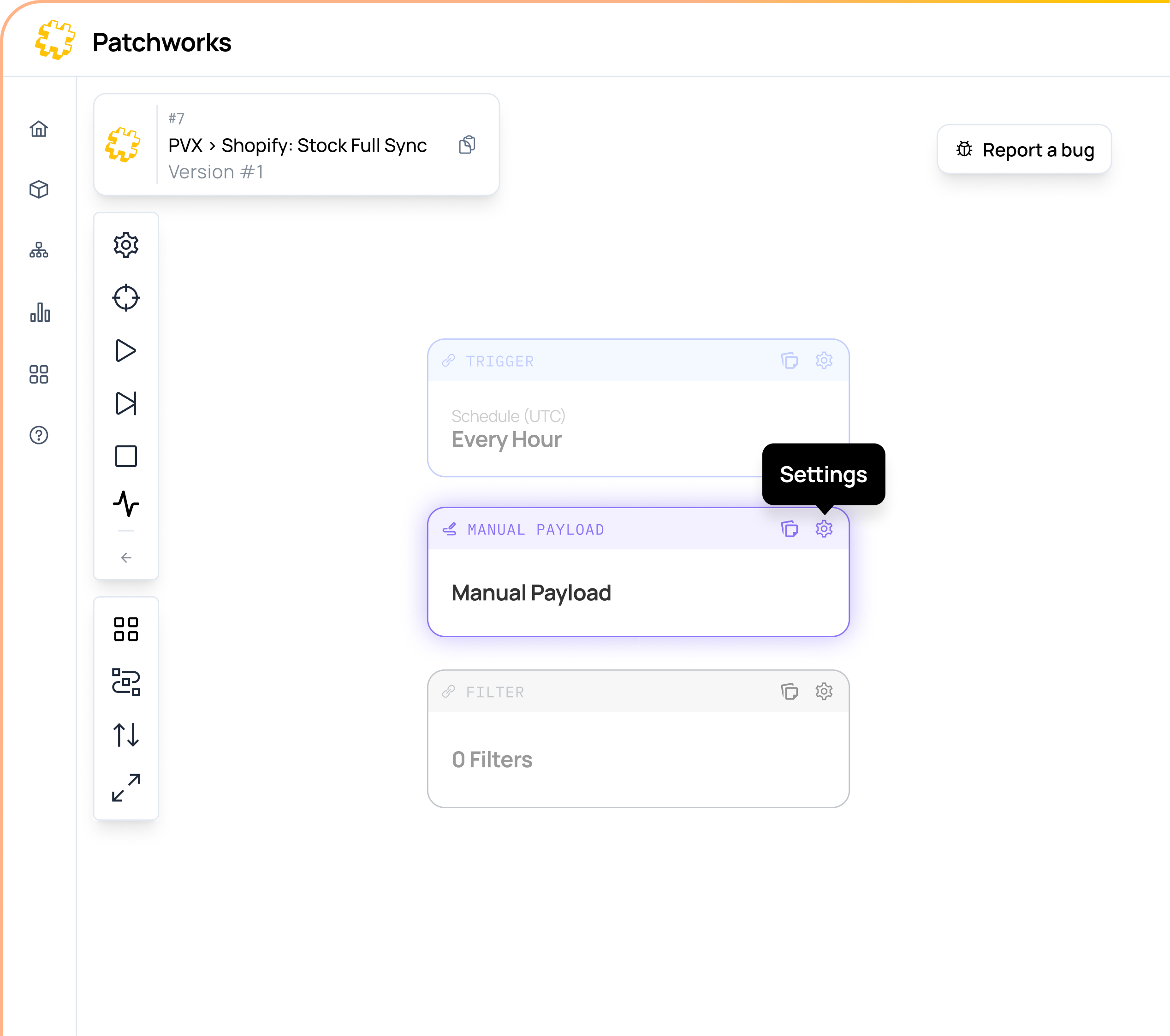
Tom’s conclusion: retailers need a layer beneath the LLM that it can trigger, but that does the work itself, keeping the LLM out of the execution loop. For Snag, that layer is the Patchworks MCP Server, which wraps each system’s API so flows run the same way every time, at a predictable cost.
Why does the data work matter more than the AI?
Tom estimates that integration is around 30% of the challenge. The other 70% is data and process work that many retailers have put off for years: choosing one system of record for orders and for products, and agreeing what an order or a product actually is. Doing that work is what moves a business from “the tech says no” to “what does the business want to do today?”
Episode 2: How did Snag build an AI-ready tech stack?
Snag has never run its own servers or employed in-house developers: everything it uses is software as a service. When the brand started in 2018, that meant a collection of systems that didn’t talk to each other, and no budget for the developers, cloud engineers and deployment pipelines needed to connect them. Before Patchworks, moving product and order data between those systems took around 70% of Snag’s technical team’s time.
In this episode, Tom explains how LLMs changed that. Technical knowledge that once needed a team of specialists is now available to anyone who can describe what they want. Snag used it to build the kind of connected architecture that large enterprises have spent decades and fortunes pursuing, without an enterprise budget.
Tom is clear about where Snag does and doesn’t use AI. It doesn’t use it to write copy or generate images. It uses LLMs to analyse its data and to operate its tech stack, turning what a person wants into the precise instructions that Shopify, the warehouse and the finance system understand. Jim closes with what Snag’s approach means for integration platforms: good user experience now has to work for machines as well as for people.
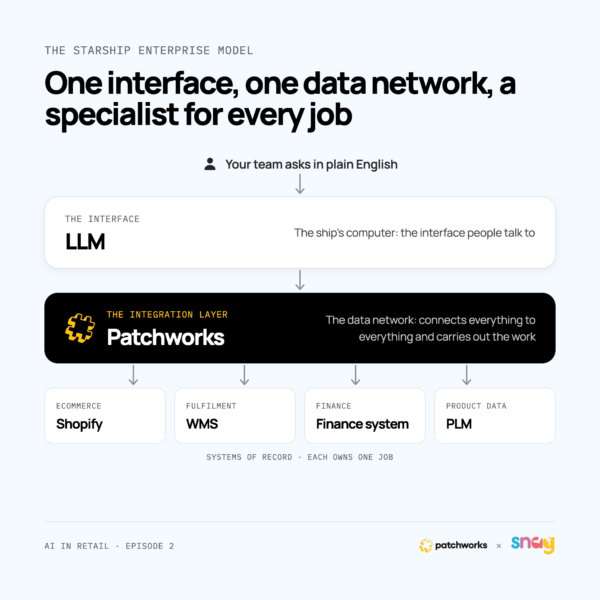
What is the “Starship Enterprise” model for a retail tech stack?
Tom’s metaphor comes from Star Trek. The crew talk to the ship’s computer; specialist subsystems such as the warp engines each run their own job; and a high-speed data network connects them all. Mapped to a retail stack:
- The ship’s computer is the LLM: the interface people talk to.
- The subsystems are the systems of record, each owning one job. Shopify owns ecommerce; the warehouse management system owns fulfilment.
- The data network is Patchworks: the integration layer that connects everything to everything and carries out the instructions.
It is a composable architecture, with each job owned by one specialist system, plus an LLM as the interface. And it works for a business of Snag’s size, not just for the largest enterprises.
“We see Patchworks as the ODN, right? It is the thing that connects everything to everything.”
Tom Martin
CTO for Snag
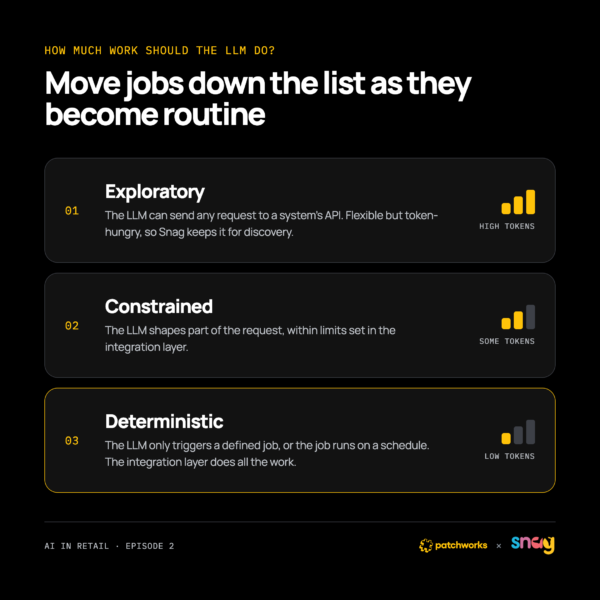
How much of the work should the LLM do?
Snag uses three levels of AI-triggered work, and moves jobs down the list as they become routine:
| Level | How it works |
|---|---|
| Exploratory | The LLM can send any request to a system’s API. Flexible but token-hungry, so Snag keeps it for discovery. |
| Constrained | The LLM shapes part of the request, within limits set in the integration layer. |
| Deterministic | The LLM only triggers a defined job, or the job runs on a schedule. The integration layer does all the work. |
AI in retail examples from Snag
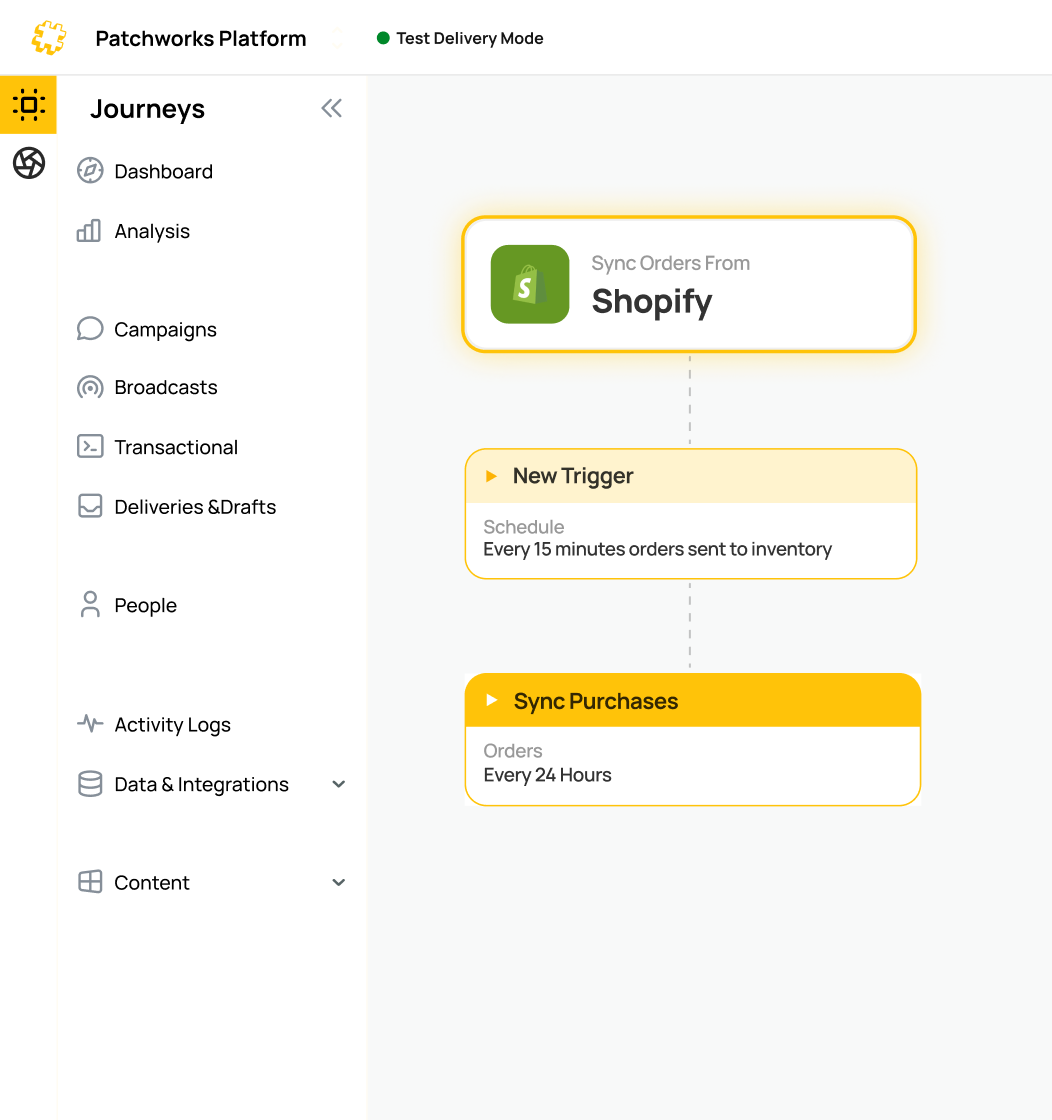
- 14,000+ Snag updated more than 14,000 products in a single operation, by triggering Shopify’s Bulk Operations API through a Patchworks flow.
- ~2 weeks Snag took one of its fastest product launches to date from concept to live in around two weeks.
- 10–12 Snag’s own team built 10 to 12 connectors in Patchworks, most of them live within hours.
- £0 Snag spent nothing on traditional consultancy or front-end development to stand up new automated processes.
The everyday gains matter as much as the headline numbers. When a carrier issue meant Snag needed invoices for 432 DHL shipments, one plain-English request replaced 432 rounds of clicking through an interface. Preparing a launch across Snag’s six storefronts used to take a day of Tom’s week; it now takes minutes. And because Snag connected an LLM to its data warehouse, anyone in the business can ask a question in plain English and get the answer, and a chart, straight back.
“It is the interpreter between what I want to do, my intent, and the language you need to speak to the cloud robot to make it do the thing I want it to do.”
Tom Martin
CTO for Snag
Episode 3: What should retail leaders do about AI?
Featuring Tom Martin and Jim Herbert · Hosted by Kieran Howells, content director, Retail Gazette
Many retail leaders feel they are behind on AI, as if competitors have found something they haven’t. In this episode, Kieran Howells, content director at Retail Gazette, asks Tom and Jim what a realistic AI playbook looks like.
Tom calls LLMs the most overhyped technology he has seen, and at the same time one of the most transformational. His advice is to ignore the noise, start with your own pain points, and ask which of them LLMs can genuinely help with. For Snag, the answers are data analysis and anything involving code, rather than customer-facing content.
The conversation moves on to cost, control and the year ahead: why AI shifts cost rather than removing it, who should be accountable for AI in a business, and why the software around the model may soon matter more than the model itself. Jim ends with a practical first step for the weeks before peak, and a free tool to help.
“I’ve never seen a technology that is more overhyped and at the same time more transformational.”
Tom Martin
CTO for Snag
Where does AI help a retailer, and where doesn’t it?
Snag’s experience draws a clear line. LLMs are excellent at translating into languages with tight rules, such as SQL, Python and API calls. That makes them transformational for data analysis: a leader can ask a question in plain English and get the query and the answer back. As Tom puts it, no one should have an inaccurate trading report on a Monday morning.
LLMs are far less consistent with human language. Snag doesn’t use AI for marketing copy, social posts or customer service, and won’t use it to generate product images, because showing customers a product the computer invented isn’t honest. For technology teams, though, LLMs remove the months once spent learning each new system or API.
Does AI really cut costs in retail?
Not in Snag’s experience. An LLM running for an hour can cost more than a person doing the same work, so AI shifts cost rather than removing it. Snag replaced its business intelligence (BI) tool with spending on tokens, and hasn’t cut any jobs. What it has gained is time: Tom has at least a day a week back. He also warns of a new kind of burnout, as the blockers that used to slow people down disappear and teams find themselves running faster than ever.
“It’s not cost-out for us; it’s cost-shifting.”
Tom Martin
CTO for Snag
Who should own AI in a retail business?
People. Tom’s view is that an LLM is a computer program: words go in, other words come out. It doesn’t make decisions, so it shouldn’t be left to make them. Use it to give people better information, faster, and connect it only to systems you’d be comfortable letting a computer program touch. Jim agrees: wired up properly, AI gives people better data to make decisions with.
Where should retailers start with AI before peak?
Start with constraints, not technology. Tom points to the Theory of Constraints: find the biggest bottlenecks and frustrations in the business, and work through them one at a time. Jim suggests a fast feedback loop: two-week projects that each tackle one constraint with whatever tools fit, AI or otherwise, then measure the result.
Peak is where this pays off. Retailers fear peak because known system problems surface when volumes rise. LLMs shouldn’t run anything during peak, Tom says; that is a job for properly scaled systems. But they can help fix the nagging issues beforehand. To find yours, score your stack with the free Peak Trading Calculator in our peak season readiness guide.
What is the future of AI in retail?
Tom expects the next 12 months to shift attention from the model to the harness: the software around an LLM that connects it to the business and controls what it can do. He predicts AI tools that work with any model, and integration software with MCP built in, giving IT leaders the control and guardrails they are asking for.
The closing advice from both is classic IT. Avoid locking yourself into any one model provider while the technology is this young. And use the right tool for each job, because an LLM is overkill for much of the work a business needs done.
“Use the right tool for the job.”
Jim Herbert
CEO for Patchworks
Where does Patchworks fit?
Patchworks is the retail-first, AI-native integration platform (iPaaS): the data network in Tom’s Starship Enterprise. It connects ecommerce, ERP, warehouse, 3PL, marketplace and finance systems, and keeps orders, stock and product data moving between them reliably.
For AI, the division of labour is simple. The LLM interprets what a person wants and decides what should happen; Patchworks carries it out against each system’s API. Through the Patchworks MCP Server, AI assistants can trigger integration flows that run the same way every time, at a predictable cost. AI Studio applies the same principle: its AI Agents build and manage integration flows from plain-English prompts, and the platform does the work.
Patchworks is used by 2,000+ brands, is Shopify’s only Certified Technology Partner for integrations, and won the 2026 MACH Impact Award with Snag.