TL;DR: Shopify ERP integration connects your Shopify store to your ERP system so orders, inventory, pricing, customer and financial data move automatically between them — the operational backbone that lets a Shopify brand scale past the point manual processes can keep up.
Shopify ERP integration connects Shopify with your ERP system so operational data (orders, inventory, customers, financial records) moves automatically between the two, rather than being copied by hand. If you’re running Shopify or Shopify Plus, this is what turns your storefront from an island into one connected part of the business.
Scaling Shopify brands, multi-channel retailers, B2B ecommerce companies and Shopify Plus merchants all tend to hit the same wall: the manual processes that worked fine at low order volume stop scaling once growth actually arrives. ERP integration with Shopify is the infrastructure that removes that ceiling. Less a technical upgrade, more an operational foundation.
This guide covers what Shopify and ERP integration actually involves, how it works, what data typically moves between the two systems, and how to think about choosing the right approach for your business.
What Is Shopify ERP Integration?
ERP systems typically manage finance, inventory, procurement, fulfilment workflows and operational reporting. Shopify manages the customer buying experience: browsing, checkout, payment. Your ERP manages what happens behind the scenes once a sale is made.
A practical example: when a customer places an order in Shopify, integration ensures your ERP receives that order automatically, updates stock levels, and triggers the fulfilment workflow, all without anyone touching either system by hand.
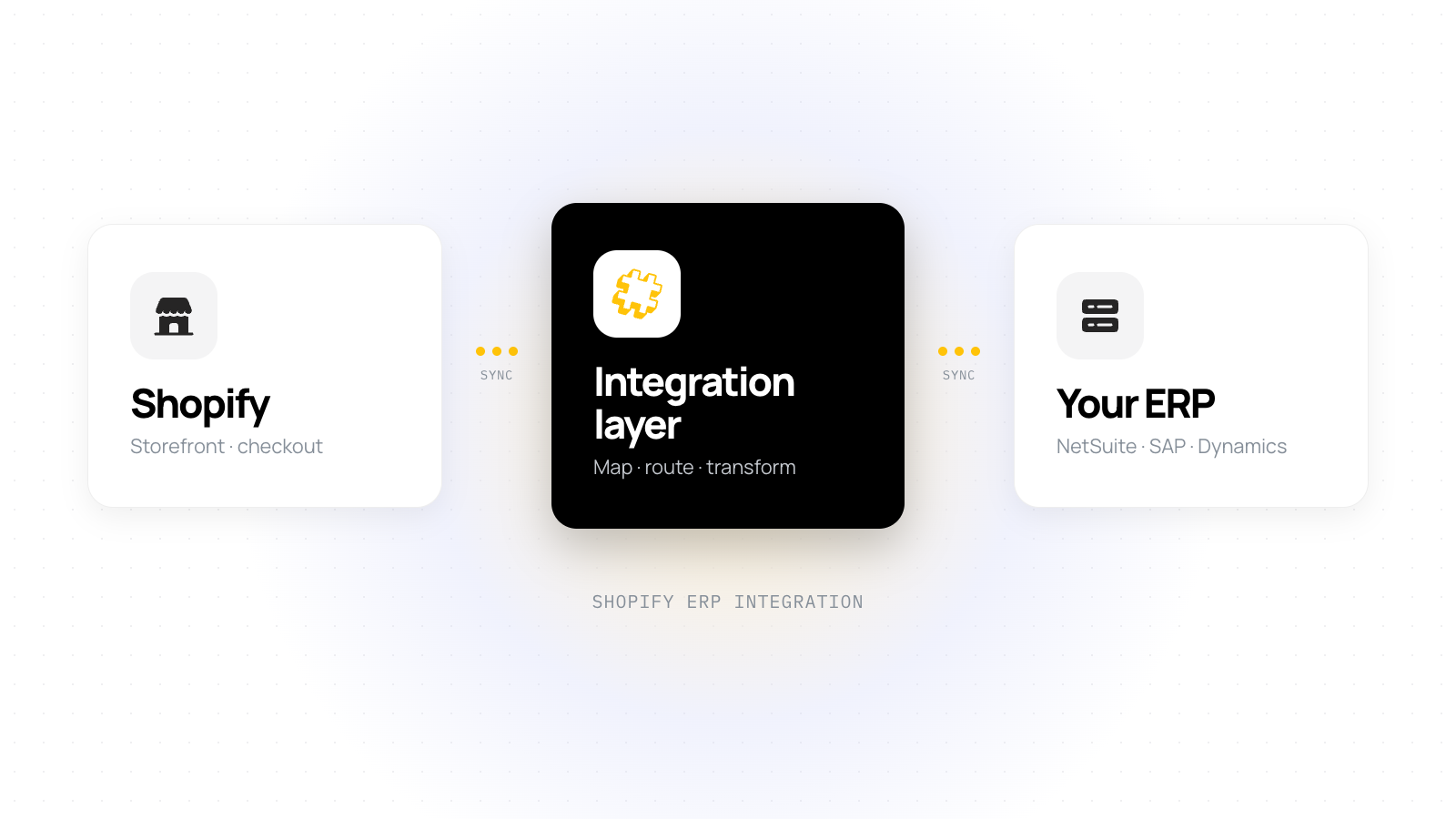
This is what Shopify integration with Patchworks is built to do: connect Shopify to whichever ERP you run (NetSuite, SAP, Microsoft Dynamics, Sage) using pre-built connectors rather than custom development for every new connection.
Why Businesses Integrate Shopify With ERP Systems
The operational drivers are consistent across most Shopify brands that reach for integration: manual order processing between systems, inventory discrepancies across channels, finance teams reconciling reports by hand, customer service lacking operational visibility, and general inefficiency caused by disconnected systems.
A common scenario: you’re growing, selling across Shopify, Amazon and wholesale, and struggling to keep inventory accurate across all three because nothing is actually talking to anything else. Shopify ERP benefits are best understood as removing that friction. Not automating for automation’s sake, but closing the gap between what your storefront shows and what’s actually true operationally.
How Shopify ERP Integration Works
At a high level, integration works through systems communicating via APIs or through an integration platform (iPaaS) that sits between Shopify and your ERP. It’s structured data movement, not complex custom engineering.
A typical flow: customer places order → Shopify sends data → the integration platform processes the information → the ERP receives the order → inventory updates → fulfilment is triggered. Each of these steps happens automatically, and, in a well-built integration, within seconds.
How Data Flows Between Shopify and ERP Platforms
Integration normally involves bi-directional data flow: orders typically move into the ERP, while inventory and fulfilment updates flow back out to Shopify. Syncing in both directions is what keeps your two systems in agreement rather than slowly drifting apart.
Common Shopify ERP Integration Architectures
You’ll generally choose between direct integrations, middleware platforms, or native integrations. Each represents a different tradeoff between flexibility, speed of setup and long-term maintenance, worth understanding before committing to one.
Native vs Middleware vs Custom Shopify ERP Integrations
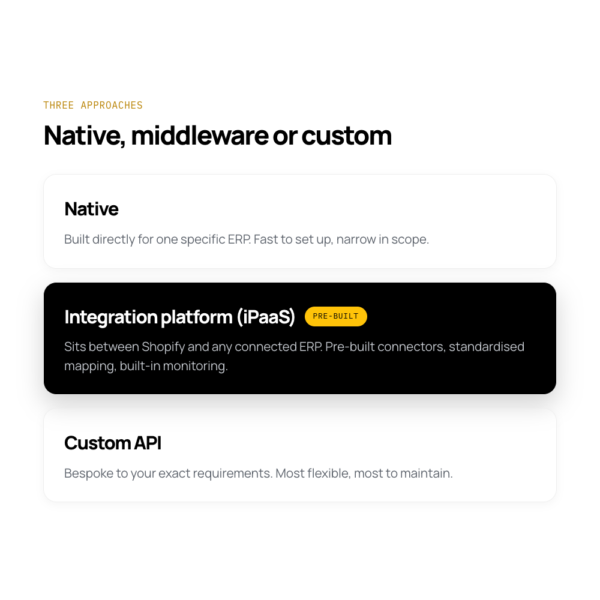
Native integrations are built directly for a specific ERP, integration platforms (iPaaS) sit between Shopify and any connected ERP, and custom API integrations are built bespoke for your exact requirements. The right choice comes down to business implications (flexibility, scalability and ongoing maintenance) rather than which is technically most sophisticated.
What Data Is Typically Synced Between Shopify and ERP Systems
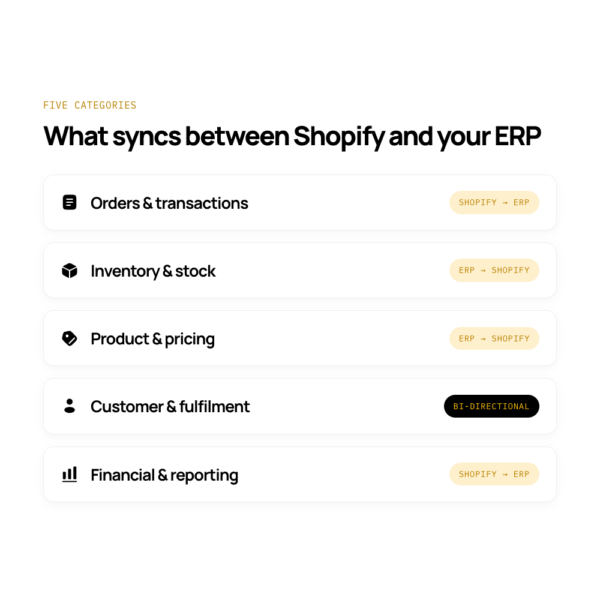
Integration success depends on which operational data is synchronised, and in which direction. Most Shopify ERP integrations focus on five categories:
| Data type | What typically syncs | Direction | Why it matters |
|---|---|---|---|
| Orders & transactions | Order ID, payment status, shipping method, tax data, order status | Shopify → ERP | Starts fulfilment and financial recording the moment an order is placed |
| Inventory & stock | Stock levels by SKU, by warehouse or location | ERP → Shopify | Prevents overselling by keeping storefront stock counts accurate in real time |
| Product & pricing | SKUs, pricing rules, product attributes, catalogue changes | ERP → Shopify | Keeps listings consistent across Shopify and every other channel a product is sold on |
| Customer & fulfilment | Customer records, shipping updates, tracking numbers | Bi-directional | Improves support visibility and keeps shoppers informed automatically |
| Financial & reporting | Sales data, reconciliation records, accounting entries | Shopify → ERP | Keeps accounting and reporting numbers current without manual reconciliation |
Orders and Transaction Data
Shopify orders move into the ERP for fulfilment, finance processing and operational tracking: payment status, shipping details, tax calculations and order status all need to arrive intact and in real time.
Inventory and Stock Availability
In most setups your ERP acts as the primary inventory source, with Shopify reflecting available stock as it changes. Real-time syncing here is what actually prevents overselling. AYBL is a useful example: the brand used Patchworks to keep inventory reliable across channels and stop selling stock that had already gone.
Product Catalogue and Pricing Data
ERP systems often hold master product records: SKUs, pricing logic, attributes. Syncing ensures consistency between Shopify and any other sales channels a product appears on.
Customer and Fulfilment Information
Customer records and shipping updates move between systems to improve visibility: fulfilment updates, tracking numbers, and the kind of customer support benefit that comes from an agent actually being able to see order status without switching tools.
Financial and Reporting Data
Connecting Shopify sales data with your accounting systems improves financial reporting accuracy and closes the reconciliation gap that would otherwise fall to someone doing it by hand at month-end.
Key Benefits of Shopify ERP Integration
The measurable outcomes worth focusing on: reduced manual processes, improved operational accuracy, business scalability, faster fulfilment, and better reporting visibility.
Improved Operational Efficiency
Integration removes repetitive manual workflows and the operational friction that comes with them. Automation running in the background, rather than a task on someone’s list.
Better Inventory Accuracy
Stock stays consistent across Shopify and every other connected channel, removing the drift that builds up when your systems aren’t talking to each other.
Faster Order Processing
Automated workflows reduce delays between an order being placed and fulfilment starting. That’s a meaningful difference for both operational speed and how quickly your customer sees things move.
Scalability for Growing Shopify Businesses
As you grow into multiple channels, regions or a wholesale arm, integration becomes less optional. Multi-warehouse expansion, international sales, wholesale expansion and catalogue growth all lean on the same underlying infrastructure.
Better Business Visibility and Reporting
Integrated data improves forecasting, reporting accuracy and operational planning. You’re making decisions on numbers that reflect what’s actually happening, not what a spreadsheet said last week.
Shopify ERP Integration for B2B Ecommerce
B2B ecommerce environments often need deeper ERP integration than standard DTC operations: account pricing, contract pricing, bulk ordering, credit terms and sales rep workflows all need to be reflected accurately and consistently.
If you’re running B2B on Shopify specifically, this integration is close to a prerequisite rather than an enhancement. That level of operational complexity doesn’t work manually past a fairly small scale. See our ecommerce and ERP integration solution for the fuller picture of what this looks like once your systems are properly connected.
Common Challenges With Shopify ERP Integration
Worth acknowledging upfront: legacy ERP limitations, data mapping complexity, workflow customisation, integration monitoring and ongoing maintenance are all realistic considerations rather than theoretical ones.
- Do treat data mapping as the first real piece of work. Most delays come from assumptions about how a field is structured in Shopify not matching how it’s structured in the ERP, not from the integration technology itself.
- Don’t assume Shopify Plus or a heavily customised storefront makes integration harder than standard Shopify. The complexity is almost always on the ERP side, not the Shopify side.
Shopify ERP Integration Solutions and Tools
The available solutions fall into a few types: integration platforms, connector tools, ERP integration partners, and custom development. Seeing how Patchworks compares to other integration platforms, like Celigo, Boomi, and Alumio, is worth a look if you’re weighing platform options directly against each other, rather than choosing between architecture types.
ERP Systems Commonly Integrated With Shopify
Shopify integrates with a range of ERP systems depending on your needs: most commonly NetSuite, SAP, Microsoft Dynamics and Oracle. Shopify SAP ERP integration specifically comes up often enough to be worth naming directly, though it’s a smaller slice of the market than the NetSuite pairing.
NetSuite is the flagship ERP pairing for Shopify brands on Patchworks — our pre-built Shopify ↔ NetSuite Accelerator covers exactly this combination. Castore runs on this pairing at scale: a single warehouse and ERP integrated across 40+ stores, with new brand websites integrated in around four hours once the underlying setup is in place.
Shopify ERP Integration Pricing Considerations
Pricing varies based on integration complexity, the systems involved, customisation requirements and ongoing maintenance needs. As a rule, pre-built connectors cost less to implement than fully custom integrations, but the right answer depends on how standard your operational workflows actually are.
How to Choose the Right Shopify ERP Integration Approach
Worth evaluating against: your business size, operational complexity, growth plans, internal technical resource, and the tradeoff between implementation speed and long-term flexibility. This is a strategic decision more than a technical one. The right approach supports where you’re heading, not just what you need today. Speak to an integration expert to discuss your current needs and growth roadmap.
When Businesses Should Consider Shopify ERP Integration
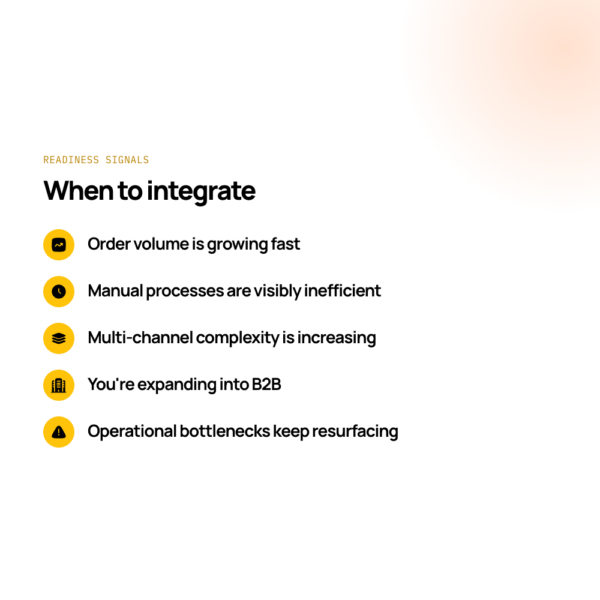
Common readiness signals: rapid order growth, manual processes becoming visibly inefficient, multi-channel complexity increasing, B2B expansion, and general operational bottlenecks that keep resurfacing regardless of how many people are thrown at them.
Frequently Asked Questions About Shopify ERP Integration
How long does Shopify ERP integration take?
Timelines depend on complexity and the ERP involved. Pre-built connectors and accelerators, typically implement in weeks; fully custom integrations can take several months. With Patchworks’ pre-built templates, AI assistance, and custom connectors, this can be exponentially quicker.
How much does Shopify ERP integration cost?
Cost depends on integration complexity, the systems involved, and how much customisation is required. Pre-built connectors are generally more cost-effective than fully bespoke development.
Do Shopify Plus merchants need ERP integration?
Most Shopify Plus merchants operate at a scale where manual data entry between systems stops being viable — integration is best treated as standard infrastructure at that scale rather than an optional extra.
What data should be integrated between Shopify and ERP?
Most integrations synchronise five categories of data: orders and transactions, inventory and stock, product and pricing, customer and fulfilment information, and financial and reporting data.