TL;DR: Enterprise retailers connect marketplace and dropship channels using a middleware or iPaaS layer that translates each channel’s data format and automates order routing, stock sync and fulfilment updates — so the core stack doesn’t need rebuilding every time a new channel is added.
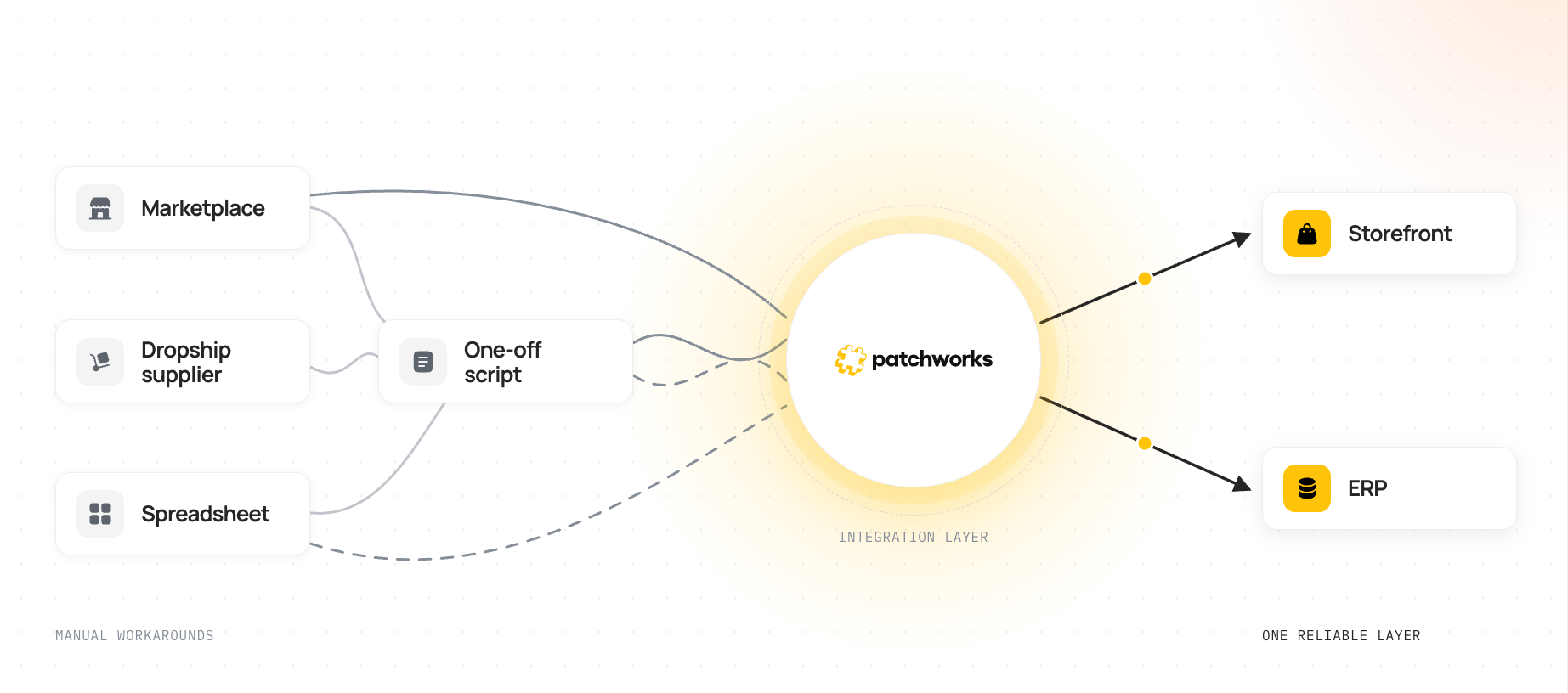
Enterprise retailers integrate marketplace and dropship channels using a middleware or iPaaS layer that sits between the storefront, ERP, and third-party networks. This layer translates each channel’s data schema into the retailer’s own formats and automates order routing, stock sync, and fulfilment updates in real time, so the core stack doesn’t need to be rebuilt every time a new channel is added.
If you’re reading this because a “quick” marketplace listing has turned into a genuine integration headache, you’re in good company. Almost every retailer we talk to has the same story: Amazon or a dropship partner started as a side channel, someone wired up a spreadsheet or a one-off script between their Shopify or NetSuite setup and that new channel to keep stock roughly in sync, and eighteen months later that spreadsheet is quietly propping up a meaningful share of revenue. This guide walks through why that happens, what your actual options are, and how the integration process tends to play out in practice.
Why Marketplace and Dropship Channels Don’t Plug Into Your Ecommerce Stack Natively
Your ecommerce platform and ERP were built around your own data model. Amazon has a different one. eBay has another. TikTok Shop has its own again, and it changes more often than you’d like. Your dropship partners each bring their own order acknowledgement formats, stock feed cadences, and courier data.
None of these systems were designed to talk to each other. A marketplace doesn’t know what your SKU naming convention looks like. A dropship supplier’s stock feed doesn’t automatically map to your product variants. Even something as simple as “an order has shipped” can mean five different data formats depending on which channel it came from.
This is manageable with one channel. It’s manageable with two if someone’s willing to babysit it. The problem shows up at channel three or four, when every new marketplace or supplier means another bespoke integration, another point of failure, and another person who needs to understand how it all fits together. That’s usually the point retailers start looking for a better way to do this.
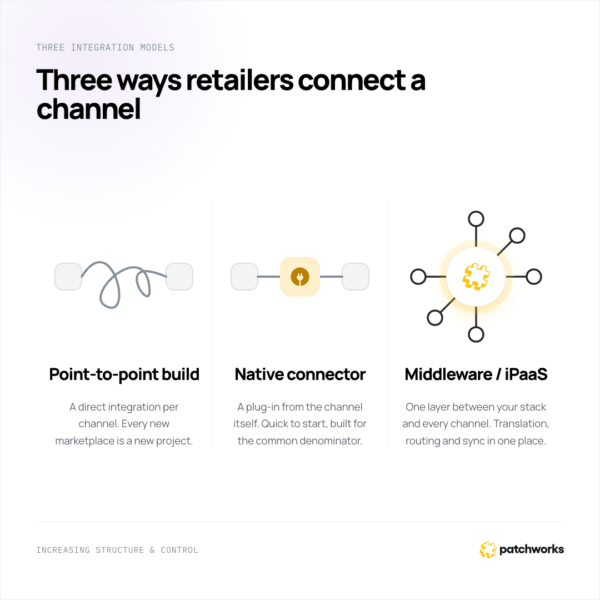
Three Ways Enterprise Retailers Approach This Integration
There’s no single “correct” answer here, and the right one depends on how many channels you’re running, how fast you’re adding new ones, and how much engineering time you have to spare. Broadly, retailers land on one of three models, usually while trying to connect a storefront like Shopify or BigCommerce, and an ERP like NetSuite or Sage, to the marketplaces and dropship networks sitting outside that core stack.
| Approach | How it works | Where it tends to work well | Where it tends to struggle |
|---|---|---|---|
| Point-to-point custom builds | A developer writes a direct integration between your stack and each individual marketplace or supplier | One or two channels, low rate of change, in-house dev capacity to maintain it | Scaling past 2–3 channels; every new marketplace is a new project, and every marketplace API change is a support ticket |
| Native or marketplace-provided connectors | You use the plug-in or app a marketplace/platform provides directly (e.g. a Shopify app for a specific marketplace) | Simple, single-channel setups where you want something running fast with minimal setup | Enterprise-scale volume, multi-channel operations, or anything needing custom logic — these tools are usually built for the smallest common denominator, not your specific stack |
| Middleware / iPaaS layer | A dedicated integration platform sits between your stack and every channel, handling schema translation, routing, and sync centrally | Multiple marketplaces and dropship partners, frequent channel additions, a need for one place to monitor and control data flow | Very simple, single-channel setups, where the overhead of a platform outweighs the benefit |
If you’re only ever going to sell on one marketplace and never touch dropship, a native connector might genuinely be all you need. The moment you’re juggling three or more channels, or mixing marketplaces with dropship suppliers, the maintenance burden of point-to-point builds tends to catch up with a team faster than expected.
What Actually Has to Happen Technically
Whichever model you choose, the same underlying jobs need doing. This is worth understanding on its own terms, because it’s the part that gets glossed over in vendor conversations and then causes surprises during implementation.
- Schema translation. Mapping your product, order, and customer data into whatever format each marketplace or supplier expects, and back again.
- Real-time inventory and stock allocation sync. Keeping stock counts accurate across every channel as orders come in, so you’re not overselling on Amazon because your warehouse stock hasn’t caught up yet.
- Order routing and acknowledgement. Getting orders from each channel into your OMS or ERP correctly, and pushing acknowledgements and status updates back out.
- Catalogue and pricing sync. Pushing product and pricing updates outward, on whatever schedule each channel needs.
- Returns and refund data. Making sure a return initiated on a marketplace, or through a dropship partner, flows back into your core systems rather than living only in that channel’s dashboard.
None of this is exotic. It’s the same handful of data problems, repeated for every channel you add. The difference between a smooth setup and a painful one is usually whether you’re solving each of these problems from scratch every time, or once, in a way that scales.
How the Integration Process Works, Step by Step
In practice, most enterprise integration projects follow a similar shape, regardless of which model you choose:
- Data mapping and schema audit. Work out what your product, order, and stock data looks like today, and what each target channel or supplier actually needs from you.
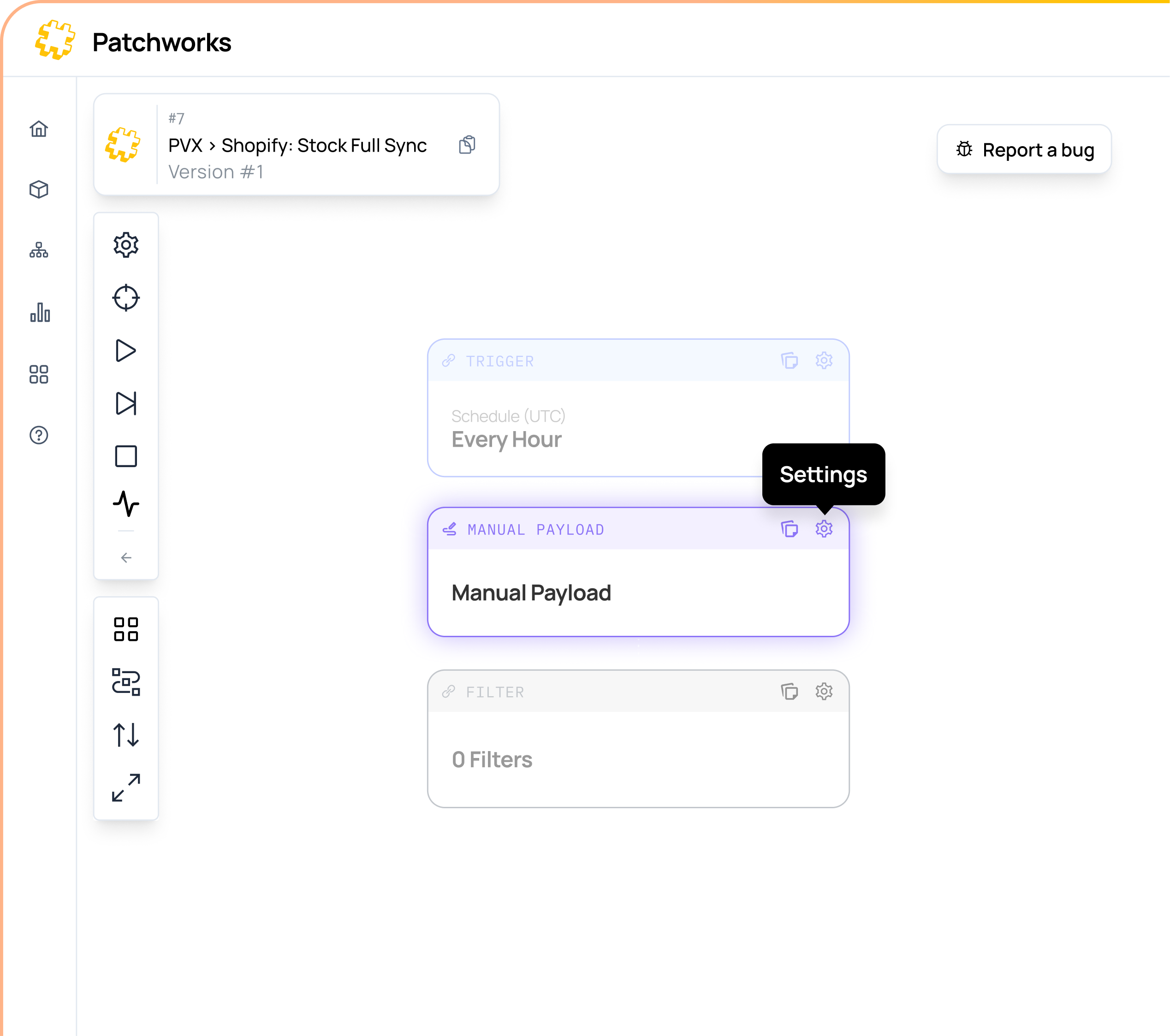
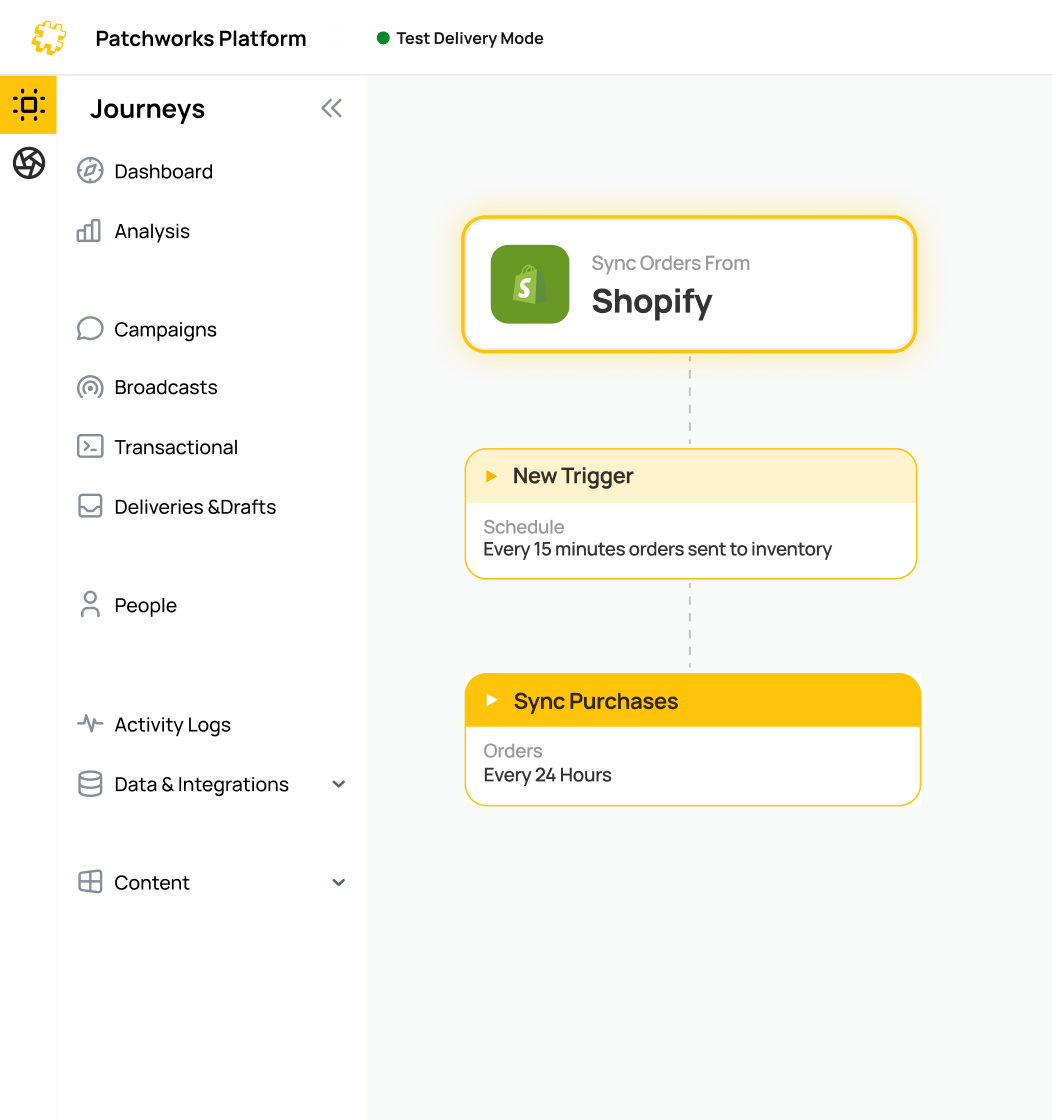
- Connector or flow configuration. Build or configure the actual data flows — whether that’s custom code, a native app’s settings, or flows within a middleware platform.
- Testing against edge cases. This is where most of the real risk lives. Peak trading periods, partial stock availability, order cancellations, and variant mismatches all need testing before go-live, not after.
- Go-live and monitoring. Launch the channel, then keep a close eye on the first few weeks of order and stock flow, since this is when mismatches tend to surface.
The step that’s easiest to underestimate is testing against edge cases. A stock sync that works perfectly on a quiet Tuesday can behave very differently during a flash sale or a peak trading weekend, when order volume spikes and the margin for error on stock accuracy shrinks fast.
Data Mapping Challenges Specific to Marketplace and Dropship Channels
A few specific data problems come up again and again, and they’re worth knowing about before you’re in the middle of a project.
SKU and variant mapping. Your internal SKU structure rarely matches what a marketplace expects, especially for products with size, colour, or fit variants. This is exactly the problem fashion and apparel retailers run into when listing the same product across Shopify and a dropship network and marketplaces like John Lewis, Argos, or Boots, each with its own variant and attribute structure. Get this wrong and you end up with mismatched listings or orders that can’t be matched back to stock.
Stock allocation rules. If you’re selling the same stock across your own site, a marketplace, and a dropship network, you need clear rules for how that stock gets allocated and reserved across channels. Without this, oversells are almost guaranteed during busy periods.
Order acknowledgement and carrier data. Each channel and supplier has its own format for confirming an order’s been received, and its own way of passing back tracking and carrier information. Reconciling these into one consistent view is a genuinely fiddly part of the job, and it’s usually where manual workarounds creep back in if the integration isn’t built to handle it properly.
Build vs. Buy vs. iPaaS: Choosing the Right Approach at Enterprise Scale
There’s no universally right answer, but a few honest patterns tend to hold true.
If you’re adding your first or second channel, and you’ve got engineering capacity to spare, a custom build or native connector can genuinely be the pragmatic choice. It’s a real trade-off, not a mistake, to keep things simple while the scope is small.
If you’re already juggling several marketplaces and dropship partners, or you know you’ll be adding new channels regularly, the maintenance cost of custom point-to-point builds tends to grow faster than most teams expect. Every marketplace API update becomes a support ticket. Every new channel is a new project rather than a configuration change. This is usually the point where a middleware or iPaaS layer starts to make more sense, because it centralises the schema translation and sync logic in one place instead of scattering it across a dozen bespoke integrations. It’s the same shift Mint Velvet made when a rigid, legacy integration layer stopped keeping pace with their omni-channel and peak trading demands.
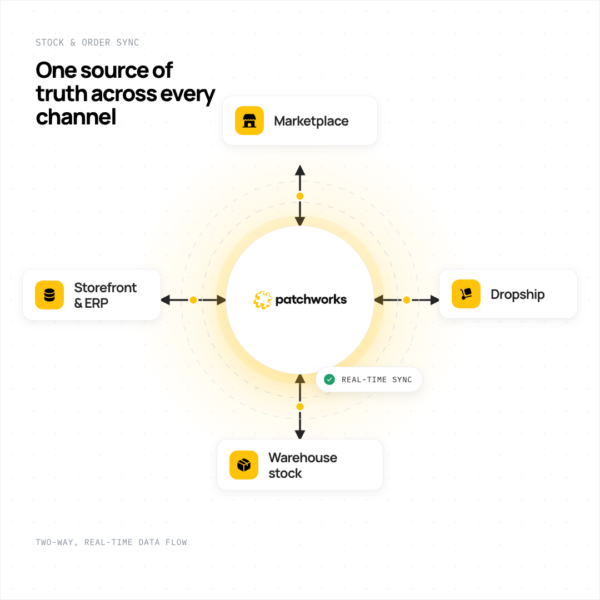
How Patchworks Approaches Marketplace & Dropship Integration
Patchworks connects your storefront and ERP to marketplaces and dropship networks through pre-built connectors, centralising the schema translation, order routing and stock sync work described above, rather than requiring a bespoke build for every channel you add.
Frequently Asked Questions About Marketplace & Dropship Integration
What’s the difference between marketplace integration and dropship integration?
Marketplace integration syncs listings, orders, and inventory with sales channels like Amazon or eBay. Dropship integration syncs orders and stock data with third-party suppliers who fulfil on your behalf. Many retailers need both, often handled through the same middleware layer.
Can enterprise retailers integrate marketplaces without replacing their ERP?
Yes. A middleware or iPaaS layer sits alongside your existing ERP and storefront, translating data between systems, rather than requiring you to rip out and replace your core stack.
Do you need a separate integration for every marketplace?
Don’t build a one-off connector for each marketplace — it doesn’t scale much past two or three channels. Do use a middleware layer with reusable connectors, so adding a new channel becomes a configuration task rather than a new development project.
What data needs to sync in real time versus in batches?
Stock levels and order acknowledgements typically need real-time or near-real-time sync to avoid overselling. Catalogue updates and pricing changes can often run on a scheduled batch basis without causing problems.
What happens if marketplace and dropship data isn’t integrated into the core stack?
Don’t rely on manual exports and imports between systems — this is usually where oversells, delayed order acknowledgements, and mismatched stock counts start. Do treat marketplace and dropship channels as first-class data sources feeding the same order and inventory logic as your core storefront.