What’s the difference between iPaaS, PaaS, SaaS and API?
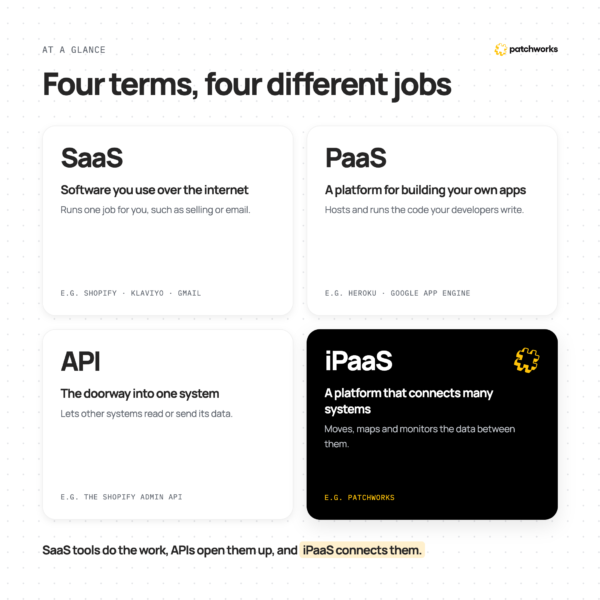
SaaS is software you use, PaaS is a platform for building apps, and an API is the way into one system. iPaaS connects many systems and manages the data between them. ESB and ETL are two older ways of moving data that often come up in the same conversation.
| Term |
What it is
|
What it does | Everyday example | When you need it |
|---|---|---|---|---|
| SaaS |
Software you use over the internet
|
Runs one job for you, such as selling or email
|
Shopify, Klaviyo, Gmail
|
Almost always
|
| PaaS |
A platform for building and running your own apps
|
Hosts code your developers write
|
Heroku, Google App Engine, AWS Elastic Beanstalk
|
When you build your own software
|
| API |
The doorway one system offers to others
|
Lets other systems read or send its data
|
The Shopify Admin API
|
Whenever two systems talk
|
| iPaaS |
A platform that connects many systems
|
Moves, maps and monitors data between them
|
Patchworks
|
When several systems must share data
|
| ESB |
Older integration software, often on-premise
|
Connects systems inside a company's own network
|
Software run by an in-house IT team
|
Mostly in older setups
|
| ETL |
Tools that copy data into a warehouse
|
Loads data in batches for reporting
|
Loading sales data into a data warehouse
|
When you need reporting across systems
|
The short version: SaaS tools do the work, APIs open them up, and iPaaS connects them.
What is iPaaS?
iPaaS (integration platform as a service) is cloud software that connects your systems and keeps data moving between them. It takes an order from your storefront, sends it to your ERP and warehouse, and sends stock and tracking updates back.
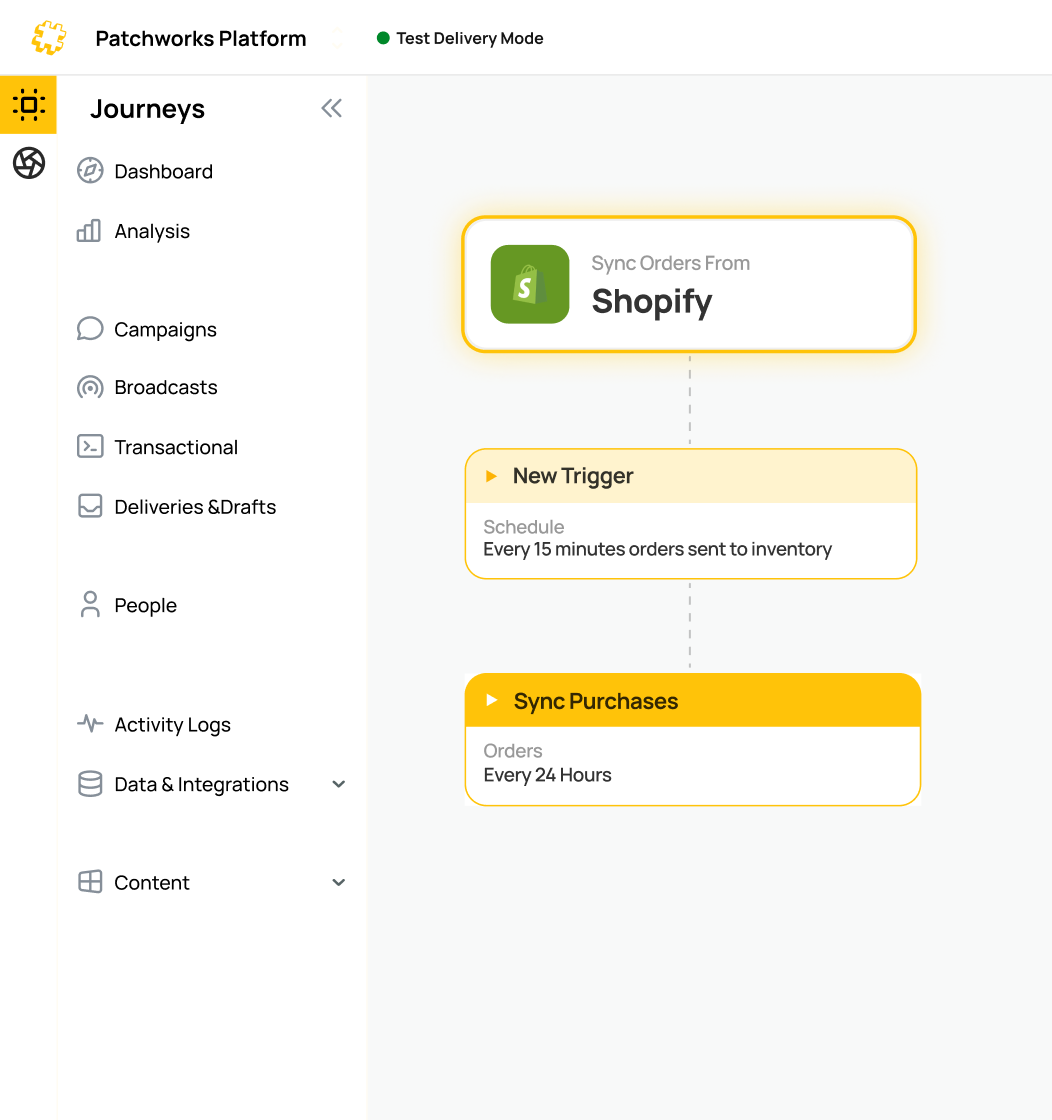
Patchworks is the retail-first, AI-native orchestration layer for retail tech stacks. See the Patchworks platform for how it works.
For the full explanation, read our guide to what is iPaaS?
What’s the difference between iPaaS and PaaS?
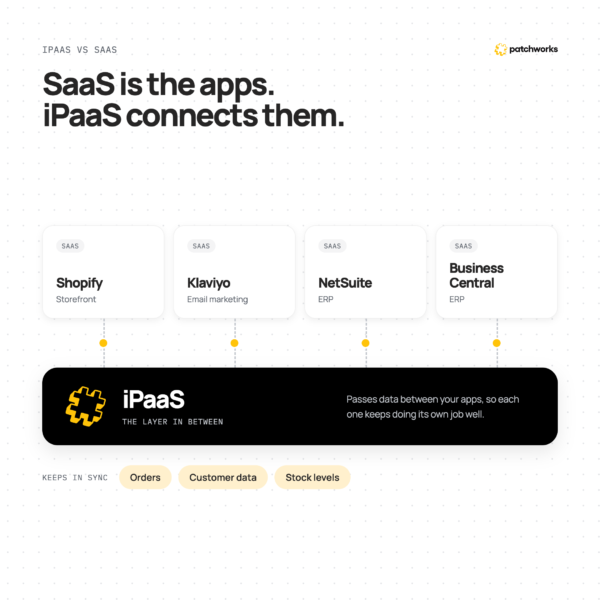
SaaS is the apps themselves, and iPaaS connects them. Shopify, Klaviyo, NetSuite and Microsoft Dynamics 365 Business Central are all SaaS. Each does its own job well, but none of them shares data with the others properly out of the box.
iPaaS is the layer in between. It passes orders from Shopify to an ERP such as NetSuite or Business Central, sends customer data to Klaviyo, and keeps stock the same everywhere.
The confusion comes from the name. iPaaS is also delivered as a service over the internet, so in one sense it’s SaaS too. The difference is its job: iPaaS exists to connect other software, not to replace it.
What’s the difference between iPaaS and PaaS?
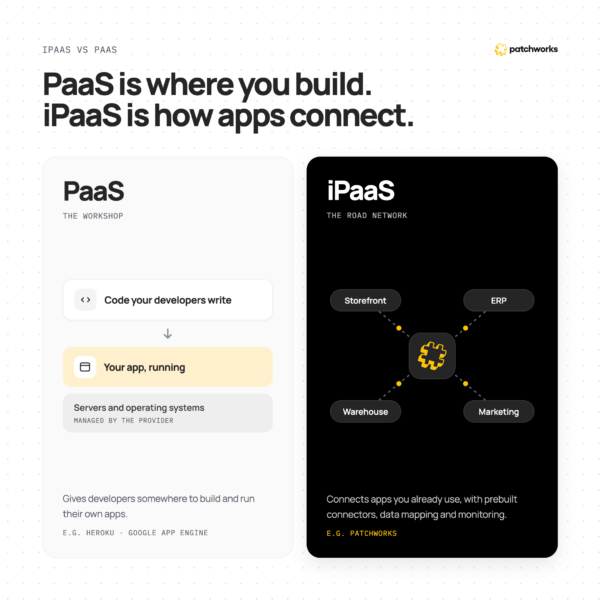
PaaS is for building and running apps, and iPaaS is for connecting them. Think of PaaS as the workshop where your developers build things. iPaaS is the road network between the buildings.
A PaaS such as Heroku or Google App Engine gives developers somewhere to run their code. The provider manages the servers and operating systems underneath. You still write the app yourself.
An iPaaS doesn’t host your apps. It connects apps you already use, with prebuilt connectors, data mapping and monitoring.
Is AWS a PaaS or SaaS?
AWS is mainly IaaS (infrastructure as a service) and PaaS. Amazon EC2 gives you raw computing power, which is IaaS. AWS Elastic Beanstalk runs your app for you, which is PaaS. Most businesses use AWS to build and host software, not as a ready-made app.
What’s the difference between iPaaS and an API?
An API is one system’s way in, and iPaaS manages many of those connections at once. On top of the APIs, iPaaS adds the parts a business needs to rely on them: data mapping, rules, retries and monitoring.
They’re not alternatives. iPaaS uses APIs to do its work. When Patchworks moves an order from Shopify to NetSuite, it reads the order through Shopify’s API and creates it through NetSuite’s.
Can you use APIs without iPaaS?
Yes, for one or two simple connections. A developer can write code that calls each API directly. It gets harder as you add systems. Each connection needs its own error handling, and someone has to update it whenever an API changes.
Patchworks also gives developers direct access through its own APIs and webhooks.
What’s the difference between iPaaS and ESB?
An ESB (enterprise service bus) is older integration software, usually installed on a company’s own servers and run by its IT team. iPaaS does a similar job from the cloud, and the provider runs the platform for you.
Companies are moving from ESB to iPaaS for three reasons:
- Their systems moved to the cloud: most retail software is now SaaS, and an on-premise ESB was built for systems inside the company’s network.
- Speed: iPaaS comes with prebuilt connectors, so each new integration doesn’t start from scratch.
- Maintenance: the iPaaS provider handles upgrades, hosting and scaling instead of the IT team.
What’s the difference between iPaaS and ETL?
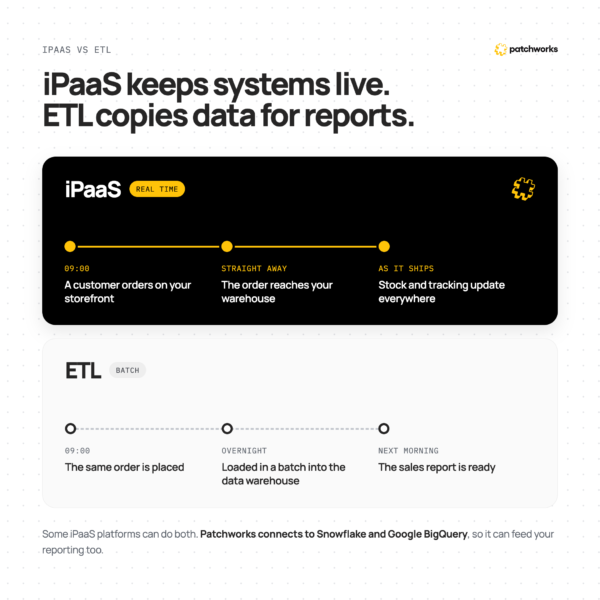
ETL (extract, transform, load) copies data in batches into a data warehouse for reporting. iPaaS keeps live systems in sync so the business can run day to day.
If a customer orders at 9am, iPaaS sends that order to your warehouse straight away. ETL might load the same order into your warehouse database overnight, so you can report on sales the next morning.
Some iPaaS platforms can do both. Patchworks has connectors for Snowflake and Google BigQuery, so the same platform that runs your orders can feed your reporting.
Is iPaaS the same as middleware?
iPaaS is a modern, cloud-based type of middleware. Middleware is any software that sits between systems and passes data between them. Older middleware, such as an ESB, was usually installed and run in-house. iPaaS is delivered as a service, with the provider looking after the platform.
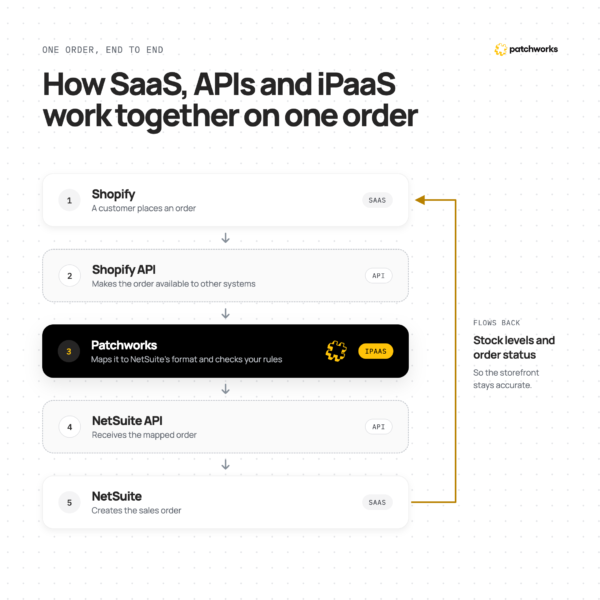
How do SaaS, APIs and iPaaS work together?
In most retail setups, all three play a part in every order. Here’s what happens when a customer orders on Shopify and the business runs NetSuite:
- A customer places an order on Shopify (SaaS).
- Shopify’s API makes the order available to other systems.
- Patchworks (iPaaS) picks up the order, maps it to NetSuite’s format and checks it against your rules.
- NetSuite (SaaS) creates the sales order through its own API.
- Stock levels and order status flow back from NetSuite to Shopify, so the storefront stays accurate.
See the Shopify and NetSuite integration pages for what moves between them. The same flow works with other ERPs, such as Sage and Business Central.
Which one do you need?
You’ll almost certainly use SaaS, and every SaaS tool has an API. The real question is whether you need iPaaS on top. That depends on how many systems you run and how much data moves between them.
- A small shop with two or three apps: SaaS and the integrations built into those apps are usually enough.
- A growing brand with a storefront, an ERP, a 3PL and marketplaces: iPaaS. With that many systems, one-off connections become hard to maintain. Castore cut pricing error rates from 30–35% to 1–2% after moving its pricing updates onto Patchworks.
- A software company building its own product: PaaS to host it, and possibly embedded iPaaS so your customers can connect it to their systems. Read embedded iPaaS explained.