Summary
B2B commerce stacks are becoming more complex — not because platforms like Shopify or ERPs are failing, but because the systems between them aren’t designed to scale. In this article, we explore what a fully connected B2B commerce tech stack really looks like, what B2B brands should expect from an iPaaS, and how pre-built, fully customisable ERP integrations can help teams move faster without rebuilding from scratch.
Why B2B commerce stacks are harder than they look
At a glance, B2B commerce can look deceptively simple. You have:
- A commerce platform like Shopify
- An ERP managing finance, inventory, and fulfilment
- A handful of supporting systems across warehousing, logistics, and reporting
But B2B operations quickly introduce complexity that differs D2C stacks, including:
- Customer- and contract-specific pricing
- Company hierarchies and approval workflows
- Multi-location inventory and fulfilment logic
- High order volumes with strict accuracy requirements
As a result, the challenge isn’t choosing the right tools — it’s connecting them in a way that holds up as the business evolves and scales.
The hidden cost of disconnected systems
Many B2B teams start with point integrations or pre-configured connectors to get up and running quickly. Early on, this can work well enough.
Over time, though, cracks start to appear:
- Data becomes inconsistent across systems
- Manual workarounds creep into day-to-day operations
- Performance issues surface during peak trading
- Changes require brittle fixes or full rebuilds
These limitations become especially painful in B2B scenarios involving complex pricing, company structures, or high-volume ordering. What starts as an integration problem becomes an operational one — affecting customer experience, internal efficiency, and confidence in the data teams rely on to make decisions.
- Data becomes inconsistent across systems
- Manual workarounds creep into day-to-day operations
- Performance issues surface during peak trading
- Changes require brittle fixes or full rebuilds
These limitations become especially painful in B2B scenarios involving complex pricing, company structures, or high-volume ordering. What starts as an integration problem becomes an operational one — affecting customer experience, internal efficiency, and confidence in the data teams rely on to make decisions.
What a “fully connected” B2B commerce tech stack really means
A fully connected B2B commerce stack isn’t just about syncing data from A to B.
It’s about creating an integration layer that:
- Keeps data consistent and reliable across systems
- Orchestrates workflows, not just individual syncs
- Adapts as pricing models, customer structures, and volumes evolve
For B2B brands, this means integrations need to handle:
- Orders, refunds, and fulfilment logic
- Inventory updates across locations and channels
- Customer, company, and pricing data
- Financial and operational reporting
This is where the difference between “connected” and “scalable” becomes clearer.
Why connectors and point integrations fall short
Out-of-the-box connectors are designed to solve common use cases quickly — and for early-stage needs, that’s often enough.
But as B2B complexity grows, teams start to hit limitations:
- Fixed data models that don’t reflect real-world workflows
- Limited visibility into errors or performance
- Little room to customise logic without workarounds
- Tight coupling that makes change risky
At this stage, teams are often forced to choose between:
- Living with constraints, or
- Rebuilding integrations entirely
And neither option is ideal!
How B2B brands could benefit from an iPaaS
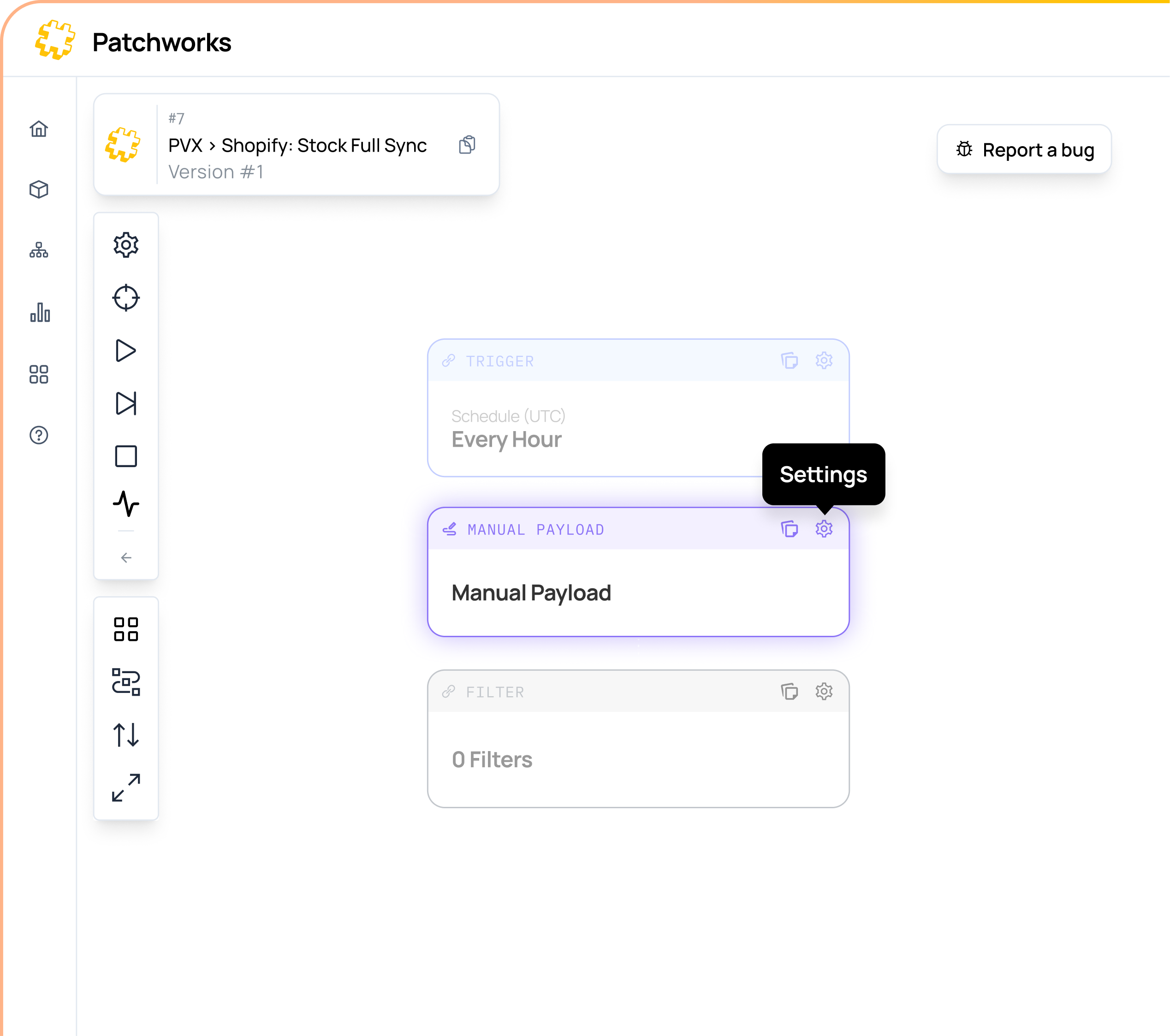
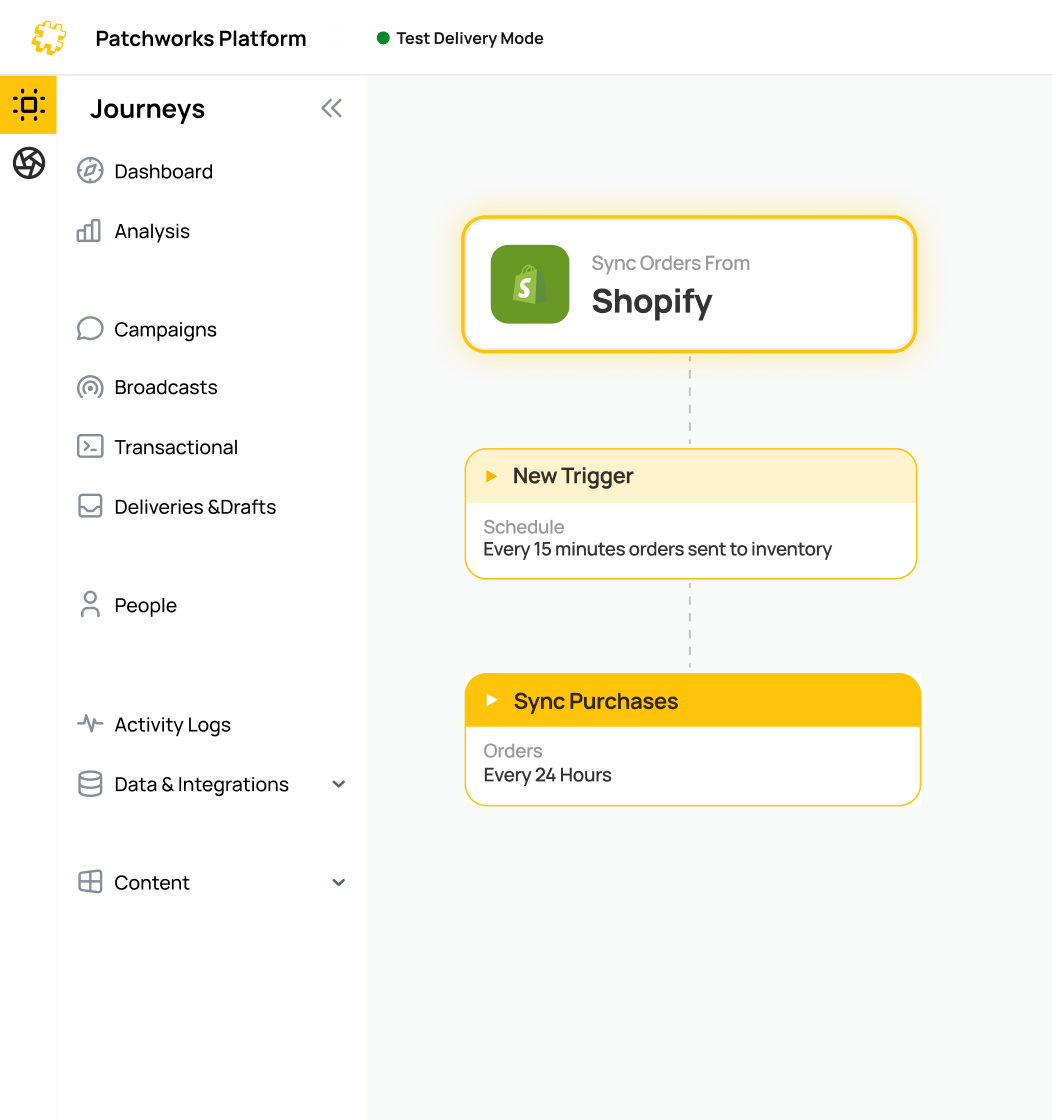
This is where an integration Platform as a Service (iPaaS), like Patchworks, becomes essential. An iPaaS provides a central layer to design, manage, monitor, and evolve integrations between commerce platforms, ERPs, and supporting systems.
For B2B commerce teams, an iPaaS should provide:
- Flexibility to adapt integrations as requirements change
- Control over data flows, mappings, and logic
- Visibility into performance, errors, and dependencies
- Scalability to support growth without constant rework
Rather than hard-coding connections between systems, an iPaaS acts as a central integration layer — designed to evolve alongside the business. For developers and agencies, this means less brittle code, clearer ownership of integration logic, and fewer late-night firefights when requirements change.
How pre-built accelerators change the game for B2B ecommerce
One of the biggest misconceptions about iPaaS is that it means starting from scratch.
In reality, modern iPaaS platforms combine pre-built foundations, and in Patchworks’ case, that comes with full customisation capabilities — giving B2B ecommerce teams the best of both worlds.
Patchworks’ Shopify ERP accelerators are a good example of this approach.
Built in close collaboration and approved by Shopify — and featured in Shopify’s Winter Editions ’26 programme — these accelerators:
- Speed up initial implementation
- Reduce integration risk
- Provide a production-ready starting point
At the same time, they remain fully customisable — allowing teams to extend, adapt, and optimise workflows as B2B requirements evolve.
Shopify–NetSuite accelerator
Designed for B2B brands running NetSuite as their ERP, this accelerator supports complex order, inventory, and financial workflows while maintaining flexibility for custom logic and scaling needs.
👉 Learn more about our Shopify-Netsuite ERP integration accelerator
Shopify–Brightpearl by Sage accelerator
Ideal for growing B2B and omnichannel retailers, this accelerator helps teams connect Shopify with Brightpearl while retaining control over data flows and operational processes.
👉 Learn more about our Shopify-Brightpearl by Sage ERP integration accelerator
In both cases, the goal is the same: remove setup friction without locking teams into rigid integrations.
Proven at scale for B2B and omnichannel retailers
Patchworks supports leading B2B and D2C omnichannel retailers, as they scale on Shopify.
These teams rely on Patchworks to:
- Keep ERP and ecommerce data in sync
- Support high-volume, high-complexity operations
- Adapt integrations as their commerce models change
The result is a more resilient, future-ready commerce stack — without constant re-engineering.
How to evaluate your current B2B commerce stack
If you’re assessing whether your integrations are fit for the future, ask:
- Can workflows evolve without rebuilding integrations?
- Do teams have visibility into errors and performance?
- Can the stack scale with order volume and complexity?
- Are integrations enabling growth — or slowing it down?
If the answer to any of these is “not really”, it may be time to rethink the integration layer.
See how a fully connected B2B commerce stack works
If you’re exploring ways to better connect Shopify with your ERP — or reassessing how your current integrations will scale — we’d be happy to help.
👉 Talk to our team to see how Patchworks supports fully connected B2B commerce stacks and how our Shopify ERP accelerators work in practice.
🚀 Explore the Shopify-Netsuite ERP integration accelerator
🚀 Explore the Shopify-Brightpearl by Sage ERP integration accelerator