Summary
- Tech monoculture—the operational dependency on a single software ecosystem or platform provider—introduces massive systemic risk to enterprise e-commerce infrastructure. Long-term business resilience requires architectural neutrality.
- Relying exclusively on one core platform leaves enterprise brands exposed to sudden changes in vendor roadmaps, unpredictable API token pricing increases, and forced ecosystem lock-in.
- True diversification involves utilising an open, headless Integration Platform as a Service (iPaaS) built on MACH Alliance principles. This decouples the core backend from front-end channels, allowing retailers to expand into new systems or geographies without heavy replatforming costs.
- Software providers and tech partners can leverage embedded, white-labeled iPaaS blueprints to deliver native marketplace and system connectivity directly inside their own applications, eliminating custom development friction for the end merchant.
Introduction
When building a high-growth retail brand, it is incredibly easy to fall in love with simplicity. In the early stages of scaling, nesting your entire business within a single, massive software ecosystem feels like an operational superpower. One login, one primary partner, one unified environment where everything seems to talk to everything else right out of the box.
But as you cross the threshold into true enterprise operations, that comfortable alignment can quietly turn into your single greatest operational vulnerability.
In biology, a monoculture—growing only one type of crop over a massive area—is highly efficient until a single tailored pathogen arrives and wipes out the entire yield. E-commerce technology operates under the exact same law. When your entire operational footprint is completely dependent on the rules, pricing models, and architectural limitations of a single technology ecosystem, you aren’t just building a streamlined business. You are establishing a single point of failure that can stall your global expansion or squeeze your margins overnight.
The Token Tax: The Hidden Danger of Platform Lock-In
Let’s be entirely candid about how the modern tech landscape moves. When you depend entirely on a monolithic suite or a single platform infrastructure, you are completely at the mercy of their corporate roadmaps and pricing fluctuations.
Consider a real-world warning pattern currently playing out across the global software layer: development agencies and tech platforms that built their entire value proposition around single AI ecosystems or rigid suites. When a major LLM provider suddenly introduces a massive, multi-fold token price increase, those dependent businesses are instantly crippled. Their underlying margins disappear because they lack the architectural flexibility to swap out components of their stack.
![[Mono-Tenant Stack] ──► Vendor Shifts Pricing/API Rules ──► ❌ Infrastructure Bottleneck](https://patchworks.io/wp-content/uploads/2026/07/TikTok-Shop-Order-No-Billing-Address-──►-Traditional-Middleware-──►-❌-ERROR-ERP-Validation-Failed-3-600x600.png)
For an enterprise retailer, this risk manifests in many ways. It could be a sudden shift in platform transaction fees, a restriction on custom data fields, or a core software provider underinvesting in a region you desperately need to expand into.
True business resilience demands strategic diversification. If your tech stack is neutral, you can adapt your business model whenever a partner changes their rules.
Breaking the Monoculture with Core Neutrality
How do elite global brands expand cross-border and launch new sales channels without constantly rewriting their underlying infrastructure? They build on an open, headless orchestration layer.
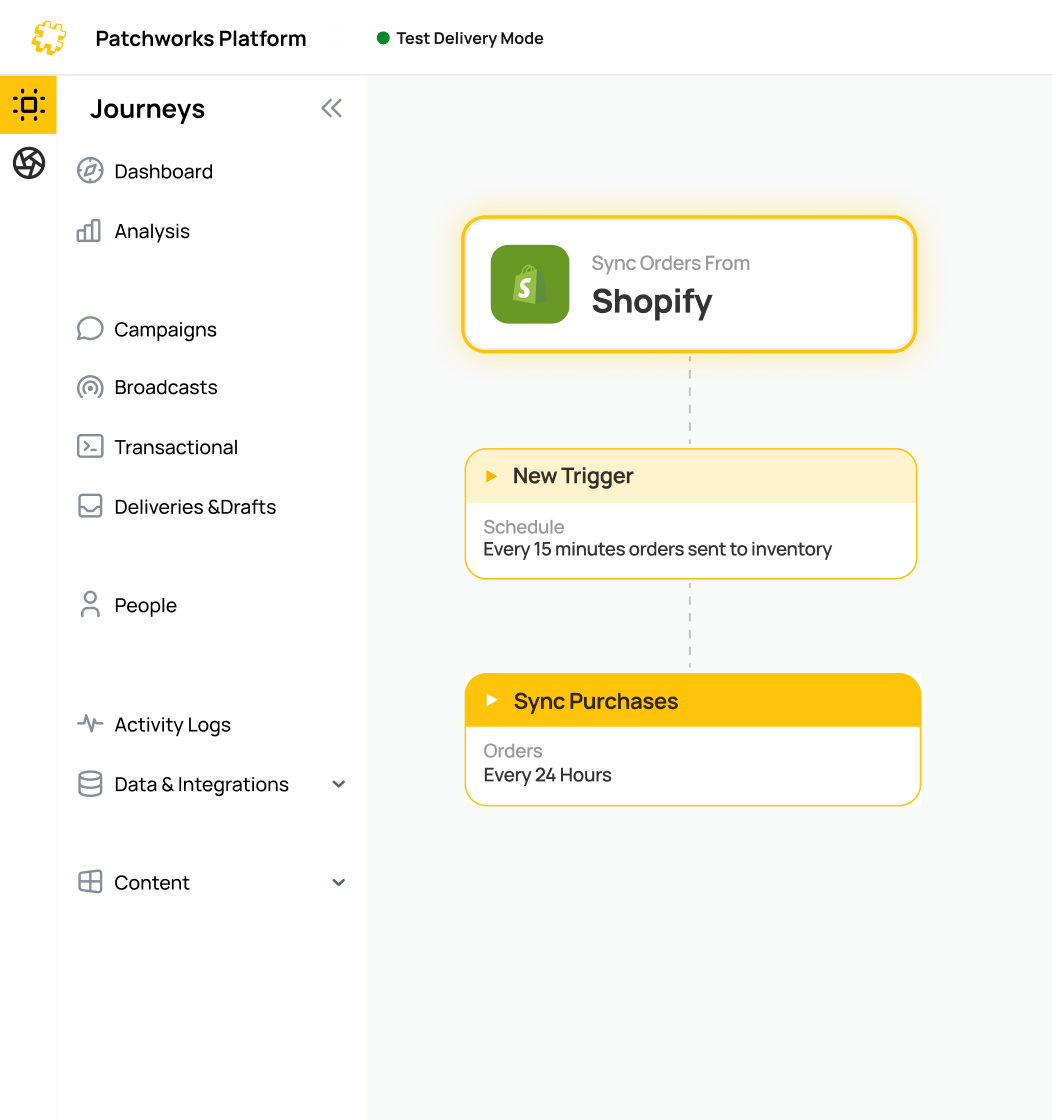
Instead of hard-coding your business logic directly into a single e-commerce platform or a single dominant ERP, a neutral Integration Platform as a Service (iPaaS) acts as an agile data buffer. By building your operations around an agnostic core, your integration layer can seamlessly connect standard setups (like the classic Shopify Plus stack) to robust specialised engines across the globe.
This open approach unlocks true operational agility across four critical growth vectors:
1. Unlocking Niche Enterprise Platforms
While specific commerce giants dominate certain regions, niche and hyper-focused alternative engines hold massive market share in specific verticals and territories. For instance, fashion-forward enterprise brands regularly utilise platforms like Centra and SCAYLE for its incredible depth in global B2B and apparel merchandising. An open iPaaS allows you to plug into these highly optimised ecosystems smoothly, bypassing standard suite limitations.
2. Localised ERP Expansion
As your business expands into manufacturing or diverse international logistics hubs, a one-size-fits-all financial suite rarely cuts it. A flexible infrastructure allows you to connect deeper, specialised regional ERPs—such as Acumatica or Epicor—into your existing retail channels seamlessly, without disrupting your day-to-day storefront operations.
3. Proactive Risk Mitigation
High-volume trading environments are incredibly volatile. Protecting your operations means having the ability to dynamically route data to backup 3PLs, localised warehouses, or alternative checkout channels the moment a main partner experiences an outage. To see how to audit your systems for these hidden operational gaps, explore our guide on the Hidden Risks of Peak Season.
4. AI Accelerated Orchestration (With Control)
Escaping a monoculture shouldn’t mean drowning in custom configuration code. Modern, platform-agnostic architecture uses artificial intelligence not to replace human logic, but to supercharge system mappings. By leveraging prompt-based workflows and intelligent schemas, operators can rapidly stage, test, and safely deploy data pipelines between completely different software ecosystems in fractions of the historical time. Learn more about how to safely speed up your tech deployment with Patchworks’ pre-built integration blueprints and AI Studio.
The Rise of Embedded iPaaS: White-Labeling the Connectivity
The need to escape the tech monoculture isn’t just a merchant problem—it’s a massive challenge for B2B technology providers as well.
If you are a returns management platform, a loyalty application, or a specialised marketplace aggregator, your growth relies entirely on your ability to connect to your customers’ diverse ecosystems. If an enterprise prospect uses a legacy or specialised backend ERP that your internal dev team hasn’t built a native plug-in for, the sale stalls out.
To solve this, forward-thinking tech platforms are shifting away from writing fragile, bespoke code for every single client request. Instead, they are utilising an Embedded iPaaS strategy.
![[Your App Interface] ──► [White-Labeled Connector Marketplace] ──► [Instant Client Integration]](https://patchworks.io/wp-content/uploads/2026/07/TikTok-Shop-Order-No-Billing-Address-──►-Traditional-Middleware-──►-❌-ERROR-ERP-Validation-Failed-4-600x600.png)
By white-labeling a headless integration core, software companies can place a native “Connect to ERP” or “Link Marketplace” button directly inside their own app portals. When the end-user clicks authorise, a pre-configured integration blueprint deploys automatically in the background. The user gets a smooth, native experience, while the software vendor completely eliminates integration development friction.
Conclusion: Future-Proofing Through Architectural Freedom
The most successful brands of the next decade will not be the ones locked inside a single vendor’s walled garden. They will be the ones that own their own architecture.
Diversifying your technology stack isn’t about creating complexity—it’s about protecting your business continuity and giving your teams the freedom to choose the absolute best tool for every job. By keeping your integration layer completely platform-neutral, you ensure that no matter how vendor roadmaps shift, API pricing changes, or new channels emerge, your business remains entirely in your own hands.
Next Steps for Commerce Operators and Ecommerce Managers
- Map Your Connections: Are your software integrations flexible enough to pivot smoothly if a vendor alters its rules tomorrow? Review your options across the Patchworks Integrations Page.
- De-Risk Your Roadmap: Ready to see how embedded infrastructure or platform-agnostic middleware can accelerate your global scaling plans? Book a live, tailored demo with our technical architecture team today.