
Executive summary
Camera Centre UK, a camera retailer with a retail premises in Cardiff, South Wales and exhibits with a retail presence at trade shows across the UK, built its Lightspeed Retail (X-Series) to Linnworks integration in-house on Patchworks. Ecommerce Manager Joe Earp, who has no formal technical training, created flows that route every type of in-store sale into Linnworks, alert store managers to returns and keep payment status in sync. Issues that once took two to three weeks to resolve now take around 15 minutes.
Camera Centre UK at a glance
- Client: Camera Centre UK
- Sector: Specialist photographic retail: new, used and ex-demo cameras, lenses, drones and optics
- Channels: Shops in Cardiff and Newport; Magento website; eBay; Amazon; OnBuy
- Systems connected via Patchworks: Lightspeed Retail (X-Series) and Linnworks
- Wider stack: Linnworks for order aggregation and stock management, with Magento, eBay, Amazon and OnBuy connected through its native channel integrations
- Patchworks customer since: 2022
- Delivery: Built in-house by the ecommerce manager in about four weeks, with no developers
- Headline results: Most issues fixed in about 15 minutes (previously two to three weeks); every in-store sale type routed into Linnworks; returns and payment status now visible
“Being able to build it myself is the big difference. I can make Patchworks do exactly what I want, without having to explain it to someone else first. Something that used to take three weeks, I can now change in 15 or 20 minutes.”
Joe Earp
Ecommerce Manager, Camera Centre UK
What was holding Camera Centre UK back?
Camera Centre UK has sold photographic equipment since 1977, through their shop in Cardiff, its own Magento website, and eBay, Amazon and OnBuy. Linnworks manages orders and stock and connects the online channels natively, while Lightspeed Retail (X-Series) runs the tills. The hard part was getting every in-store sale into Linnworks accurately.
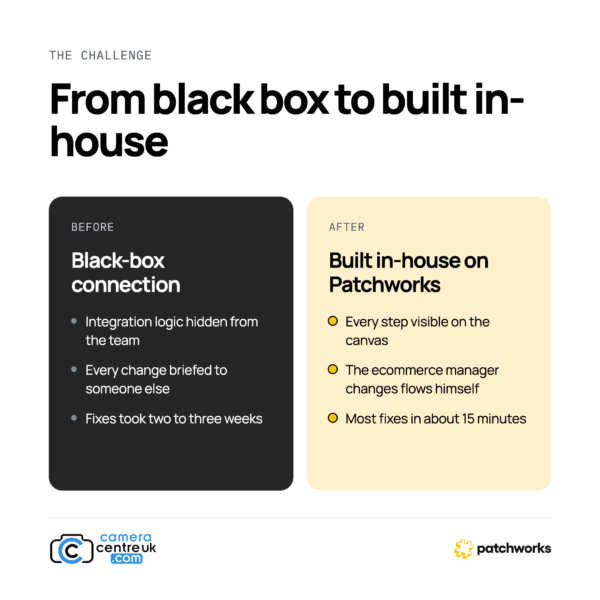
- A black-box connection. The shops were linked to Linnworks, but the logic was hidden. Every change had to be briefed to someone else, and even small changes took around three weeks.
- No visibility when things went wrong. Finding the cause of a failed sale or product sync was guesswork, and fixes took two to three weeks.
- In-store edge cases slipped through. Returns vanished without a trace (full refund, partial refund or store credit), and orders shipped from a shop or collected in store weren’t marked as paid in Linnworks.
- Years of manual work. After around 12 years of handling much of this by hand, the team wanted automation they could trust.
“Before, it was all hidden away. If something didn’t go the way I expected, there was no way for me to go back and fix it. I had to get in touch with someone, and then a week would pass.”
— Joe Earp, Ecommerce Manager, Camera Centre UK
Can an ecommerce manager build integrations without a developer?
At Camera Centre UK, yes. When the company moved to Patchworks Core, Joe chose to build the integration himself rather than bring in an integration partner.
Joe has no formal technical training. What he did have was years of experience running Linnworks, so he knew exactly how every type of order should land. On a platform where he could see and change every step, that knowledge went straight into the build.
“There isn’t that gap where I have to explain how Linnworks works to someone who’s programming it. I know exactly what I want to happen when something feeds over, and with Patchworks I can set it up to do exactly that.”
— Joe Earp, Ecommerce Manager, Camera Centre UK
It took about four weeks of focused learning, with an AI assistant helping to plan flows and write the occasional script. Now Joe plans flows on his own.
“Make the move sooner rather than later, but give yourself time to learn it rather than trying to do everything in four weeks. It’s a great platform for automation, and I’m very glad we switched.”
— Joe Earp, Ecommerce Manager, Camera Centre UK
How does the Lightspeed X-Series to Linnworks integration work?
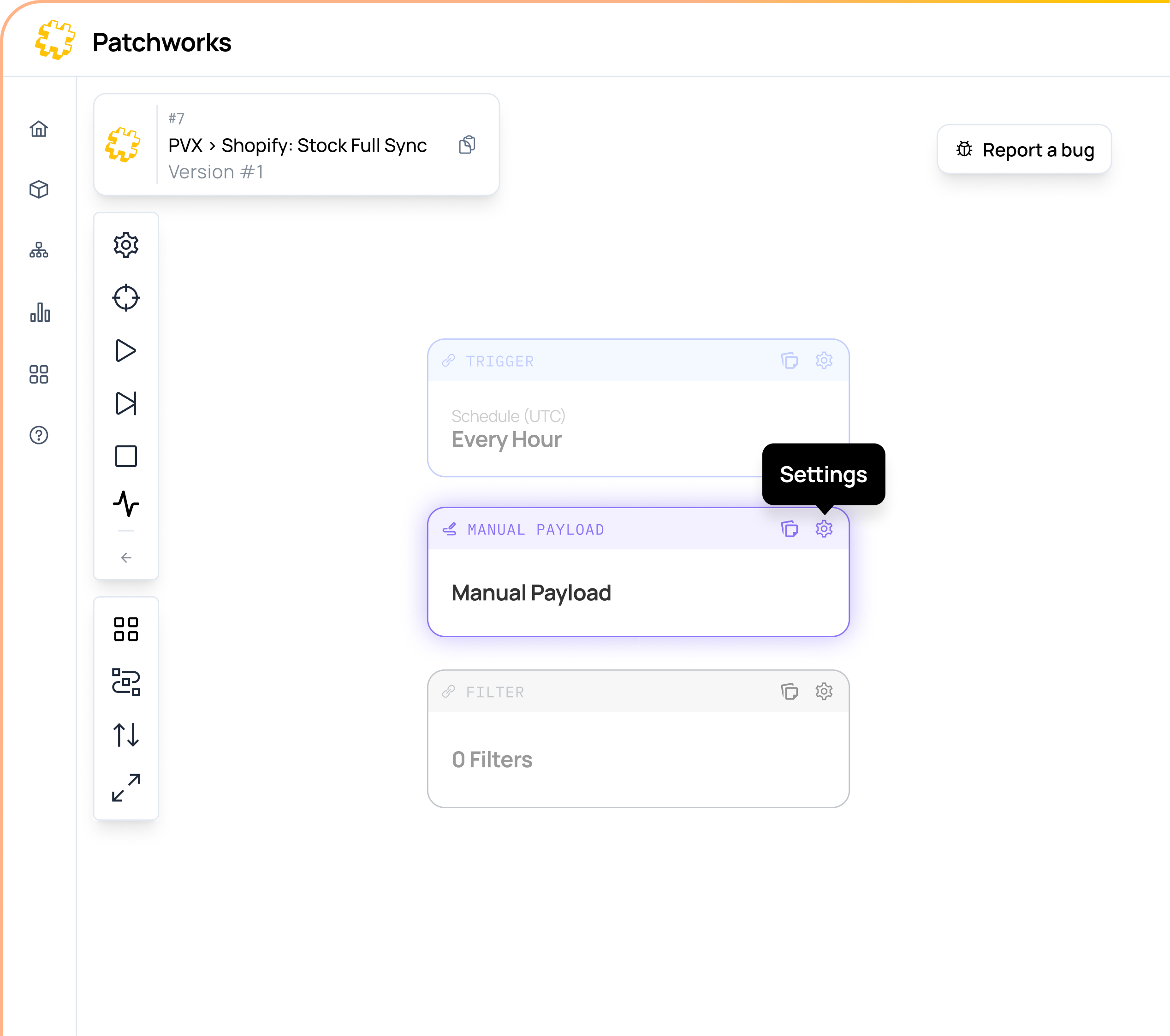
Patchworks connects Lightspeed Retail (X-Series) and Linnworks through prebuilt connectors. Joe built the business logic on top as a set of flows he can see, test and change on the Patchworks process flow canvas.
One header flow, a route for every type of sale
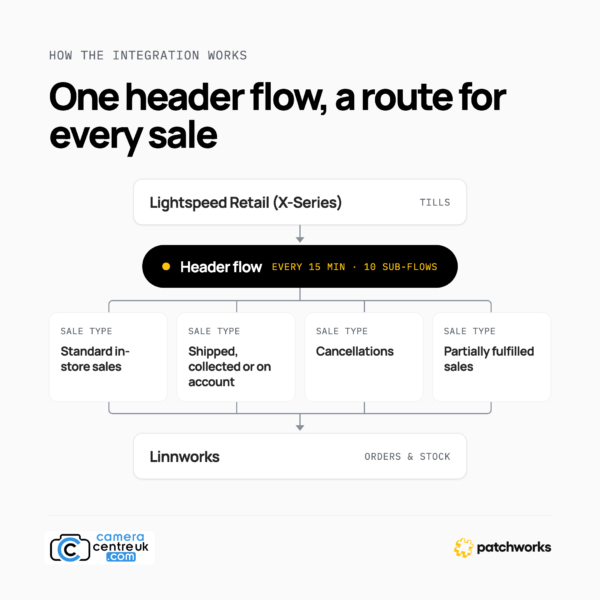
A header flow runs every 15 minutes. It collects new sales from Lightspeed and sends each one to a dedicated sub-flow, based on how the sale was made and settled. Ten sub-flows cover the ways a sale can go through the tills:
- Standard in-store sales,
- Sales settled by shipping, click and collect, in store or on account
- Cancellations
- Sales for partially fulfilled in store sales, with other parts needing shipping or collection later
- However a salesperson puts a sale through, Linnworks records it the way the business needs.
Payment status that updates itself
Lightspeed increments a version number every time a record changes. Joe’s flows use it to spot updates, so when a ship-from-store or click-and-collect order is paid, Patchworks tells Linnworks to mark it as paid. Nobody has to chase payment status between systems.
Returns that reach a person
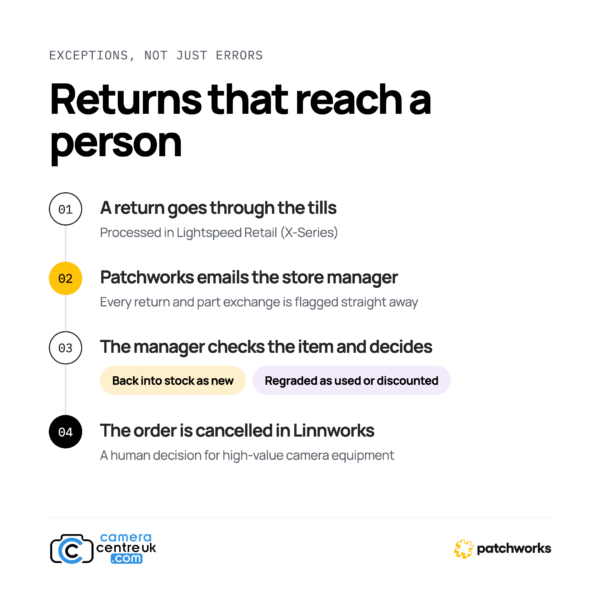
Linnworks doesn’t handle negative quantities easily, so returns needed a different approach. Whenever an in-store return goes through, Patchworks emails the store manager. The manager checks the item and decides whether it goes back into stock as new or is regraded and sold as used or discounted stock. The order is then cancelled in Linnworks. For high-value camera equipment, that human decision is deliberate.
Errors flagged and isolated
Patchworks emails Joe as soon as anything fails. One failing order used to stop a whole batch, so he added a try/catch step that pulls the failed order out on its own and lets the rest run.
“Now I can drop in a try-catch, get the data out for that one failed payload, and the problem’s solved in five minutes.”
— Joe Earp, Ecommerce Manager, Camera Centre UK
Beyond orders: automated catalogue housekeeping
On the first of every month, a housekeeping flow finds products that have been out of stock for more than 90 days but are still listed on Magento. It emails a CSV so the team can end those listings and archive the products in Linnworks, with further plans to automate this with Patchworks in future, along with their other sales channels. Keeping the catalogue focused on in-stock products is better for shoppers and for Google.
“Once it’s built, you get an email on the first of the month telling you what to sort out. There’s no keeping a notepad of what needs doing.”
— Joe Earp, Ecommerce Manager, Camera Centre UK
What results did Camera Centre UK see?
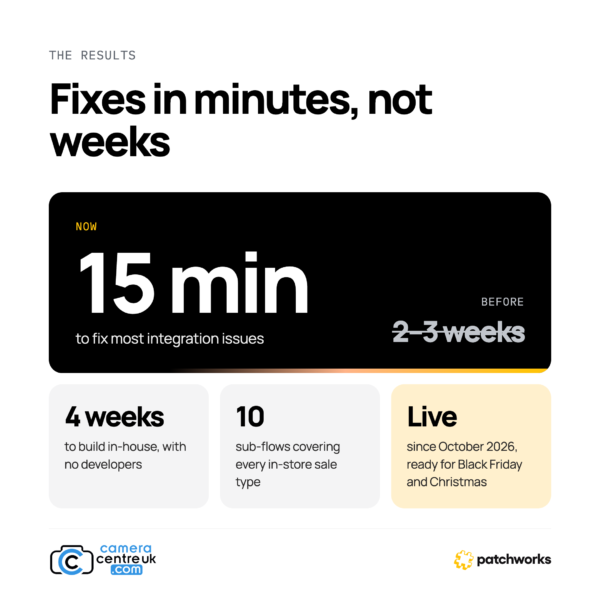
Camera Centre UK now resolves most integration issues in about 15 minutes instead of two to three weeks, and every type of in-store sale reaches Linnworks correctly.
Most fixes in about 15 minutes, down from two to three weeks. Joe sees the problem in Patchworks, fixes it and redeploys. The longest fix so far took an hour, tracing a misconfiguration error. Changes that took around three weeks now take 15 to 20 minutes.
Every in-store sale type handled. Standard sales, customer orders, collections, account sales and cancellations all reach Linnworks the way the business needs.
Returns, part exchanges, and payments visible. Store managers receive an email for every return, or part exchange to action, and paid orders update in Linnworks automatically.
Ready for peak. After step-by-step testing, the orders flow has performed exactly as expected since going live in October 2026, ahead of Black Friday and Christmas.
“The highest praise you can give any system is that it works how you expect it to. Every step was tested, and it’s performed exactly as I anticipated. Even in scenarios I had not considered during the build stage”
— Joe Earp, Ecommerce Manager, Camera Centre UK
Why it worked
The person who knew how Linnworks should behave could build it directly, so nothing was lost in translation.
Key takeaways for retailers with shops and online channels
- Avoid black-box connections. If you can’t see how your integration works, you can’t fix it quickly.
- Let the person who knows the process own it. Whoever understands your order flow best should be able to see and change the logic.
- Route each sale type deliberately. Customer orders, unpaid sales, collections and account sales each need their own rules.
- Alert people to exceptions, not just errors. Returns on high-value items deserve a human decision.
Ready to take control of your integrations?
Whether you sell through shops, your own website, marketplaces or all three, Patchworks connects your POS, order management and sales channels on one platform, and your own team can build and change the flows. Book a demo to see how.