The 2026 Reality Check: High Stakes and Higher Complexity
Modern commerce has reached a level of complexity where “good enough” technology inevitably fails under the weight of high-volume demand. Our first-party research highlights the structural risks currently facing retail leaders as they approach the busiest quarter of the year:
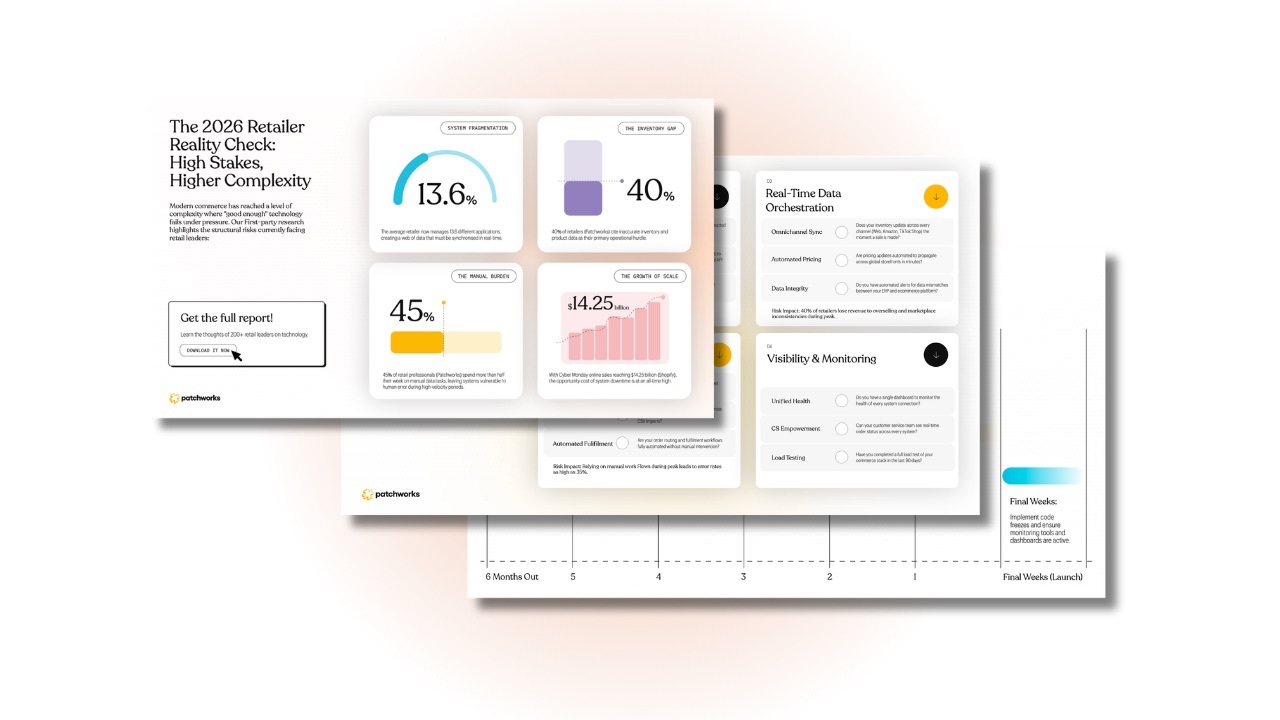
- System Fragmentation: The average retailer now manages 13.6 different applications, creating a complex web of data that must be synchronised in real-time.
- The Inventory Gap: 40% of retailers cite inaccurate inventory and product data as their primary operational hurdle.
- The Manual Burden: 45% of retail professionals spend more than half their week on manual data tasks. During high-velocity periods, this reliance on human intervention leaves systems highly vulnerable to human error.
- The Opportunity Cost: With Cyber Monday online sales reaching $14.25 billion, the opportunity cost of even a few minutes of system downtime is at an all-time high.
The Peak Readiness Audit: Diagnosing Technical Debt
To avoid operational failure, retail leaders must evaluate their infrastructure across four critical pillars to identify “Technical Debt” and hidden risks.
1. Integration Resilience
The foundation of a peak-ready stack is how your core systems—such as your ERP, Shopify storefront, and WMS—are connected.
- Centralisation vs. Point-to-Point: Are systems linked via a central integration layer, or a mess of point-to-point code?.
- Concurrency Limits: Have you confirmed your ERP concurrency limits to handle peak transaction volumes and avoid API bottlenecks?.
- Buffering Capabilities: Can your middleware buffer data if downstream systems, such as a 3PL, begin to lag under the load?.
Risk Impact: Fragile, point-to-point integrations are prone to “ghost orders” and catastrophic data loss during surges.
2. Real-Time Data Orchestration
Speed is irrelevant if the data is inaccurate. Real-time synchronisation is the only way to maintain a “single version of truth”.
- Omnichannel Sync: Does inventory update across every channel (Web, Amazon, TikTok Shop) the moment a sale is made?.
- Automated Pricing: Are pricing updates automated to propagate across global storefronts in minutes rather than hours?.
- Data Integrity Alerts: Do you have automated alerts to catch data mismatches between your ERP and ecommerce platform before they reach the customer?.
Risk Impact: 40% of retailers lose significant revenue to overselling and marketplace inconsistencies during peak periods.
3. Operational Efficiency
Your team’s time is your most valuable resource during peak. If they are bogged down by data entry, they cannot focus on growth.
- Manual Work Reduction: Does your team spend less than 20% of their week on manual data reconciliation?.
- Global Agility: Can you propagate a site-wide discount across 30+ stores simultaneously without manual CSV imports?.
- Automated Fulfilment: Are your order routing and fulfilment workflows fully automated without the need for manual intervention?.
Risk Impact: Relying on manual workflows during peak leads to error rates as high as 35%.
4. Visibility & Monitoring
You cannot fix what you cannot see. Monitoring tools act as your early warning system.
- Unified Health Dashboard: Do you have a single dashboard to monitor the health and performance of every system connection?.
- Customer Service Empowerment: Can your CS team see real-time order status across every system to provide accurate updates to shoppers?.
- Load Testing: Have you completed a full load test of your entire commerce stack in the last 90 days?.
The 6-Month Execution Roadmap
Peak readiness is a strategic marathon, not a sprint. Use this timeline to stay ahead of the curve:
- Phase 1: Strategy Review (6 Months Out)
Audit the current commerce stack to identify fragmented integrations, legacy middleware, or “brittle” connections that may fail under pressure.
- Phase 2: Infrastructure Testing (3-4 Months Out)
Conduct rigorous load testing. Validate ERP concurrency limits to find exactly where your breaking point lies.
- Phase 3: Operational Prep (1-2 Months Out)
Automate pricing workflows and ensure inventory synchronisation is truly real-time across all global storefronts.
- Phase 4: Final Weeks (Launch)
Implement strict code freezes to prevent last-minute bugs. Ensure all monitoring tools and dashboards are active and that the team is trained on incident response.
Proof Point: How Castore Transformed Peak Performance
Global sportswear brand Castore utilised Patchworks to redesign its pricing architecture and eliminate the manual bottlenecks holding back its global growth.
- The Challenge: Pricing updates were manual and relied on slow CSV imports, taking 5 hours to update across global storefronts.
- The Solution: They implemented Patchworks as a retail-first integration layer to automate data orchestration and stabilise ERP concurrency.
- The Results:
- Pricing error rates dropped from 35% to just 1-2%.
- Pricing update times were slashed from 5 hours to 2-3 minutes.
- Supported 35 global Shopify storefronts simultaneously during peak demand.
Secure Your Peak Revenue: Next Steps
Don’t leave your most important trading period to chance. Modern retail success is built on a foundation of resilient, automated infrastructure.
Ready to calculate your own “Resilience Score”? The full playbook includes the 2026 Peak Readiness Audit, a detailed Tactical Infrastructure Checklist, and the full Resilience Scoring Guide.
What’s your Resilience Score?
- 15-24 (Peak-Ready): You have a resilient architecture. Focus on final load testing.
- 8-14 (Operational Risk): Your technical debt is a “silent killer.” You are at high risk of inventory mismatches.
- 0-7 (Critical Failure Imminent): Your stack is over-reliant on manual work. You need a retail-first iPaaS to survive the surge.