
Executive Summary
Newby Teas, a premium tea brand selling direct to consumers and to luxury hotels worldwide, used Patchworks to connect Shopify Plus to three of its four 3PL warehouse partners during its Magento to Shopify Plus migration. Delivered with Shopify Plus agency blubolt, the integrations push orders to each warehouse and pull stock back into Shopify. That replaced manual data syncs in a business running several ERPs, including SAP, Sage and Odoo, and freed the team to focus on trading.
Newby Teas at a glance
Client: Newby Teas
Sector: Food and beverage (premium tea), D2C and B2B
Agency partner: blubolt, Shopify Plus agency and Patchworks delivery partner
Platform change: Adobe Magento to Shopify Plus
Systems connected: Shopify Plus and three 3PL warehouse partners via Patchworks; wider stack includes SAP, Sage and Odoo ERPs
Data flows: Orders pushed to warehouses; stock levels pulled into Shopify
Markets: UK, USA, Canada, Europe, Poland, Switzerland, Japan, India and the UAE
Headline results:
- Manual warehouse data syncs replaced with automated flows
- +43% add-to-cart rate
- +41% conversion rate after the replatform launch
“Running four warehouses across multiple markets meant our team spent far too much time keeping orders and stock in sync by hand. With Patchworks connecting Shopify Plus to our warehouse partners, orders flow out and stock flows back automatically. Our team can now focus on trading and growing the brand, not on managing data.”
Hélène Bégusseau
Global Ecommerce & Digital Manager, Newby Teas
Migrating ecommerce from Magento to Shopify Plus
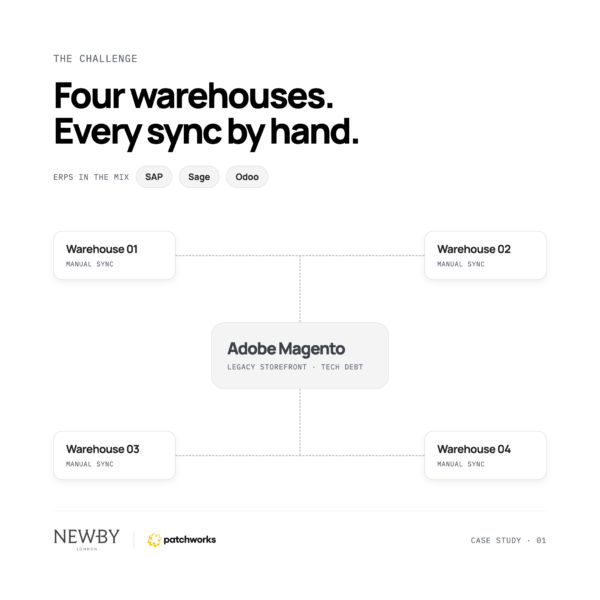
Newby Teas sells through its online store, boutiques in London and Switzerland, and a global B2B business supplying luxury hotels, Michelin-starred restaurants and luxury retailers. Its Adobe Magento site carried heavy technical debt, and its back office relied on inefficient manual data syncs with four separate warehouses.
- Manual warehouse syncs: Orders and stock had to be moved between the storefront and four warehouse partners by hand.
- Mixed ERP landscape: Operations ran across several markets on different ERPs, including SAP, Sage and Odoo, so no single template fitted every warehouse.
- Team time lost to legacy systems: Staff spent their time maintaining old systems instead of driving growth.
- International complexity: The brand sells across the UK, USA, Canada, Europe, Japan, India, the UAE and more, served through different warehouse partners.
“Our old Magento setup had us managing legacy systems instead of growing the business. Every warehouse needed manual data syncs, and that drag held back everything we wanted to do online.”
— Hélène Bégusseau, Global Ecommerce & Digital Manager, Newby Teas
Newby Teas briefed blubolt to migrate to Shopify Plus and build one architecture that could serve every market. Connecting that new storefront to the warehouse network reliably was the hardest part of the job.
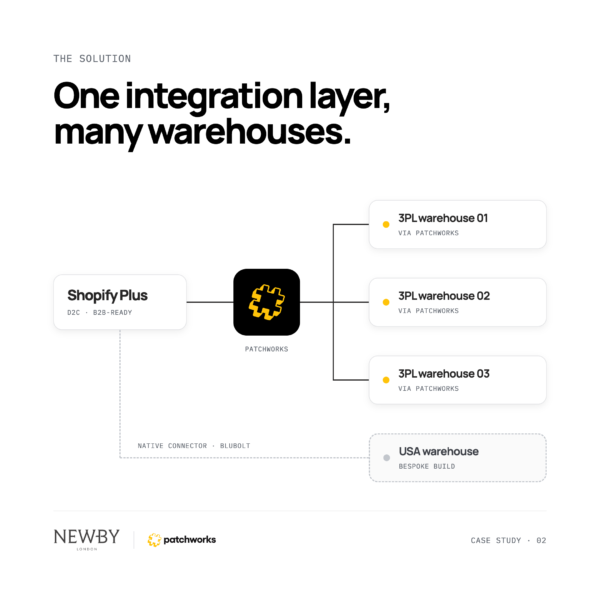
How did Patchworks and blubolt connect the warehouse network?
blubolt, a Shopify Plus agency and official Patchworks delivery partner, used Patchworks to connect Shopify Plus to three of Newby Teas’ four warehouses, and built a native connector for its USA operation. blubolt called unifying the back office the most complex challenge of the migration.
“Sustainable growth comes from doing the small, hard things exceptionally well.”
— Iestyn Keyes, CEO, blubolt (Read the blubolt Newby Teas case study)
One integration layer, many warehouses
| System | Role | Connection |
|---|---|---|
| Shopify Plus | D2C storefronts across all markets; built B2B-ready | Sends orders; receives stock levels |
| Three 3PL warehouse partners | Fulfilment across Newby Teas’ markets | Patchworks |
| USA warehouse | Fulfilment for the USA | Native connector built by blubolt |
Behind the warehouses, Newby Teas runs a mix of ERPs, including SAP, Sage and Odoo, which is why a single multi-warehouse template wouldn’t fit.
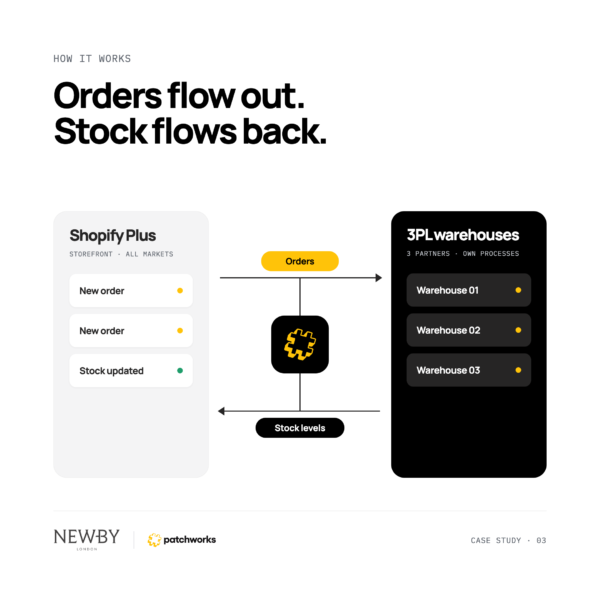
Automating orders out and stock in
Patchworks pushes every new Shopify Plus order to the right warehouse and pulls stock data back into Shopify automatically. That removed the manual bottleneck between selling and shipping, and keeps on-site availability accurate across markets.
Fitting each warehouse, not forcing a template
Each warehouse partner runs on its own systems and processes. Patchworks lets blubolt shape each flow around how that warehouse already works, so Newby Teas didn’t have to change its fulfilment partners to move platforms.
“We needed one Shopify Plus storefront to work with very different warehouse partners and ERPs across our markets. blubolt and Patchworks made that work without us changing how each warehouse operates.”
— Hélène Bégusseau, Global Ecommerce & Digital Manager, Newby Teas
The agency view
blubolt’s CEO has said Patchworks helps the agency “convert backend complexity into front-end simplicity” (source). On Newby Teas, that meant the storefront work (product storytelling, localised checkout and a retention stack) could rest on reliable order and stock data.
“Newby Teas runs a genuinely complex operation: several markets, four warehouse partners and three different ERPs. Patchworks gave us one place to build and manage those flows, so we could connect three warehouses on one platform and focus our own development on the parts that needed something bespoke.”
— Iestyn Keyes, CEO, blubolt
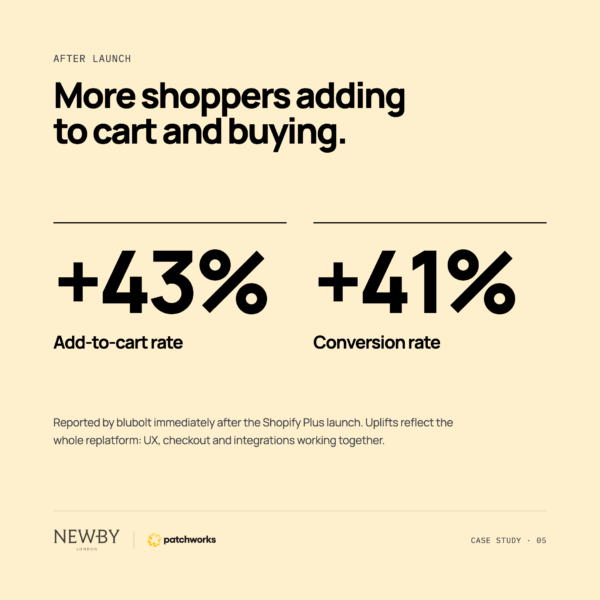
What results did Newby Teas see?
The automated warehouse integrations removed hours of manual administration, and the new Shopify Plus site lifted add-to-cart by 43% and conversion by 41% straight after launch.
Manual warehouse syncs replaced with automated flows. Orders now reach three warehouses through Patchworks, and stock levels update in Shopify Plus without manual input.
Hours of admin returned to trading. According to blubolt, the unified warehouse integrations freed the Newby Teas team to focus on trading the site. “Before Patchworks, four people across our four markets each spent around 30 minutes a day downloading data, correcting it and sending it to the warehouse. That’s two hours a day, or around 10 hours a week, all done manually. Automating it has given us back roughly 520 hours of team time a year.” — Hélène Bégusseau, Global Ecommerce & Digital Manager, Newby Teas
+43% add-to-cart and +41% conversion rate. blubolt reports both uplifts immediately after the Shopify Plus launch. They reflect the whole replatform, including UX, checkout and integrations working together.
A foundation for B2B growth. The platform is built on Shopify B2B-ready, so Newby Teas can move offline trade customers to online self-serve ordering. From Patchworks’ side, the same integration layer could also route those B2B orders to the right warehouse as trade customers move online.
“The integrations have removed hours of manual administration. We trust our stock data, and orders reach the right warehouse without anyone touching them.”
— Hélène Bégusseau, Global Ecommerce & Digital Manager, Newby Teas
Why it worked
Patchworks handled the repeatable warehouse connections on one platform, which let blubolt spend its custom development where only bespoke would do.
Key takeaways for multi-warehouse brands
- Plan warehouse integration as part of the migration. A new storefront only performs if orders and stock move reliably behind it.
- Don’t force every warehouse into one template. Brands with several 3PLs and ERPs need flows shaped around each partner’s processes.
- Use an iPaaS for the repeatable, build custom for the rest. One integration platform for most connections keeps bespoke development for genuine edge cases.
- Choose an agency and iPaaS that already work together. A delivery partnership shortens the handover between storefront build and integration.
Ready to automate your warehouse network?