Executive Summary
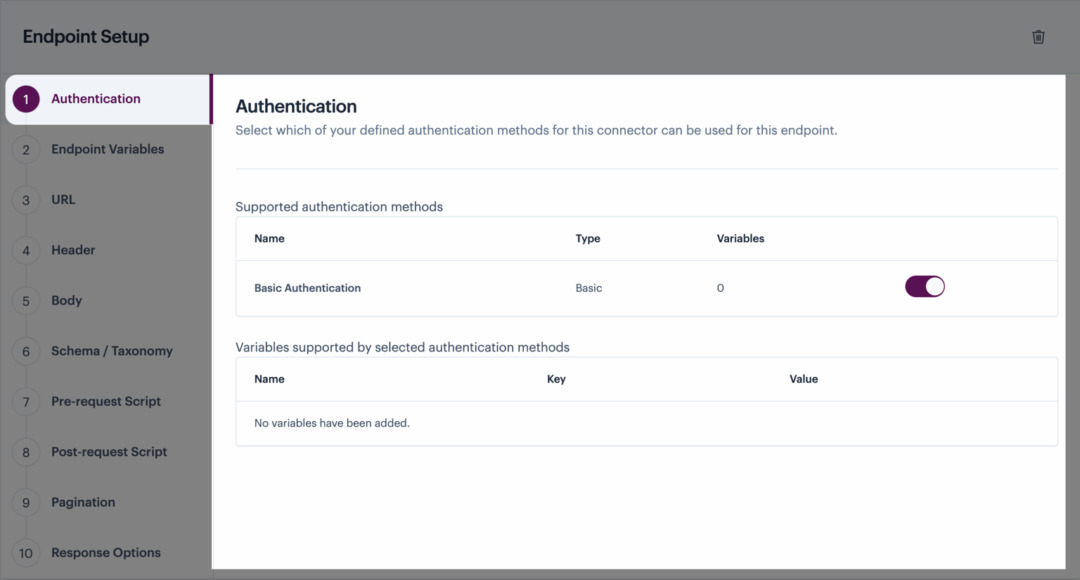
Patchworks decouples its enterprise integration platform (iPaaS) engine from the user interface using the Model Context Protocol (MCP). Built natively on MACH architecture, every platform layer—flows, connectors, and mappings—is exposed programmatically. This allows external AI models to directly query live integration data, orchestrate multi-system operations, and execute autonomous self-healing error resolution without a human-in-the-loop bottleneck.
Moving Beyond the UI Bottleneck in Enterprise Integration
For years, the standard enterprise integration platform operated on a predictable, human-centric model: a developer logs into a graphical user interface (UI), maps data fields from an ERP to an e-commerce platform, and manually triages errors when a sync fails.
But as enterprise commerce ecosystems scale into dozens of composable microservices, this reliance on manual UI interaction becomes a major bottleneck.
To build an iPaaS optimised for AI workflow automation, you can’t just slap an AI chatbot wrapper or an assistant widget onto a legacy system. AI models don’t think in dropdown menus, drag-and-drop canvases, or colorful dashboards. They think in data structures, contexts, and actions. If an integration platform’s core architecture isn’t built from the ground up for programmatic execution, any AI layer added on top is just a retrofit.
Why Composable MACH Architecture is the Foundation of AI
When we designed the core Patchworks engine—long before generative AI entered the enterprise mainstream—we made a foundational architectural choice: the user interface must always be optional.
This choice is anchored in MACH Architecture principles:
- Microservices: Modular, independently deployable components.
- API-first: Every piece of functionality is exposed via a clean, programmatic interface.
- Cloud-native: Highly scalable infrastructure built for modern web performance.
- Headless: The front-end presentation layer is completely decoupled from back-end logic.
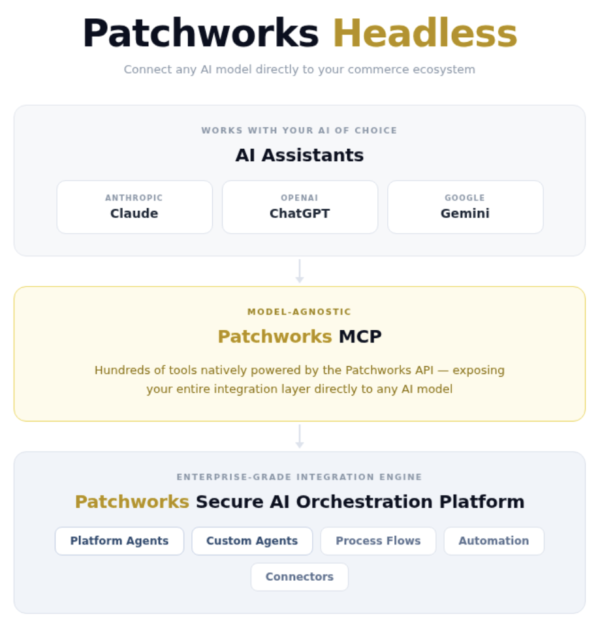
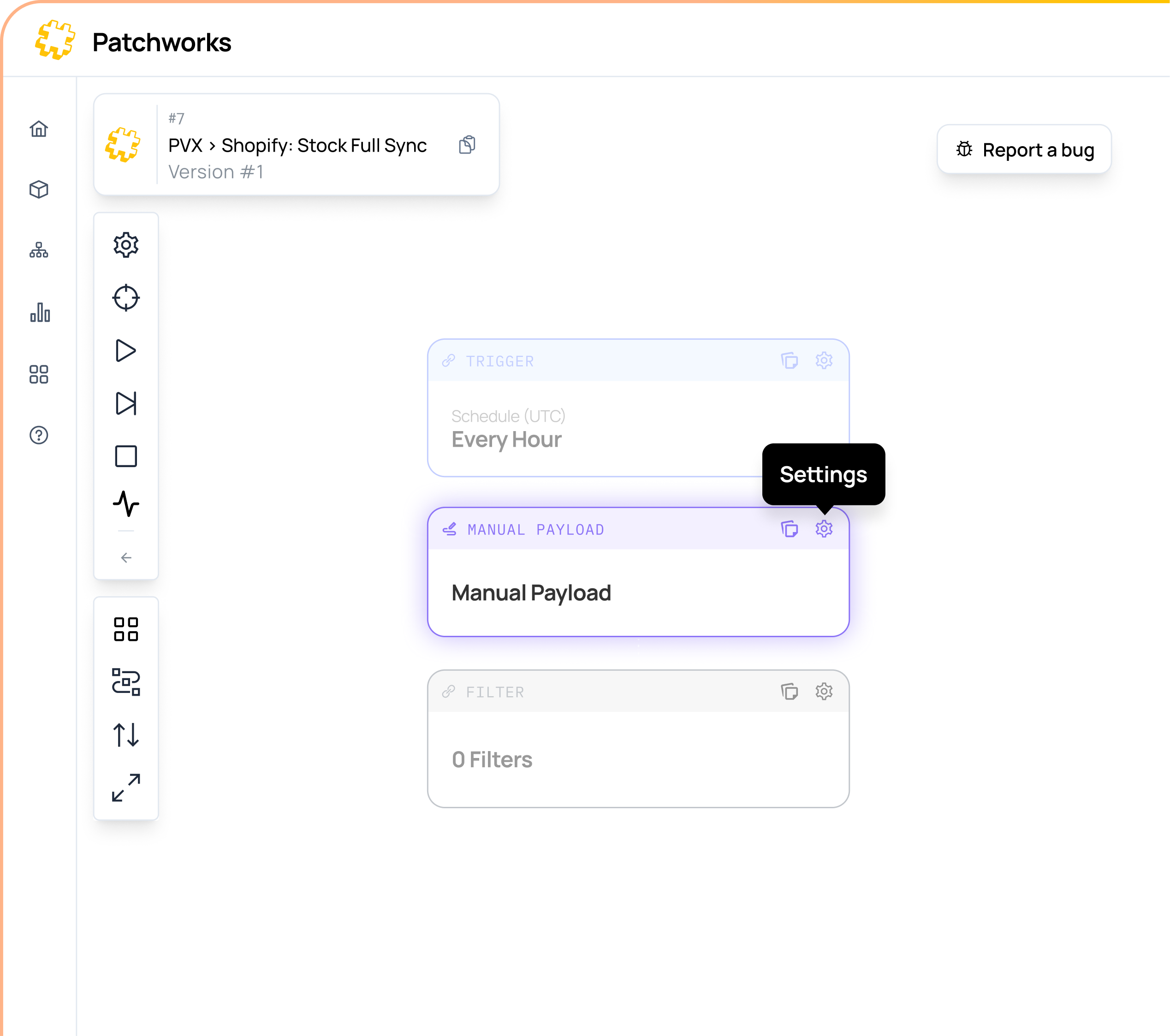
Because Patchworks is a native headless iPaaS, our process flows, data transformations, connectors, and platform agents are composable by default, not by retrofit. We didn’t have to rebuild the platform to speak the language LLMs require; it already spoke it.
The Model Context Protocol (MCP) in Action
The bridge connecting raw AI capability to enterprise integration infrastructure is the Model Context Protocol (MCP). Originally open-sourced by Anthropic, MCP functions like an open standard API for AI models. It explicitly defines how an LLM can securely query data sources, use tools, and safely execute actions within an external software environment.
Introducing Patchworks Headless
With the launch of Patchworks AI Agents, we unlocked our entire orchestration engine from the platform interface. Through the Patchworks MCP, any external AI model—whether you utilise Anthropic’s Claude, OpenAI’s ChatGPT, or Google’s Gemini—can directly interact with your live commerce ecosystem.
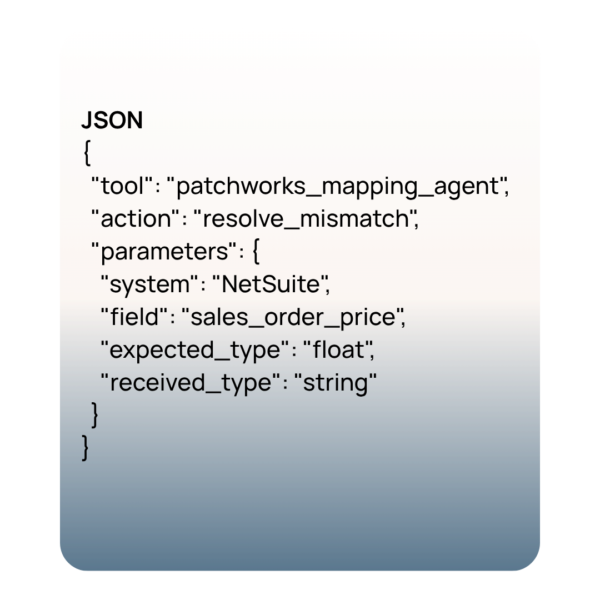
Example schema of an AI model invoking a Patchworks MCP tool to resolve a data type conflict programmatically.
This is where the architecture truly compounds. By exposing our integration engine as a set of MCP tools, an external AI can query live integration data and surface issues exactly like a human operator would—but faster, at scale, and without needing a login screen. When deeper intelligence or complex multi-system operations are needed, it calls back into Patchworks’ own internal layer where you can use our Platform and Custom Agents to design flows, edit shapes, or resolve mappings on the fly.
Real-World Application: Autonomous Self-Healing Mappings
The clearest example of this compounding architecture is Self-Healing integrations.
In a traditional setup, if an ERP mapping fails, the data sync halts, an error log is generated, and a support ticket is filed. The business loses velocity while a developer hunts down the visual mapping step or source code to apply a hotfix.
In a Patchworks headless environment, the workflow can heal itself entirely in the background:
- Triage: The AI agent monitors the live run logs of your active process flows.
- Identification: It detects an anomaly—for instance, a NetSuite sales order mapping failing because a price field was passed as a string instead of a numerical float.
- Reasoning: The AI determines the explicit structural transformation rule required to fix it.
- Resolution: Using our Platform Agents via the MCP, the AI locates the correct map step, applies the data-type transformation rule, and deploys the fix directly.
Future-Proofing via Headless Integration
Good architecture compounds over time. By decoupling the interface from the integration engine and embracing a native API-first paradigm, Patchworks gives you an infrastructure that doesn’t just connect your software—it empowers your AI layer to actively maintain, optimise, and scale your business operations.
Want to see how it works in practice?
👉 Watch an overview of Patchworks iPaaS
👉 Explore the Patchworks product documentation
👉 Talk to the team for expert advice and support with your query
Frequently Asked Questions
What is an enterprise integration platform as a service (iPaaS)?
An enterprise iPaaS is a cloud-based suite of tools that connects disparate software applications, databases, and data streams across an organisation. Unlike traditional point-to-point integrations, an enterprise iPaaS like Patchworks centralises your data flows, allowing complex systems—such as your ERP, e-commerce engine, and WMS—to securely communicate under a single management layer.
What makes an integration platform “headless”?
A headless iPaaS fully decouples the underlying integration and data-transformation engine from the graphical user interface (UI). While a traditional iPaaS requires a developer to log into a visual dashboard to build flows or fix errors, a headless iPaaS exposes every single capability—flows, connectors, and mappings—programmatically via clean APIs. This makes the manual UI completely optional for external tools and AI agents.
How do AI agents utilise the Model Context Protocol (MCP) for workflow automation?
The Model Context Protocol (MCP) acts as an open-standard API bridge between Large Language Models (LLMs) and external software tools. Instead of an AI simply generating text, the MCP gives the AI agent a safe, structured way to read data logs, understand system contexts, and execute specific tools within an iPaaS. For example, using the Patchworks MCP, an external AI agent can detect a failed workflow log, safely navigate to the exact mapping step, and autonomously apply a structural data-type fix without requiring human intervention.