The Future of Retail Connectivity: From Fragmented Systems to Agentic Commerce
In the modern retail landscape, “hyper-connection” is no longer a buzzword—it is a survival requirement. Today’s shoppers expect seamless personalisation, real-time tracking, and just-in-time availability as standard. To deliver these unified experiences, technology complexity must become invisible to the end user.
Yet, for many UK retail leaders, the reality behind the scenes is a complex web of fragmented systems, siloed operations, and manual workarounds that drain resources and stall growth. Integration has evolved from a back-office operational necessity into the primary engine that powers business agility and customer satisfaction.
Based on the 2025/26 Patchworks Retail Tech Leaders Survey—an independent study of 200 UK retail decision-makers—this article explores the current state of integration maturity and the roadmap to the next frontier: Agentic Commerce.
The Integration Maturity Model: Where Do You Stand?
Understanding your integration maturity level is the first step in identifying where you are losing efficiency and leaving money on the table. Our research reveals a stark divide in the UK market:
Level 1: Fragmented: Systems and data are completely siloed with little to no integration between platforms. Nearly 1 in 3 brands are still grappling with this phase.
Level 2: Reactive: Some point-to-point integrations exist, but they are ad-hoc and often brittle. IT teams spend their time fixing issues as they arise rather than proactively improving processes. 29% of retailers remain stuck here.
Level 3: Connected & Scalable: This represents stable integrations, streamlined processes, and growth-ready operations. Currently, only 27% of commerce brands describe themselves as being in this position.
Level 4: Ready for “What’s Next”: This is the threshold for Agentic Commerce, featuring autonomous, self-regulating, and future-ready tech stacks. Only 1 in 4 brands are currently in a position to progress toward this model.
The Billion-Pound Leak: The Financial Impact of Poor Integration
Poor integration is not just an IT headache; it is costing the UK retail industry billions annually. When systems don’t talk to each other, the impact ripples across the entire business—from sales and stock to supply and transactions.
Quantifying the Revenue Loss
Our survey highlights a substantial financial drain caused by disconnected systems:
- Broad Impact: 60% of UK retailers report losses due to integration issues.
- The £50k Threshold: 48% of respondents lose more than £50,000 annually due to poor integration.
- Mid-to-Large Scale Impact: 14% report losses exceeding £500,000 each year.
- The Haemorrhage: 1 in 10 retailers are losing more than £1M annually.
These losses stem from slow launches, inflated operational costs, and the inability to pivot during market shifts. Fixes are often temporary, leading to a cycle of “manual survival” that drains profitability.
Red Flags: Identifying the Symptoms of System Failure
What starts as a minor sync issue can quickly escalate into a business-wide problem. Retail leaders have identified several key signals that their systems are not connecting as they should:
- Frequent Order Errors: Flagged by 23% of respondents as a top signal of poor integration.
- Poor Customer Experience: Identified by 20% of leaders; shoppers suffer when transactions lack visibility.
- Lack of Visibility: 18% of brands struggle to see data across systems, leading to slow fulfilment and inaccurate inventory.
The Hierarchy of Integration Complexity
Front-end and customer-related systems are proving to be a bigger integration challenge than back-office functions. This is often due to the wider diversity of systems and the need to accommodate continuous change.
| System Type |
% of Leaders Reporting as Operationally Challenging
|
|---|---|
| Point of Safe (POS) |
34%
|
| Customer Relationship Management (CRM) |
32%
|
| Ecommerce Platforms |
27%
|
| Order Management Systems (OMS) |
25%
|
| Warehouse Management (WMS) |
24%
|
| Enterprise Resource Planning (ERP) |
21%
|
Breakthrough or Breaking Point? Why Legacy Approaches Are Failing
As businesses grow, traditional integration methods—such as plug-ins, custom development, and point-to-point connections—hit a ceiling. They are slow, resource-heavy, and rigid, making scaling across channels a constant challenge.
- Custom Integrations (31%): Bespoke solutions consume significant in-house or expensive third-party developer time.
- Plug-ins (20%): These pre-packaged tools often don’t work seamlessly across more than one system.
- Manual Processes (18%): Teams expend massive resources on hand-coded workarounds and manual fixes.
The “No Plan” Risk (11%): Over a tenth of retailers operate without an integration strategy, leaving teams to fight fires constantly.
Operational Roadblocks: What’s Stopping Growth?
Beyond the financial loss, poor integration creates daily friction for retail teams. Our respondents highlighted three primary roadblocks:
1. The Time and Resource Trap
Small teams often know what they want to achieve but are forced to deprioritise integrations when “urgent” fires need extinguishing. As David Webster of Bollin Group notes, integrations are often put down the moment a more pressing issue arises.
2. The Third-Party Tug-of-War
Effective integration is rarely just about connecting APIs. Tech leaders must juggle change requests, deployment schedules, updates, and the conflicting roadmaps of multiple software vendors.
3. System Multiplicity
Fragmentation often leads to “tech bloat.” Some retailers report running three separate systems just to support four ecommerce platforms for listings and inventory control because they lack a single, unified software system.
Peak Trading: The Ultimate Stress Test
Periods like Black Friday/Cyber Monday (BFCM) should be a golden opportunity, but for 42% of retail tech leaders, they are a source of “sleepless nights”. Peak trading is when integration weaknesses are most obvious.
- Reputational Risk: 58% fear poor system performance during peaks will damage their reputation with customers.
- System Failure: 43% believe a single surge could halt business altogether.
- The Firefighting Cycle: 39% of teams spend more time firefighting integrations than optimising seasonal highs.
- Survival Workarounds: 48% rely on temporary manual workarounds just to survive sales spikes.
The iPaaS Shift: A New Standard for Connectivity
Integration Platform as a Service (iPaaS) is gaining ground as the solution for forward-thinking retailers and smart CTOs moving away from custom builds. Currently, 13% of retailers have already made the switch.
Why Flexibility Outweighs Cost
When choosing a solution, flexibility across platforms (48%) is the top priority for retailers, outweighing long-term cost reduction (38%) and real-time visibility (35%).
iPaaS transforms operations by:
- Accelerating Workflows: Using pre-built, reusable connectors to speed up deployment and reduce resource use.
- Ending the “Black Box”: Replacing opaque vendor-managed systems with dashboards that provide direct access and total control.
- Building Reliability: Enabling operations and customer service teams to work with complete, real-time information to improve swifter customer responses.
What’s Next? Preparing for Agentic Commerce
We are entering a new era where integration and automation converge into Agentic Commerce. In this model, intelligent, self-regulating AI systems do more than just assist—they “think for themselves” and adapt in real time.
What Is Agentic Commerce?
It is a paradigm shift where AI-powered agents, rather than humans, perform the actions of discovering, comparing, and purchasing goods on behalf of the consumer. These are proactive decision-makers, a massive leap beyond current chatbots or AI assistants.
The Adoption Timeline
- Current State: 40% of retailers are already using AI to automate or improve operations.
- The Prepared: 21% believe their tech stacks are ready to support AI today.
- The Infrastructure Gap: 17% are interested in AI but admit their current tech stack cannot support it.
Deloitte projects that 25% of enterprises using GenAI will deploy autonomous agents in 2025, rising to 50% by 2027. Gartner predicts that by 2029, agentic AI will autonomously resolve 80% of common customer service issues, reducing operational costs by 30%.
Conclusion: Integration as a Strategic Catalyst
The findings of the 2025/26 Retail Tech Leaders Survey make one thing clear: integration is no longer a back-office IT challenge; it is the foundation of competitive retail. Decisions made today regarding whether to workaround, replace, or modernise will define a business’s readiness for the AI-powered commerce of tomorrow.
By breaking down silos and adopting flexible architectures like iPaaS, retailers can move away from firefighting and build stacks that solve current pain points while unlocking future growth.
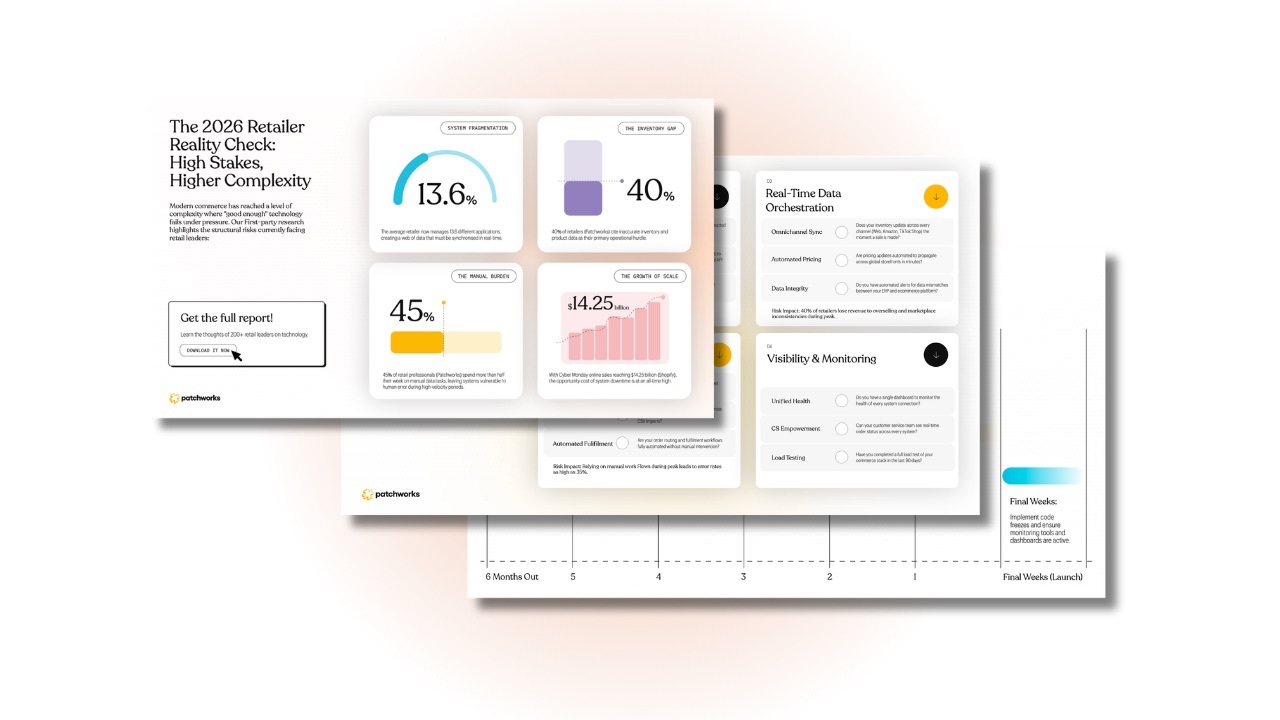
Ready to see the full report?
We’ve only scratched the surface of the survey findings. The complete Retail Integration Report 2025/26 contains:
- Detailed revenue loss brackets for high-turnover brands.
- Full expert commentary from leaders at Mint Velvet, Bollin Group, and Bentley Gift.
- The complete checklist for Agentic Commerce readiness.
About Patchworks
Patchworks is the leading integration platform built for retailers and partners. Our MACH-Alliance certified iPaaS connects your online store, warehouse, ERP, CRM, and POS to ensure they work seamlessly together. Headquartered in the UK, we power some of the fastest-growing names in global retail.
Survey Methodology
The findings in this report are based on an independent study conducted by OnePoll on behalf of Patchworks in August 2025. The online survey captured responses from 200 UK retail managers and leaders who make technology decisions. Respondents represented a diverse mix of sectors, including grocery, fashion, beauty, home, and consumer electronics.